
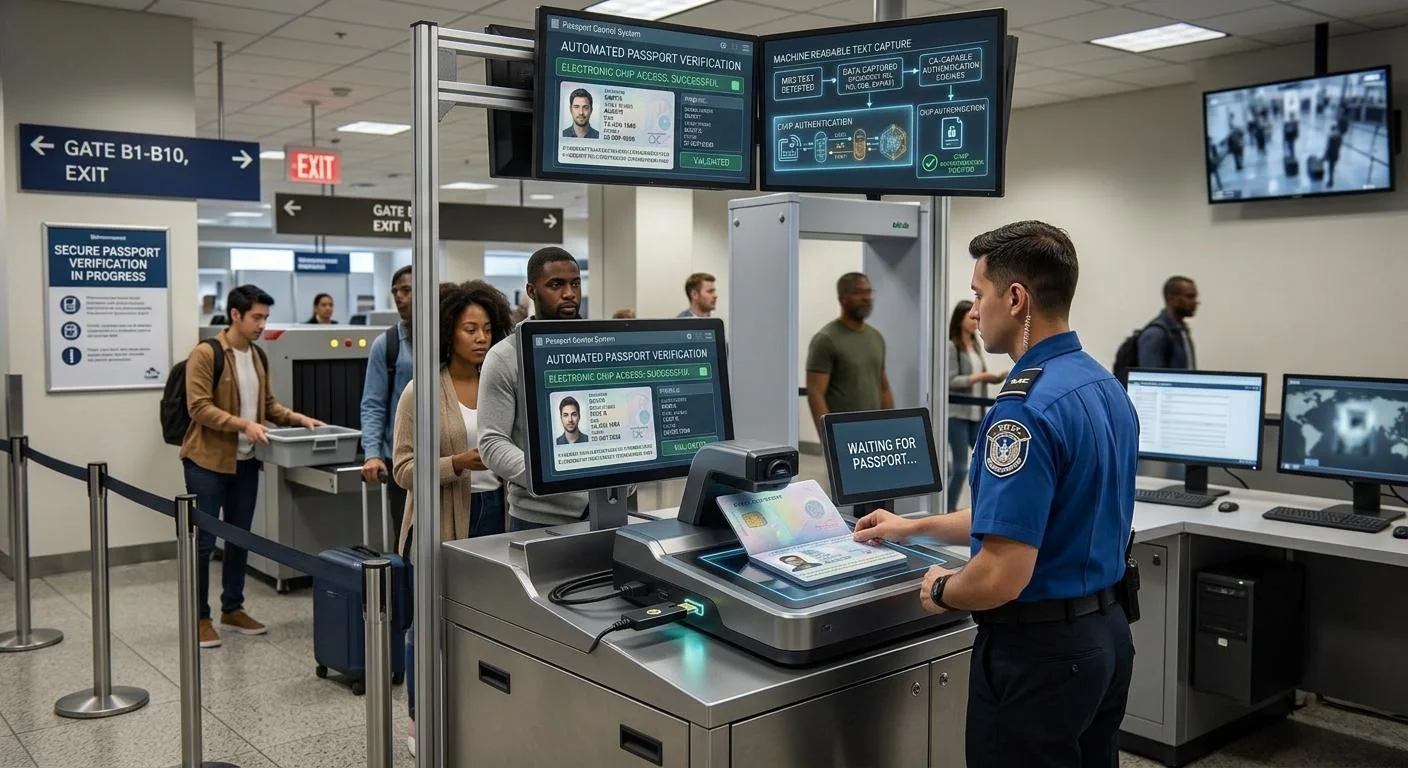
Compatible inspection systems use cryptographic exchanges to authenticate chip capabilities and strengthen protection for subsequent communication.
Washington, DC, October 22, 2026 — Chip Authentication adds another layer to electronic passport security by letting compatible inspection systems perform cryptographic exchanges with the contactless chip, helping confirm the chip has the expected secret capabilities while strengthening protection for the communication that follows.
Unlike Passive Authentication, which focuses primarily on the integrity and provenance of signed data, Chip Authentication involves an interactive exchange with the chip itself, allowing the reader to derive fresh session information while evaluating whether the electronic component behaves consistently with the protected document structure.
Chip Authentication Tests More Than Stored Data
An electronic passport can contain readable identity information, facial images, and signed security objects, but those static records alone do not prove that the responding hardware is the original chip associated with the legitimately issued document.
Chip Authentication addresses that limitation by requiring the electronic component to participate in a cryptographic key-agreement process that depends on protected, chip-specific secret material rather than merely returning files stored in memory.
The International Civil Aviation Organization’s machine-readable travel document standards define the broader technical framework for these electronic travel-document mechanisms and support interoperable passport security across participating systems.
When the exchange succeeds under the expected conditions, the reader gains additional evidence that the chip has cryptographic capabilities that a simple copy of readable passport data should not automatically reproduce.
The Chip Possesses Protected Secret Information
Chip Authentication relies on secret cryptographic material intended to remain protected within the secure integrated circuit, not available through ordinary passport-reading commands.
The corresponding public information can be stored in authenticated passport data so the reader knows which values belong to the legitimate electronic document.
This arrangement allows the reader and chip to derive fresh shared session information without requiring the chip to expose its protected secret directly.
The security model therefore depends upon the secure hardware preserving confidential cryptographic material while still allowing approved operations to use that material during authentication.
The Reader and Chip Establish Fresh Session Keys
During Chip Authentication, the reader and passport participate in a cryptographic key-agreement procedure that produces fresh session keys for the current interaction.
Those session keys can then strengthen secure messaging between the passport and inspection device by replacing earlier session protection with new cryptographic material derived from the chip-authentication exchange.
Because the resulting values are generated for the current session, they are not simply static keys stored openly within the passport or reused identically during every reading event.
This dynamic approach improves both chip authentication and subsequent communication security within the same protocol sequence.
Chip Authentication Helps Address Cloning Risks
A simple electronic copy can potentially reproduce readable data groups, facial images and other stored files without reproducing the protected secret material embedded within the original secure chip.
Chip Authentication takes advantage of that distinction by asking the electronic component to participate in an exchange that depends upon possession of its secret key.
A copied device containing authentic-looking files should therefore fail to produce the expected cryptographic result if it does not possess the protected secret associated with the original passport chip.
This makes Chip Authentication an important anti-cloning control within supported electronic travel-document architectures.
It Differs From Active Authentication
Active Authentication also addresses chip originality, but it typically uses a challenge-response mechanism in which the chip proves possession of a private key by generating a cryptographic response to a fresh reader challenge.
Chip Authentication instead uses a key-agreement process that both helps authenticate chip capabilities and establishes new shared session keys for protected communication.
This integration gives Chip Authentication an operational advantage because the same exchange that provides anti-cloning evidence can also improve confidentiality and integrity protection for later electronic messaging.
The two mechanisms therefore address related security concerns through different cryptographic designs and should not be treated as identical protocols.
It Also Differs From Passive Authentication
Passive Authentication validates digitally signed data and cryptographic hashes to determine whether protected information remains unchanged and connected to the expected issuing-authority trust structure.
Chip Authentication evaluates the responding electronic component more directly by requiring participation in a cryptographic exchange that depends upon protected secret material.
A passport can therefore pass Passive Authentication because its copied data remains perfectly intact while still failing Chip Authentication if the responding device lacks the original secret key.
Together, both checks provide stronger evidence than either mechanism can alone.
Trusted Signed Data Still Matters
Chip Authentication does not operate in isolation because the public information used during the exchange must itself be trusted as belonging to the legitimate passport.
Signed electronic data can protect that public information, with Passive Authentication and appropriate certificate validation establishing integrity.
Without that trust context, a fraudulent device could theoretically present its own public key and successfully perform cryptographic operations using an unrelated private key.
The result becomes meaningful only when the chip-authentication parameters are linked to data authenticated through the legitimate issuing-government trust structure.
Secure Messaging Becomes Stronger After Authentication
One significant benefit of Chip Authentication is that the resulting session keys can protect subsequent messages exchanged between the passport and reader.
These fresh keys can provide stronger confidentiality and integrity than relying exclusively upon the original session established during earlier access-control procedures.
The reader can therefore continue retrieving protected information through a communication channel whose cryptographic strength has been reinforced through interaction with the chip-specific secret.
This illustrates how electronic passport security can evolve during a single reading session, with different protocols progressively establishing stronger assurances and better communication protection.
Chip Authentication Can Work With PACE
Newer electronic passport architectures may use PACE to establish initial protected access before carrying out Chip Authentication as an additional electronic-security step.
PACE helps create the secure communication channel from document-derived access information, while Chip Authentication provides stronger evidence about the chip and derives new session keys.
These protocols therefore complement one another rather than performing the same function.
The sequence shows how modern ePassports use layered cryptography much like physical passport design uses overlapping printing, optical, and material protections.
Extended Access Control Can Incorporate Chip Authentication
Chip Authentication is closely tied to Extended Access Control frameworks that provide stronger protection for sensitive biometric information, particularly in passport systems that store fingerprints.
In such architectures, Chip Authentication helps establish a more secure communication environment before additional authorization procedures determine whether a terminal may access especially sensitive data.
This combination separates chip authenticity from whether the inspection terminal is authorized to retrieve specific biometric information.
The layered design reflects the fact that secure communication, chip authentication and terminal authorization solve different technical and privacy problems.
Terminal Authentication Performs Another Distinct Function
Terminal Authentication can require the inspection device to prove that it holds appropriate authorization credentials before the passport releases protected biometric information.
Chip Authentication, by contrast, focuses primarily upon the passport chip and the protected communication session rather than deciding whether the terminal has governmental authorization to read specific data.
In some advanced architectures, the two protocols work in opposite directions: the chip proves its cryptographic capabilities, and the terminal proves its authorization status.
This mutual structure provides stronger protection for especially sensitive biometric information than for ordinary passport data.
Chip Authentication Is Usually Invisible to Travelers
A traveler normally does not enter passwords, approve cryptographic exchanges or manually initiate Chip Authentication during routine border inspection.
Compatible systems can perform the necessary operations automatically while the passport remains within the reader’s electromagnetic field.
The exchange can occur within seconds alongside access control, Passive Authentication and other electronic checks before the inspection process moves to biometric comparison or immigration screening.
For the traveler, a sophisticated cryptographic sequence may therefore appear to be nothing more than placing the passport on an electronic reader.
Smartphone Applications May Support Different Capabilities
Consumer passport-reading applications vary substantially in the protocols they implement, so one application may perform Chip Authentication while another may only read basic data and perform Passive Authentication.
A successful smartphone scan therefore does not automatically indicate that chip-specific cryptographic checks have been completed.
Passport generation must support the mechanism, the application must implement the relevant protocol correctly, and the device must complete the electronic exchange successfully.
Travelers seeking a broader explanation of these different verification layers can review the Amicus International Consulting guide to modern passport security and counterfeit detection.
Failed Chip Authentication Requires Careful Interpretation
A failed Chip Authentication result may indicate that the responding device lacks the expected secret material, but technical problems can also disrupt an otherwise legitimate exchange.
Reader incompatibility, software implementation errors, interrupted NFC communication or physical chip damage can all affect the authentication sequence.
Inspection systems therefore need to distinguish protocol failure from deliberate cloning before reaching conclusions about document authenticity.
As with other passport checks, one technical anomaly generally warrants further examination rather than an automatic final verdict.
A Successful Exchange Does Not Prove the Traveler’s Identity
Chip Authentication provides evidence about the electronic passport component and secure communication but does not establish whether the person presenting the document is the legitimate holder.
An impostor can still present a genuine passport with a valid chip, so officers must separately compare the traveler with the enrolled facial image.
Border officers or automated systems perform that biometric identity check independently from the cryptographic chip-authentication process.
The distinction reinforces the principle that document authenticity and traveler identity represent separate security questions even when both are evaluated during the same inspection.
Physical Inspection Still Remains Important
A successful Chip Authentication result also does not prove that every physical page, hologram, binding element, or printed security feature remains original and untouched.
Authorities may still need to inspect the booklet for alterations, substituted pages, unusual personalization, or other physical inconsistencies that electronic verification cannot fully address.
The passport’s chip and physical construction protect different aspects of the same document and therefore provide complementary forms of evidence.
The strongest assessment occurs when physical examination, electronic authentication and biometric comparison all support one another.
Trusted Certificates Remain Part of the Chain
The electronic data protecting Chip Authentication parameters ultimately depends upon the same broader governmental trust environment used elsewhere in ePassport authentication.
Inspection systems must know that the relevant signed information traces back to the expected issuing authority before treating the cryptographic exchange as evidence about a legitimate passport.
The ICAO Public Key Directory supports participating authorities by distributing certificate information used to validate electronic passport signatures across borders.
This trust layer ensures that chip-specific cryptography remains tied to recognized government issuance rather than merely proving that an arbitrary electronic device can perform sophisticated mathematical operations.
Chip Authentication Supports Automated Border Processing
Automated border gates can incorporate Chip Authentication into wider workflows that evaluate electronic document integrity, chip capabilities, biometric similarity, and immigration status.
Because the protocol operates electronically, systems can gather stronger evidence about the passport chip without requiring a border officer to perform manual cryptographic analysis.
This allows advanced authentication to scale across high-volume airport environments while remaining largely invisible to passengers.
The result is a more sophisticated automated inspection sequence in which multiple electronic checks can occur before the traveler receives a final processing decision.
Fresh Session Keys Reduce Dependence on Earlier Protection
One of the most important technical benefits of Chip Authentication is that it refreshes the cryptographic protection used during the current passport-reading session.
Earlier access-control mechanisms may establish initial session keys, but Chip Authentication can derive new keys from stronger, chip-specific cryptographic material.
This reduces dependence upon the original access-derived protection and creates a stronger foundation for later secure messaging.
The protocol therefore contributes not only to anti-cloning assurance but also to improving the quality of the protected channel used for subsequent electronic operations.
Chip Authentication Addresses a Specific Security Question
Modern passport systems divide security into separate functions because no single protocol can simultaneously establish document integrity, chip originality, terminal authorization, traveler identity, and immigration status.
Chip Authentication focuses on whether the electronic component can demonstrate expected cryptographic capabilities and participate in secure key agreement.
Passive Authentication addresses signed data integrity; PACE or BAC controls initial access, Terminal Authentication can protect sensitive biometrics, and facial comparison evaluates the traveler.
Understanding these distinctions prevents one successful electronic result from being interpreted as a universal certificate of passport authenticity.
Layered Cryptography Strengthens the Electronic Passport
Chip Authentication shows how modern electronic passports go beyond simple data storage by requiring the chip to actively participate in cryptographic security processes.
A copied file set may reproduce names, images and valid signatures, but reproducing protected chip-specific secret capabilities presents a different and more difficult technical challenge.
When Chip Authentication succeeds alongside trusted Passive Authentication and consistent physical document examination, the inspection system gains several independent forms of evidence supporting the electronic passport.
For legitimate travelers, these exchanges remain largely invisible, yet they play an important role in how modern border systems distinguish secure electronic credentials from devices that merely imitate a genuine passport’s readable contents.