
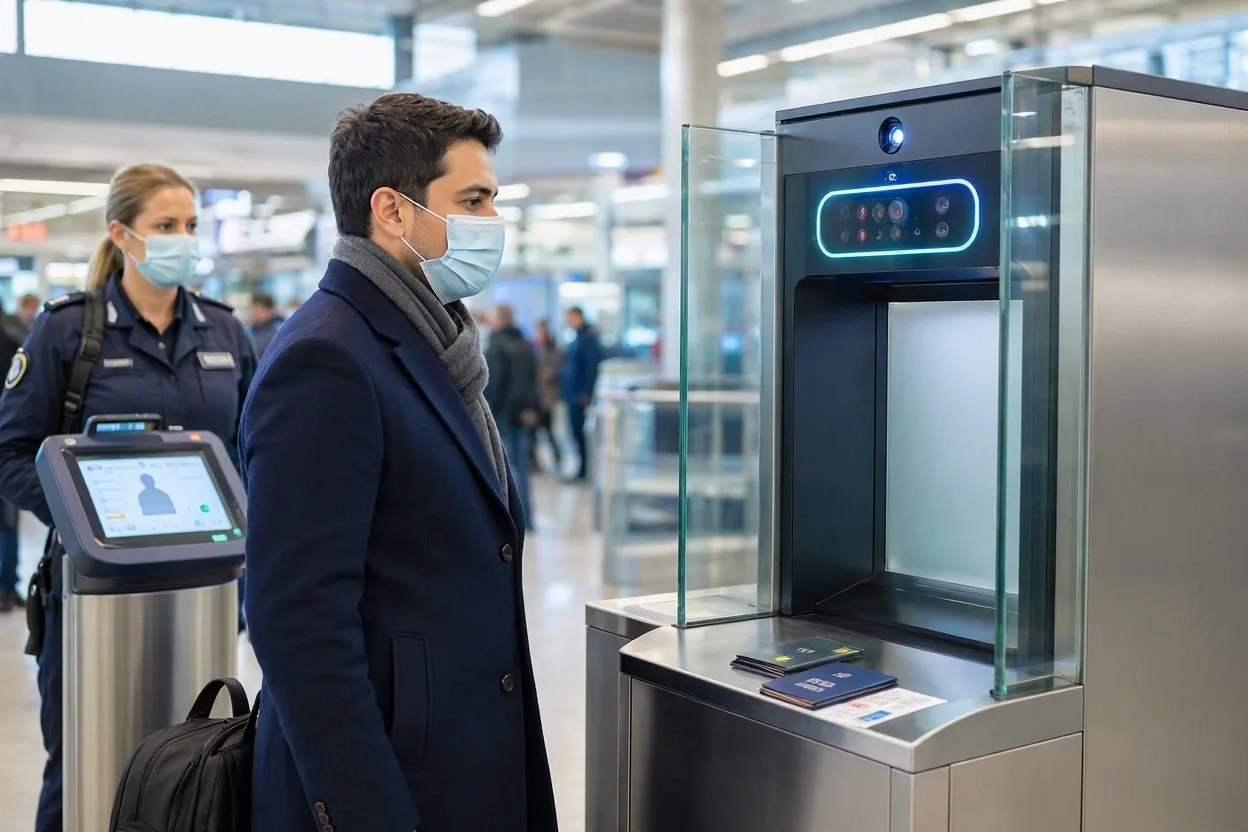
Presentation attack detection tools help assess whether a camera is viewing a person or an attempted imitation, adding another defensive layer to automated facial comparison systems increasingly used at airports, border checkpoints and other identity-verification environments.
WASHINGTON, DC, October 23, 2026, As airports and border authorities expand automated facial recognition, another security technology is increasingly working behind the camera to answer a different question than traditional biometric matching: whether the face presented appears to belong to a real person physically present before the sensor.
That additional process, commonly described as liveness detection or presentation attack detection, aims to identify suspicious presentations involving photographs, screens, masks, or other imitations before an automated system relies on the captured facial image for an identity comparison.
Facial Matching and Liveness Detection Answer Different Questions
Traditional facial recognition primarily evaluates whether characteristics extracted from one facial image resemble those in a reference image, while presentation attack detection evaluates whether the biometric information reaching the capture system appears to originate from the genuine physical presentation the system expects.
Those functions are related but fundamentally different, because even an extremely accurate face-matching algorithm could create security concerns if an attacker could place a convincing representation of another person’s face before a camera and have the system treat it exactly like a live traveler.
Presentation attack detection therefore serves as an additional defensive mechanism rather than a replacement for facial recognition, passport authentication, database screening, or human inspection, giving the system another opportunity to question suspicious input before making an automated identity decision.
The National Institute of Standards and Technology describes presentation attacks as attempts to present biometric characteristics to a recognition system in ways intended to interfere with its normal operation, including attempts to impersonate another individual or conceal one’s own identity.
A Camera Cannot Simply Assume Every Face Is Real
An airport camera receives light reflected from whatever appears in front of its lens, so the imaging equipment itself doesn’t automatically know whether those pixels come from a human face, a printed photograph, an electronic display, a mask, or another object resembling facial characteristics.
Without additional safeguards, a biometric system that focuses solely on similarity could theoretically encounter an image that matches its stored reference closely enough to trigger further processing, even though the image source may not represent the live person expected at the checkpoint.
Liveness and presentation attack detection technologies address this problem by examining the incoming presentation for signals that distinguish ordinary human presence from suspicious or artificial representations, without relying solely on the visual resemblance used for identity matching.
This process matters at automated checkpoints because eGates are designed to process legitimate travelers efficiently with limited officer intervention, making reliable automated methods for identifying unusual biometric presentations a key part of a layered security architecture.
Presentation Attacks Can Take Different Forms
The broad concept of a presentation attack includes multiple categories rather than one universal technique, and international biometric standards distinguish among different kinds of artifacts and presentations because defensive technology must operate against more than a single type of suspicious facial input.
Examples discussed within biometric-security research include printed photographs, images displayed on electronic screens, video presentations, partial facial artifacts, and masks, although the sophistication, purpose and technical characteristics of these presentation types can differ considerably across operational environments.
A simple printed image and a highly realistic three-dimensional facial artifact create fundamentally different sensing challenges, so manufacturers and government agencies cannot assume a detector that recognizes one suspicious presentation will necessarily recognize every other type with comparable reliability.
Research presented at NIST’s International Face and Fingerprint Performance Conference has highlighted this diversity, with presentation attack classifications including printed photographs, displayed images, videos, masks, and partial artificial presentations, showing why evaluation programs examine many attack categories rather than treating spoofing as a single standardized event.
Liveness Can Be Evaluated Without Asking Travelers to Perform Obvious Tasks
Some people associate liveness detection with instructions requiring a person to blink, turn their head or perform another deliberate movement, but modern presentation attack detection can also operate passively while the traveler simply looks toward the inspection camera during an ordinary biometric capture.
Passive systems can analyze information contained within the captured imagery or additional sensor measurements without requiring the traveler to complete a conspicuous challenge, helping border authorities preserve passenger throughput while conducting security assessments that remain largely invisible during routine processing.
Active approaches can still be useful in specific applications because asking a person to perform an unpredictable action provides additional information about whether a responsive human subject is physically present, although such interaction can increase processing time and raise accessibility and usability concerns.
The appropriate method therefore depends on the operating environment, available sensors, risk level, traveler population, and security architecture, rather than a universal requirement that every airport camera perform the same visible liveness procedure.
Texture Can Provide Useful Defensive Information
Printed photographs and electronic displays reproduce facial appearances through physical materials or pixel structures that differ from natural human skin, allowing certain detection technologies to examine texture, reflection, resolution, and other image properties for indications that the camera may be viewing a representation rather than a person.
These differences can produce visual patterns that are subtle or invisible to ordinary travelers but measurable by software, especially when cameras and algorithms are engineered to recognize characteristics associated with artificial presentation media.
However, defensive systems cannot rely upon one simple texture rule because printers, display panels, cameras and reproduction techniques continue to improve, while environmental lighting and imaging conditions can also influence the characteristics observed during legitimate facial capture.
Effective presentation attack detection therefore depends on evaluating multiple signals and testing systems against realistic examples, rather than assuming every artificial presentation will contain one obvious visual defect that remains consistent across technologies.
Depth Information Can Strengthen the Assessment
Human faces have a three-dimensional structure, with the nose, eyes, cheeks, forehead, and jaw at different distances from a sensor, while a conventional printed photograph represents the face primarily on a flat surface.
Some biometric installations can use depth-sensitive cameras or multiple imaging perspectives to examine this geometry, providing information that can help distinguish a naturally three-dimensional face from certain flat representations placed before the system.
Depth alone cannot address every conceivable presentation because masks and other three-dimensional artifacts can also contain facial geometry, but combining depth information with additional visual and sensor characteristics can strengthen the overall assessment compared with relying exclusively upon conventional two-dimensional photography.
This layered approach reflects a recurring principle in modern border technology: security improves when independent checks evaluate different properties rather than expecting a single biometric measurement, database, or physical feature to provide complete assurance.
Motion Can Contain Additional Information
Natural human subjects produce subtle movement even when trying to remain still, including small changes in posture, breathing, blinking, and facial expression, creating temporal information that video-based detection systems can evaluate across multiple frames rather than from a single photograph.
A static representation may lack these natural changes, while electronically replayed video introduces its own characteristics that specialized systems can potentially evaluate, although designers must account for ordinary traveler behavior so legitimate passengers are not unnecessarily rejected for remaining unusually still.
Movement analysis therefore represents another possible source of evidence rather than a universal test, because successful defensive systems generally combine several observations before deciding whether the captured presentation deserves additional scrutiny.
Airport cameras often capture image sequences during a face check, giving biometric software chances to select high-quality frames for identity matching while other processing components examine changes during the brief capture interval.
Light Reflection Can Reveal Differences
Human skin interacts with visible and sometimes infrared illumination differently from paper, glass, electronic displays, and synthetic materials, creating another category of measurable information that appropriately equipped biometric sensors can use when assessing whether a presentation appears genuine.
Systems incorporating specialized illumination may examine reflected-light characteristics beyond what an ordinary passenger sees on the checkpoint display, providing additional evidence that complements conventional facial imagery without necessarily requiring extra actions from the traveler.
These techniques show why the phrase facial recognition can oversimplify modern biometric checkpoints: equipment around an automated gate may take several distinct measurements- image quality, facial similarity, presentation integrity, and document information- before allowing automated processing to continue.
The exact sensor configuration varies considerably among airports and jurisdictions, however, meaning travelers should not assume that every terminal uses identical infrared, depth, motion, or presentation attack detection capabilities merely because the checkpoints appear visually similar.
Artificial Intelligence Has Expanded Detection Capabilities
Machine-learning systems can be trained to recognize patterns associated with legitimate and artificial facial presentations, allowing software to consider combinations of image characteristics that would be difficult to express through a small collection of manually programmed rules.
This capability has helped presentation attack detection evolve alongside facial recognition itself, although machine learning also introduces familiar challenges involving training data, previously unseen attack types, environmental differences and performance variations when systems encounter conditions that differ from their development environments.
NIST researchers have emphasized that presentation attack detection remains an active measurement challenge, reporting that evaluated algorithms can perform well against particular presentation types while still failing to identify every category included within broader testing.
That limitation reinforces the importance of treating liveness detection as one component within a larger security architecture, because no responsible border system should assume that a single automated detector provides absolute protection against every future form of biometric manipulation.
International Standards Provide a Framework for Testing
Presentation attack detection has developed into a formal biometric-security discipline supported by international standards, including the ISO/IEC 30107 series, which establishes terminology and approaches for characterizing, evaluating and reporting how biometric systems respond to presentations intended to interfere with normal recognition.
Standardized evaluation matters because simply advertising a biometric product as containing liveness detection says relatively little about the range of presentations examined, the testing methodology used or how effectively the technology performed under conditions resembling real deployment.
The standards framework distinguishes the attack presented to the biometric capture subsystem from the automated process intended to detect it, helping laboratories, government agencies, and technology suppliers discuss system performance using more consistent definitions and measurement practices.
NIST conference material continues to identify presentation attack detection as an important area within international biometric standardization and operational testing, particularly as facial recognition expands across government, commercial and digital identity applications.
Passport Authentication Remains a Separate Security Process
Presentation attack detection does not establish a passport’s authenticity because determining that the person before a camera appears live addresses a different security problem than establishing whether the travel document was legitimately issued and remains unaltered.
Electronic passport validation instead examines the digitally signed information stored in the passport chip, allowing border systems with the appropriate certificates and infrastructure to determine whether the issuing authority created the protected electronic information and whether it has remained intact.
The International Civil Aviation Organization’s ePassport validation framework explains that chip authentication lets border authorities confirm the authenticity and integrity of electronically protected passport information, providing a trusted reference against which they can examine biographical information and the stored facial image.
A robust automated border process can therefore evaluate several independent questions, including whether the passport chip authenticates correctly, whether the live face resembles the trusted passport portrait and whether the biometric presentation itself appears to originate from a genuine person.
Similarity Scores Do Not Measure Liveness
When facial recognition software generates a similarity score, that number generally reflects how closely the submitted facial characteristics match the reference characteristics under the recognition algorithm, rather than directly indicating whether the incoming face came from a living subject.
Presentation attack detection can produce separate signals or decisions that influence whether to trust the biometric comparison, meaning an apparently strong facial resemblance does not eliminate the need for independent safeguards for the integrity of the capture process.
This separation matters when explaining automated border technology because travelers sometimes assume everything around the camera is one enormous facial-recognition calculation, when the checkpoint can actually include several specialized components performing different security functions.
Keeping those functions independent also allows system designers to respond differently when a problem occurs, because poor image quality, insufficient facial similarity, suspected presentation manipulation and passport authentication failure represent different conditions that may require different follow-up procedures.
Image Quality Still Matters During Liveness Assessment
The same lighting, posture, focus, and camera-position considerations that affect conventional facial recognition can also influence presentation attack detection, because defensive algorithms need sufficiently useful sensor information to reliably distinguish ordinary human presentations from suspicious or ambiguous inputs.
Extremely poor illumination, excessive motion, obstruction or unusual positioning can therefore complicate more than the facial match itself, potentially reducing the amount of information available to multiple components within the biometric-processing chain.
Border authorities can address these challenges through controlled lighting, carefully positioned cameras, traveler prompts, repeated capture and human referral procedures, creating redundancy when automated equipment cannot obtain sufficient confidence from its initial observations.
For legitimate travelers, cooperating with ordinary instructions to face the camera, remain within the indicated position and briefly hold still can help the checkpoint capture stronger information for both identity matching and other automated quality or security assessments.
Human Review Remains Important
Automated presentation attack detection is designed to identify suspicious or uncertain biometric input efficiently, but a flagged result does not independently establish that a traveler deliberately attempted fraud because technical uncertainty, environmental conditions and unusual legitimate circumstances can sometimes contribute to automated referrals.
Border architectures therefore commonly preserve pathways for additional examination, allowing officers or other inspection systems to reconsider a traveler when an automated gate cannot confidently complete the checks required for automatic admission or departure processing.
Human involvement becomes particularly valuable when multiple signals disagree, because an officer can evaluate the traveler, passport, physical circumstances, and available system information in a broader context that a narrowly specialized algorithm may not possess.
This structure reflects the wider philosophy behind automated border control, where technology handles large volumes of routine verification efficiently while uncertain, exceptional or potentially suspicious cases receive additional attention rather than being resolved entirely through one computerized decision.
Presentation Attack Detection Does Not Make Biometrics Infallible
No biometric technology should be characterized as impossible to defeat, because security systems operate within constantly changing technical environments in which attackers, researchers and manufacturers continue developing new methods, countermeasures, and testing procedures.
NIST’s recent research discussions highlight this challenge, noting that tested presentation attack detection algorithms can show strong capabilities yet still fail against specific presentation types, making continued evaluation essential as biometric systems face new threats.
Responsible deployment therefore requires performance testing, updates, operational monitoring and complementary controls rather than assuming that installing a liveness-detection feature permanently resolves every presentation threat facing a biometric checkpoint.
The strongest security architecture combines document authentication, biometric comparison, presentation integrity assessment, database checks, and trained human oversight, ensuring that a weakness or uncertainty in one mechanism does not automatically determine the outcome of the entire inspection.
Liveness Detection Is Becoming Part of a Broader Identity-Security Model
Presentation attack detection also appears outside airports in digital identity verification, financial onboarding, mobile authentication, and remote government services, where organizations face the same fundamental challenge: determining whether captured biometric information comes from the expected individual rather than an artificial representation.
Remote identity environments can make this problem especially important because no officer may be physically present during capture, increasing reliance upon automated safeguards that evaluate both facial similarity and whether the submitted biometric information appears genuinely captured from the applicant.
Airport checkpoints differ because travelers operate in physically controlled environments with government equipment and, often, nearby officers, yet the underlying security principle remains similar: trustworthy biometric matching requires confidence in both the reference identity and the incoming sample.
As biometric systems become more widely deployed, terminology such as liveness detection, presentation attack detection and biometric capture integrity will consequently become increasingly important for understanding what modern identity systems actually evaluate beyond simply deciding whether two faces appear similar.
Multiple Security Layers Protect the Border Process
Modern passports and automated border checkpoints increasingly rely on layered authentication because no single security feature can independently verify every aspect of identity, document authenticity, and physical presence that authorities may need to assess during international travel.
The relationship among physical passport features, electronic chip authentication, and biometric inspection is examined more broadly in the Amicus International Consulting guide to how modern passport security helps detect counterfeits and protect identity, where multiple independent safeguards collectively strengthen document and traveler verification.
Presentation attack detection fits naturally within this layered model because it protects the point where the physical traveler interacts with the biometric sensor, while other technologies protect the document, reference image, electronic chip, and databases supporting the inspection.
The distinction matters because verifying a genuine passport does not automatically prove that the person presenting it is its rightful holder, just as determining that a live person stands before a camera does not independently establish that the person’s claimed identity is correct.
Automated Borders Are Evaluating More Than a Face
When a traveler stands before an airport eGate, the visible experience may seem remarkably simple: a passport reader, a camera, and a barrier that either opens or directs the passenger elsewhere after several seconds of automated processing.
Behind that simple interaction, however, modern systems can perform several technically distinct assessments involving travel-document data, electronic authenticity, facial image quality, biometric similarity and indications that the camera is observing the kind of genuine physical presentation expected by the inspection process.
Liveness detection contributes specifically to that final concern, helping defend biometric systems against situations where an artificial representation could otherwise provide facial information resembling the legitimate passport holder without the legitimate traveler actually standing before the sensor.
As automated border control continues to develop, presentation attack detection will remain an important example of how identity security increasingly depends not merely upon recognizing a face, but upon establishing confidence in how that face entered the biometric system in the first place.