
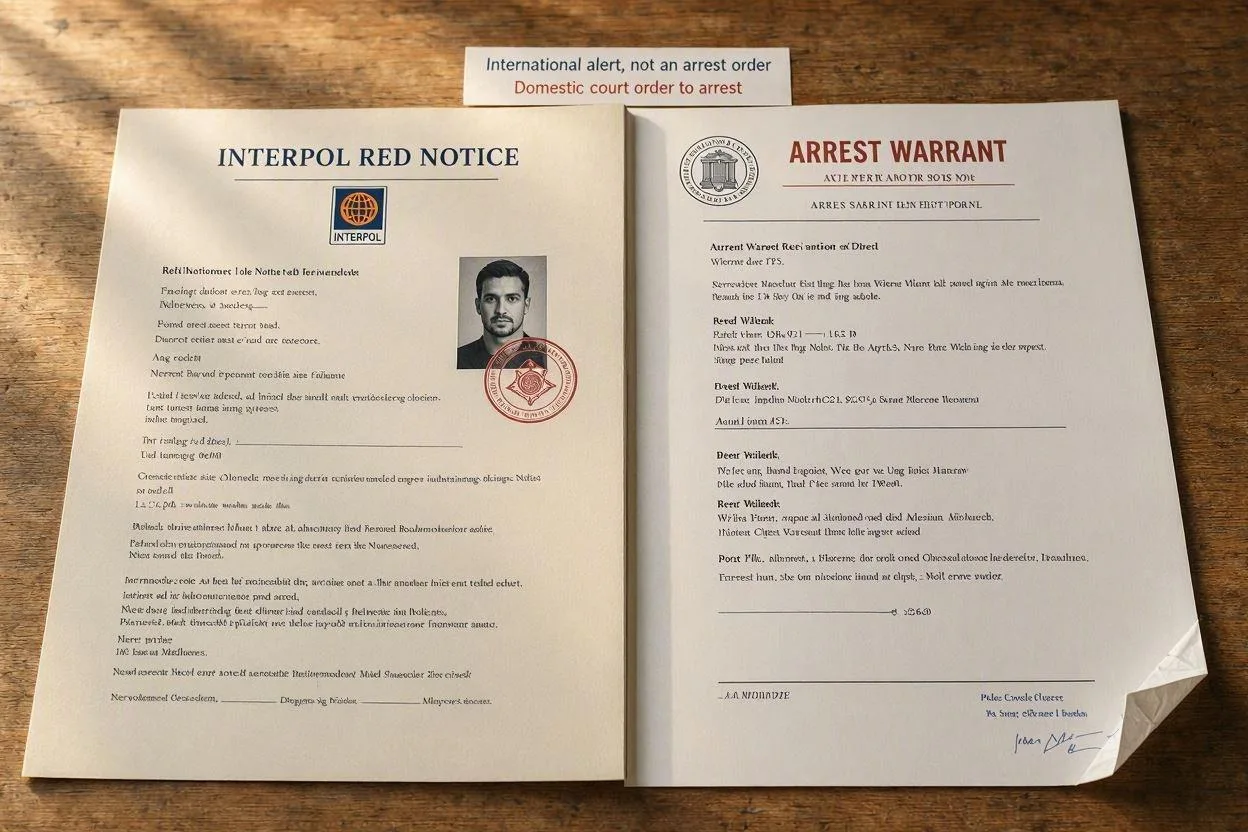
What a Red Notice is and isn’t, why countries decide differently, and how cases proceed.
WASHINGTON, DC, September 7, 2026 — An INTERPOL Red Notice ordinarily means that a requesting country or authorized international tribunal has obtained an arrest warrant or judicial order. Still, the notice itself does not become a universally enforceable international warrant.
That distinction explains why the same international alert can produce immediate provisional detention in one country, further judicial paperwork in another, immigration questioning elsewhere, and no arrest at all where domestic law requires additional authority.
The warrant begins the national criminal case, the Red Notice communicates wanted information internationally, and the country encountering the person decides whether its own legislation permits arrest, extradition proceedings, immigration action, monitoring, or release.
Understanding those separate functions prevents two opposite errors: assuming that a Red Notice has no legal significance because it is not a warrant, or believing that publication automatically empowers every officer worldwide to make an arrest.
The Short Answer Is Yes, but With an Essential Qualification
A Red Notice is ordinarily based upon an arrest warrant or court order issued by judicial authorities in the country seeking the person for prosecution or to serve an existing criminal sentence there.
That underlying warrant is legally distinct from the notice. It derives its authority from the requesting jurisdiction’s criminal law, courts, procedural rules, and allegations or conviction rather than from INTERPOL’s international information system.
INTERPOL reviews and circulates qualifying identifying and judicial information. Still, it does not create the original accusation, issue the national warrant, determine guilt, sentence the person, or order another sovereign government to surrender anyone.
The most accurate public formulation is therefore that a Red Notice indicates an underlying warrant or judicial order exists, while leaving unanswered whether that process can lawfully support arrest in the country where the person is found.
The Warrant Comes First
Before authorities can seek a Red Notice, they generally need judicial process identifying the wanted person and establishing that the individual is sought for prosecution or punishment connected with a qualifying serious ordinary-law offense.
The source-country record may include a criminal complaint, indictment, conviction, judgment, sentence, arrest warrant, factual summary, statutory provisions, penalty information, photographs, fingerprints, aliases, nationality information, passport details, and other important identifying material available.
National investigators transmit the request through their country’s National Central Bureau, which connects domestic law enforcement with INTERPOL and should independently verify that the submission satisfies organizational requirements before seeking international publication worldwide.
The General Secretariat then reviews the proposed notice for factors including identity, warrant information, factual clarity, offense seriousness, international relevance, proportionality, political neutrality, human rights, data accuracy, and compliance with institutional data-processing rules.
The Notice Does Not Replace the Warrant
The Red Notice functions as an international alert carrying selected information about the person, alleged or adjudicated conduct, source-country warrant, and requested police action, allowing authorized officials worldwide to recognize the case quickly.
It does not replace the underlying warrant because the national judicial order continues to possess its own legal status, validity, territorial effect, appeal history, limitation rules, and procedural consequences under the requesting country’s domestic law.
If the notice is later deleted, the national warrant may remain active. In contrast, withdrawal or cancellation of the underlying warrant should ordinarily prompt the requesting authorities and INTERPOL to reassess whether continued circulation remains lawful.
This separation matters whenever public statements claim that INTERPOL canceled someone’s warrant, because the organization controls its own data but generally lacks authority to invalidate judicial process issued by a member country’s courts.
A Foreign Warrant Is Not Automatically a Local Warrant
An arrest warrant issued in one country does not necessarily authorize police in another country to enter a home, stop a traveler, or take someone into custody without further national legal process.
Sovereign states decide how they recognize foreign warrants through extradition treaties, implementing legislation, constitutional protections, judicial precedents, immigration powers, reciprocal arrangements, and national procedures governing urgent provisional arrest requests from overseas authorities.
Some countries allow a verified Red Notice to support immediate provisional arrest. In contrast, others require a formal diplomatic request, a domestic judicial warrant, a prosecutor’s application, sworn evidence, or assurance that complete extradition documents will follow.
Consequently, a person may have a valid foreign warrant but remain temporarily beyond arrest in a particular country because local authorities have not received or obtained the additional judicial process required there.
The United States Requires Independent Arrest Authority
Inside the United States, a foreign Red Notice alone does not provide an independent legal basis for arrest; authorities must rely on extradition legislation, immigration law, an American warrant, or another recognized domestic power.
Archived Justice Department guidance concerning Red Notices and provisional arrest explains that American law prohibits arrest based solely upon a foreign notice and describes how a diplomatic request can lead prosecutors to obtain judicial process under applicable extradition authority.
The notice can still prompt identity verification, treaty analysis, investigation, surveillance, immigration scrutiny, diplomatic communication, border attention, or preparation of the complaint necessary for a federal judge to issue an extradition arrest warrant.
That American distinction reflects the broader international rule: trusted police information can initiate government action, but coercive detention must remain connected to valid legal authority recognized by the country making the arrest.
Other Countries Give Notices Different Legal Weight
INTERPOL member countries have substantially different constitutions, legal traditions, arrest statutes, treaty networks, evidentiary standards, judicial structures, nationality protections, and human-rights obligations, so one notice cannot carry identical enforceable legal authority worldwide.
A jurisdiction may treat the notice as enough for temporary detention while requesting confirmation. In contrast, another may regard it only as intelligence until a judge receives authenticated warrant records and a formal provisional-arrest request.
Some countries distinguish between citizens and foreign nationals, refuse to extradite their own citizens, demand stronger evidence for particular offenses, or require assurances concerning capital punishment, prison conditions, medical treatment, or sentence length.
News reports saying that a country failed to honor a notice may therefore oversimplify a lawful decision to demand the domestic warrant, judicial authorization, or treaty documentation required before taking someone’s personal liberty.
A Red Notice Can Concern an Accusation or a Conviction
Some people named in Red Notices are wanted to face unresolved charges. In contrast, others were convicted and are sought to begin or complete a sentence, making precise procedural status essential to accurate public reporting.
For an accused person, the underlying warrant does not establish guilt, and the notice does not mean INTERPOL independently tested witnesses, resolved evidentiary disputes, admitted exhibits, or delivered a criminal judgment after trial.
For a convicted person, reporters should still determine whether the judgment was final, entered in absentia, appealed, later overturned, or subject to retrial rights that could materially influence extradition and human-rights review abroad.
The phrase “wanted under a warrant” describes legal process and availability for proceedings, not necessarily final criminal responsibility, making careful allegation language necessary whenever the source-country case remains unresolved before a competent court.
A Public Red Notice Is Only Part of the System
Only selected Red Notice extracts appear on INTERPOL’s public website when the requesting country authorizes public visibility, meaning most notices remain confidential within secure international channels available exclusively to authorized national law-enforcement authorities.
An unsuccessful public name search therefore does not prove that no notice exists. In contrast, a public listing does not reveal every document, evidentiary detail, communication, caveat, or restriction associated with the confidential police record.
Travelers may first learn about an undisclosed notice during a visa application, airport stop, border inspection, immigration interview, police encounter, banking review, or official communication from an authority possessing restricted international database access.
Likewise, removal from a public webpage does not necessarily mean formal deletion, because visibility settings can change independently of the ongoing status of confidential international police data and the underlying source-country warrant.
Identity Must Be Verified Before the Warrant Matters
A valid warrant directed at one person cannot lawfully justify arresting someone else, so accurately comparing names, birth details, photographs, fingerprints, nationality, passports, aliases, and physical identifiers is essential in every police encounter.
Mistaken identity becomes more likely when names are common, records use different alphabets, transliterations vary, birth dates are incomplete, photographs are outdated, or stolen documents connect innocent travelers with another person’s criminal history.
Amicus International Consulting’s analysis of biometric border screening and wanted-person identification explains how modern travel systems increasingly compare facial and biographical records, while every consequential match still requires accurate verification and lawful authority.
Defense counsel challenging identity may use official documents, fingerprints, photographs, travel records, family evidence, employment history, or identifying witnesses to demonstrate convincingly that authorities encountered someone entirely other than the warrant’s true subject.
Provisional Arrest Is a Temporary Legal Bridge
When local law permits, provisional arrest prevents the person from leaving while the requesting country prepares authenticated documents supporting a complete formal extradition request within the deadline established by treaty and national legislation.
This temporary custody does not determine guilt or guarantee surrender, because its immediate purpose is to preserve availability. At the same time, courts and government authorities assess whether the foreign warrant supports continued detention and extradition.
The requested country typically brings the detained person before a judge or other competent authority, addresses counsel and interpretation, confirms identity, considers possible bail, and identifies the deadline for submitting complete diplomatic papers.
Failure to submit adequate documents on time can result in release. However, release does not necessarily cancel the foreign warrant, terminate the prosecution, delete the Red Notice, or prevent a later corrected extradition request.
The Formal Extradition Request Adds More Than the Notice
A complete extradition package usually includes the warrant, charging instrument or conviction judgment, factual affidavits, relevant statutes, penalty provisions, identity evidence, procedural history, official certifications, diplomatic notes, evidentiary exhibits, and required professional translations.
Those materials allow the requested country to evaluate questions the notice alone cannot resolve, including treaty coverage, dual criminality, evidence, limitation periods, political offenses, punishment, specialty, and serious human-rights concerns.
The notice may alert police quickly, but the formal request must meet the specific treaty and domestic requirements governing surrender, which can differ substantially between countries and across categories of criminal allegations.
This fuller record explains why someone can be arrested after a notice yet later released when the requesting state misses a deadline, supplies inadequate evidence, or cannot overcome an applicable legal prohibition against surrender.
An Extradition Warrant Is Another Separate Instrument
In some countries, prosecutors obtain a local warrant specifically authorizing arrest for extradition after receiving a foreign diplomatic request, creating a new domestic judicial instrument distinct from both the foreign warrant and Red Notice.
The local extradition warrant allows national courts to supervise custody under their own law, ensuring that coercive police action is not based merely upon a foreign database entry lacking necessary domestic judicial authorization.
Public reports can become confusing when they mention three warrants without distinction: the original source-country criminal warrant, the requested country’s extradition arrest warrant, and a later final surrender order following independent judicial review.
Accurate public language should identify precisely which instrument was issued. By this authority, in which country, for what legal purpose, and whether it remains subject to judicial challenge, appeal, replacement, cancellation, or withdrawal.
The Extradition Hearing Is Not the Criminal Trial
An extradition court ordinarily decides whether the legal conditions for surrender are satisfied. In contrast, the requesting jurisdiction’s criminal court retains ultimate responsibility for determining guilt, defenses, evidentiary admissibility, conviction, acquittal, sentencing, and punishment.
Available extradition issues may include identity, document authentication, dual criminality, evidentiary sufficiency, limitation periods, political-offense exclusions, nationality, prior judgments, specialty, refugee status, diplomatic assurances, prison conditions, significant medical concerns, and individualized torture risk.
Approval therefore does not mean the extradition judge found the accused guilty. At the same time, refusal does not always establish factual innocence or terminate the warrant and criminal charges remaining inside the requesting national jurisdiction.
For a public audience, the correct description identifies whether the court approved extraditability, rejected surrender, granted conditional bail, authorized an appeal, or issued a final enforceable order capable of producing physical international transfer.
A Warrant Can Remain Valid After Extradition Is Refused
An extradition refusal generally controls the requested country’s proceeding rather than invalidating the underlying foreign warrant, leaving the source case active unless the issuing court or another competent national authority formally changes it.
Another country encountering the person may apply a substantially different treaty, evidentiary threshold, nationality rule, political-offense exception, or human-rights standard and consequently reach a different legal conclusion about provisional arrest and eventual surrender.
A favorable refusal can become persuasive evidence elsewhere, particularly where a court documented mistaken identity, political motivation, torture risk, or serious evidentiary deficiencies. Still, it is not automatically a worldwide binding criminal acquittal.
Travel can therefore remain risky after release unless counsel verifies the notice, warrant, extradition history, immigration records, appeals, and legal requirements applied by every jurisdiction the person expects to enter or transit through.
No Extradition Treaty Does Mean No Warrant
A source-country warrant can remain active even when the person resides somewhere lacking a bilateral extradition treaty, because the warrant belongs to the national prosecution and does not depend upon one foreign relationship.
The absence of a treaty may complicate formal surrender. Still, domestic legislation, multilateral conventions, deportation, immigration removal, expulsion, local prosecution, or a negotiated arrangement can sometimes provide alternative lawful pathways to international return or criminal accountability.
The notice can also identify the person during travel through a third country possessing a treaty and different arrest rules, turning an otherwise difficult case into an urgent provisional-arrest and formal extradition proceeding.
No responsible adviser should describe a non-treaty country as a guaranteed haven without carefully analyzing citizenship, immigration status, domestic extradition law, political relationships, transit routes, diplomatic options, and alternative government enforcement powers.
Immigration Detention Can Follow Without Extradition Arrest
A Red Notice may cause immigration authorities to investigate whether the person entered lawfully, used accurate documents, complied with visa conditions, presents security concerns, or remains eligible for asylum, permanent residence, or citizenship.
Immigration custody rests on a different legal authority than extradition detention, even when both proceedings arise from the same database match. They could eventually deliver the person into the requesting country’s direct physical control.
Removal proceedings involve substantially different evidence, decision-makers, appeal routes, detention standards, and non-refoulement protections, making the phrase “arrested on a Red Notice” materially incomplete when immigration law actually supplies the controlling legal basis.
Lawyers must identify every parallel proceeding because defeating extradition does not necessarily stop deportation, and deleting the notice may not automatically erase national immigration records created from its earlier official international circulation.
The Ghana Case Demonstrated Careful Public Language
Ghana requested a Red Notice against former finance minister Ken Ofori-Atta in 2025 amid corruption allegations he and his lawyers disputed, including disagreements over his absence and his reported medical treatment abroad.
The Associated Press report on the Ofori-Atta notice correctly explained that the alert was not an arrest warrant, while separately and carefully describing its function, the prosecution’s claims, the defense’s position, and the surrounding political context.
That distinction did not suggest that no warrant existed in Ghana or that the allegations lacked significance. Still, it prevented readers from assuming the notice independently authorized arrest in every participating country worldwide.
The reporting model demonstrates how responsible news organizations can accurately describe a major international development without conflating the source-country judicial process, INTERPOL publication, foreign arrest authority, extradition review, and underlying unresolved criminal merits.
Notice Deletion and Warrant Cancellation Are Different Remedies
The Commission for the Control of INTERPOL’s Files can consider qualifying requests seeking access, correction, deletion, or revision of personal data processed within the organization’s secure systems under applicable institutional data-processing rules and procedures.
Deletion may follow inaccurate identity information, an invalid or obsolete warrant, political predominance, serious human-rights concerns, disproportionality, inadequate factual detail, insufficient international relevance, or another documented failure to satisfy continuing institutional data requirements.
That remedy removes information from INTERPOL’s systems. It should notify member countries receiving it, but it does not ordinarily compel the issuing national court to withdraw its underlying warrant or dismiss pending criminal charges.
Conversely, a source-country court may cancel its warrant. At the same time, derivative records remain visible internationally until domestic authorities report the development and implement appropriate database corrections across connected official and commercial information systems.
A Warrant Can Become Stale or Obsolete
Charges may be dismissed, convictions overturned, sentences completed, limitation periods resolved, identities corrected, warrants withdrawn, or prosecutions abandoned after a notice was published, making timely source-country updates essential to lawful continuing international circulation.
An official-looking alert can cause serious harm if those developments never reach INTERPOL, national police systems, immigration authorities, financial institutions, or other organizations relying upon earlier international data during consequential legal and commercial decisions.
Affected individuals should preserve certified judgments, prosecutorial letters, registry extracts, warrant cancellations, acquittals, sentence records, and reliable translations capable of demonstrating the present legal status objectively rather than relying upon informal verbal assurances.
Where the underlying warrant no longer exists, counsel may need to approach both the source-country authority and INTERPOL’s files commission while separately correcting downstream databases that retained copies during their earlier lawful access.
A Notice Challenge Does Not Automatically Stop the Warrant
Submitting a CCF request does not ordinarily suspend the source-country warrant, halt national extradition proceedings, release a detainee, stay immigration removal, or prevent authorities from acting under separate and independent domestic legal powers.
The applicant may require coordinated representation in the source country, country of detention, extradition proceeding, immigration case, and INTERPOL process, with each lawyer pursuing remedies available from the authority controlling that particular issue.
Emergency protection against transfer normally must come from a competent national court or administrative authority. At the same time, the CCF independently considers whether personal data can continue being lawfully processed through INTERPOL’s international information systems.
This separation prevents one institution from exercising unlimited authority. Still, it also creates substantial complexity and delay when a person must challenge the warrant, detention, extradition, immigration consequences, and international police data at the same time.
What Families Should Ask After a Detention
Families should determine which country issued the original warrant, which agency made the arrest, whether a local extradition warrant exists, what specific treaty applies, and when complete formal supporting documents must arrive officially.
They should also carefully record the custody location, arrest time, court date, case number, medical needs, lawyer contacts, consular communications, interpretation requirements, available bail options, and every official document received directly from authorities.
Questions should distinguish the source warrant from the Red Notice and the local detention order, because each instrument may have different challenge procedures, expiration rules, supervising courts, and consequences for immediate conditional release.
For broader guidance on these overlapping proceedings, Amicus International Consulting’s detailed resource on Red Notices and extradition explains how judicial hearings, executive decisions, appeals, diplomatic assurances, and national legal standards influence eventual surrender.
What Journalists Should Verify Before Publishing
Reporters should identify the warrant’s issuing authority, date, alleged offense, procedural status, requesting country, notice visibility, arresting agency, domestic legal basis, current extradition stage, and whether the person disputes identity or underlying allegations.
They should avoid saying INTERPOL issued the criminal warrant, made the arrest, approved extradition, found guilt, or canceled national charges unless authoritative records clearly demonstrate that the specific institution actually performed that action.
When facts remain confidential, reporting should attribute claims, acknowledge uncertainty, preserve the presumption of innocence, and explain that public absence from the notice website cannot establish that no restricted international police data exist.
Later acquittals, warrant withdrawals, extradition refusals, or notice deletions deserve prominent published updates, ensuring that old headlines and archived articles do not preserve wanted status after the legal or institutional foundation materially changes.
The Complete Chain Has Several Independent Links
The ordinary sequence begins with a national investigation and judicial warrant, moves through a Red Notice request and institutional review, reaches foreign authorities during an encounter, and enters domestic arrest and extradition procedures.
Formal documents, court hearings, appeals, executive approval, diplomatic assurances, and physical transfer may follow, with each stage applying a different legal mandate rather than one international command automatically extending from the source warrant.
Breaking one link does not necessarily dissolve the entire chain, because notice deletion can leave the warrant, extradition refusal can leave international data, and release from custody can leave both proceedings available for later action.
Understanding the sequence helps the public identify who remains responsible at each stage and prevents officials from vaguely attributing national decisions to INTERPOL when domestic law and national authorities actually controlled the outcome.
Notice and Warrant Are Connected but Never Identical
A Red Notice ordinarily confirms that an underlying arrest warrant or judicial order supports the requesting country’s international request, making it a serious indicator of wanted status rather than an informal rumor or private accusation.
The notice nevertheless remains separate from that warrant and cannot by itself guarantee arrest, extradition, conviction, or punishment in another sovereign country whose laws independently determine the available response and required procedural safeguards.
The correct public answer is therefore carefully qualified: yes, an underlying warrant normally exists, but whether it permits local detention depends upon identity verification, current validity, domestic authority, treaty requirements, and judicial review.
That precise distinction protects due process without weakening international enforcement, because valid foreign warrants can still produce lawful cooperation. At the same time, every country retains responsibility for deciding when police information becomes coercive national action.
This article provides general information on Red Notices, national warrants, provisional arrest, extradition, immigration proceedings, data review, and international police cooperation. Still, it offers no individualized legal advice about any person, allegation, country, warrant, or pending case.