
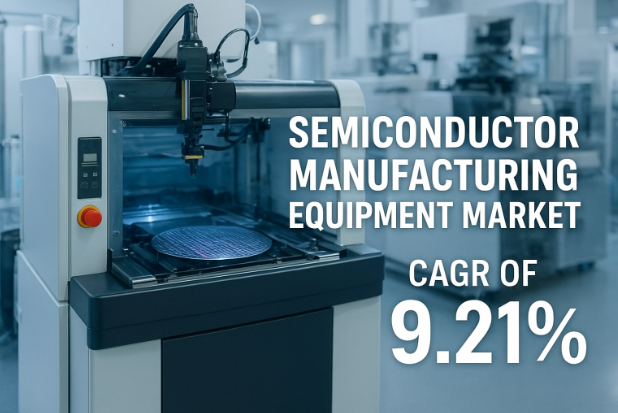
The global technology landscape is advancing at an unprecedented pace, and at the heart of this evolution lies the Semiconductor Manufacturing Equipment Market. Semiconductors are the building blocks of modern electronics, powering everything from smartphones and electric vehicles to data centers and artificial intelligence systems. As industries embrace automation, 5G, and the Internet of Things (IoT), the demand for advanced semiconductor components has skyrocketed — driving rapid growth and innovation in semiconductor production technologies.
Semiconductor Manufacturing Equipment Market Size and Growth Overview
As per the SNS Insider, The Semiconductor Manufacturing Equipment Market size was valued at USD 97.15 billion in 2023 and is expected to reach USD 214.12 billion by 2032, growing at a CAGR of 9.21% over the forecast period 2024–2032. This impressive growth reflects the surging investments in chip fabrication facilities and the increasing need for highly efficient, miniaturized, and high-performance semiconductors. Governments and private players worldwide are ramping up efforts to localize semiconductor manufacturing to reduce supply chain dependencies and enhance technological sovereignty.
As the global economy transitions toward digitalization, semiconductor equipment suppliers are experiencing massive demand surges from industries such as automotive, telecommunications, consumer electronics, and industrial automation.
Top Semiconductor Manufacturing Equipment Companies are:
Tokyo Electron Limited, ASML, Nikon Corporation, FormFactor, Lam Research Corporation, KLA Corporation, Advantest, Plasma-Therm, Hitachi High-Tech Corporation, EV Group, Advanced Dicing Technologies, Evatec, Nordson, QP Technologies, Modutek, Daifuku, Canon
Key Growth Drivers in the Semiconductor Manufacturing Equipment Market
Several factors are propelling the growth of the Semiconductor Manufacturing Equipment Market. One of the most significant drivers is the continuous innovation in chip design and architecture, leading to the production of smaller, faster, and more energy-efficient chips. The rapid adoption of artificial intelligence (AI) and machine learning (ML) applications also requires high-performance computing power, which, in turn, fuels the demand for cutting-edge semiconductor manufacturing tools.
The rise of 5G networks is another major catalyst, enabling faster communication and supporting connected devices across industries. Additionally, electric vehicles (EVs) and autonomous driving technologies rely heavily on semiconductor components for sensors, processors, and power management systems. These trends are prompting semiconductor companies to expand capacity and upgrade their manufacturing facilities, creating a booming market for advanced equipment.
Technological Advancements Shaping the Semiconductor Manufacturing Equipment Market
The future of the Semiconductor Manufacturing Equipment Market is defined by technological innovation. Equipment manufacturers are increasingly integrating advanced process control systems, automation, and artificial intelligence into their tools to enhance production accuracy and yield. Extreme ultraviolet (EUV) lithography has emerged as a game-changer, allowing chipmakers to produce transistors with smaller nodes while improving performance and reducing power consumption.
Moreover, the shift toward 3D chip stacking and heterogeneous integration has opened new opportunities for equipment providers to develop specialized etching, deposition, and inspection tools. The integration of smart sensors and data analytics also supports predictive maintenance and operational efficiency in fabrication plants (fabs), minimizing downtime and improving throughput.
Regional Insights: Asia-Pacific Dominates the Semiconductor Manufacturing Equipment Market
The Semiconductor Manufacturing Equipment Market is heavily concentrated in the Asia-Pacific region, which accounts for the majority of global semiconductor production. Countries like Taiwan, South Korea, Japan, and China play dominant roles due to the presence of major foundries and integrated device manufacturers (IDMs). Taiwan’s TSMC and South Korea’s Samsung Electronics lead global chip fabrication, driving robust demand for advanced equipment.
North America follows closely, supported by government initiatives such as the U.S. CHIPS and Science Act, which aims to boost domestic semiconductor manufacturing and research. Europe is also making significant strides with investments in advanced microchip production to strengthen its technological independence. Meanwhile, regions in Southeast Asia, such as Malaysia and Singapore, are emerging as manufacturing hubs due to favorable policies and skilled labor availability.
Challenges Facing the Semiconductor Manufacturing Equipment Market
Despite its strong growth outlook, the Semiconductor Manufacturing Equipment Market faces several challenges. High equipment costs and long lead times pose barriers for new market entrants and smaller players. Moreover, the complexity of advanced semiconductor processes demands continuous innovation and significant R&D investments.
Supply chain disruptions and geopolitical tensions have also impacted the timely delivery of raw materials and components, leading to production delays. Additionally, the ongoing chip shortage has emphasized the need for a more resilient and diversified manufacturing ecosystem. Addressing these issues requires strategic collaboration between governments, technology companies, and equipment suppliers.
Future Outlook: Opportunities Ahead for Semiconductor Equipment Manufacturers
The future of the Semiconductor Manufacturing Equipment Market looks promising, with opportunities spanning across multiple industries. The expansion of AI data centers, renewable energy technologies, quantum computing, and edge devices will continue to drive semiconductor innovation. Equipment manufacturers that invest in next-generation lithography, metrology, and wafer inspection technologies are likely to gain a competitive edge.
Sustainability is also emerging as a critical focus area. The semiconductor industry is working to reduce carbon emissions and water usage through eco-friendly manufacturing processes. Companies developing energy-efficient tools and sustainable production solutions are expected to thrive in the coming years.
Conclusion
The Semiconductor Manufacturing Equipment Market is the cornerstone of the global electronics industry, enabling technological progress in virtually every sector. As demand for semiconductors continues to surge, driven by AI, 5G, and EV adoption, equipment manufacturers are poised to benefit from a decade of transformative growth. With continuous innovation, regional expansion, and sustainability efforts, the market’s long-term outlook remains exceptionally bright.
FAQs About the Semiconductor Manufacturing Equipment Market
- What is the CAGR of the Semiconductor Manufacturing Equipment Market?
The Semiconductor Manufacturing Equipment Market is projected to grow at a CAGR of 9.21% during the forecast period 2024–2032, reflecting steady demand for advanced semiconductor fabrication tools and technologies.
- What is the forecast period for the Semiconductor Manufacturing Equipment Market?
The market forecast period spans from 2024 to 2032, during which significant growth is expected due to rising semiconductor investments, 5G rollout, and AI-driven innovations.
- Which region leads the Semiconductor Manufacturing Equipment Market growth?
Asia-Pacific dominates the global market, led by semiconductor giants in Taiwan, South Korea, Japan, and China. The region’s strong manufacturing infrastructure and government-backed initiatives continue to fuel its leadership in semiconductor production.