
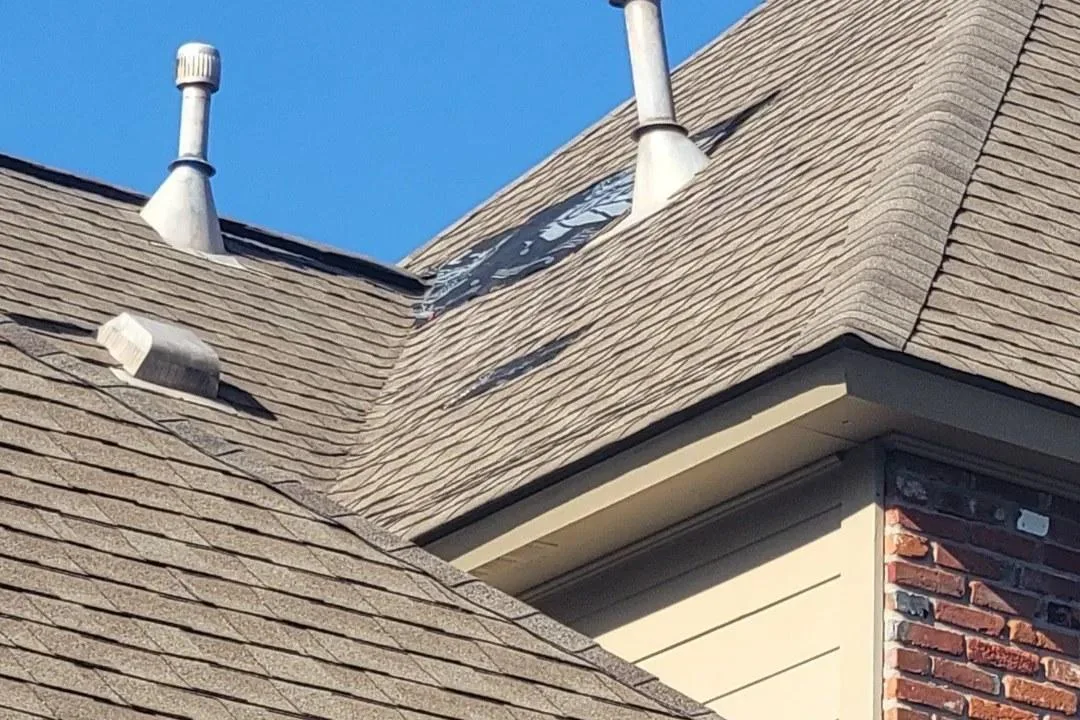
Every roof in East Baton Rouge Parish faces the same weather. What differs is how many storms it has already been through, and how much of the house underneath has been there for decades.
Two federal records help put that in perspective. One shows when the parish’s homes were built. The other shows how often the federal government has declared a major disaster that covered the parish.
Most Homes in the Parish Were Built Before 1990
The Census Bureau’s American Community Survey asks when each housing unit was built. Its five-year estimates for 2020 through 2024 count 206,591 housing units in East Baton Rouge Parish.
The single largest group was built in the 1970s, with 37,984 units. The 1980s followed with 35,122.
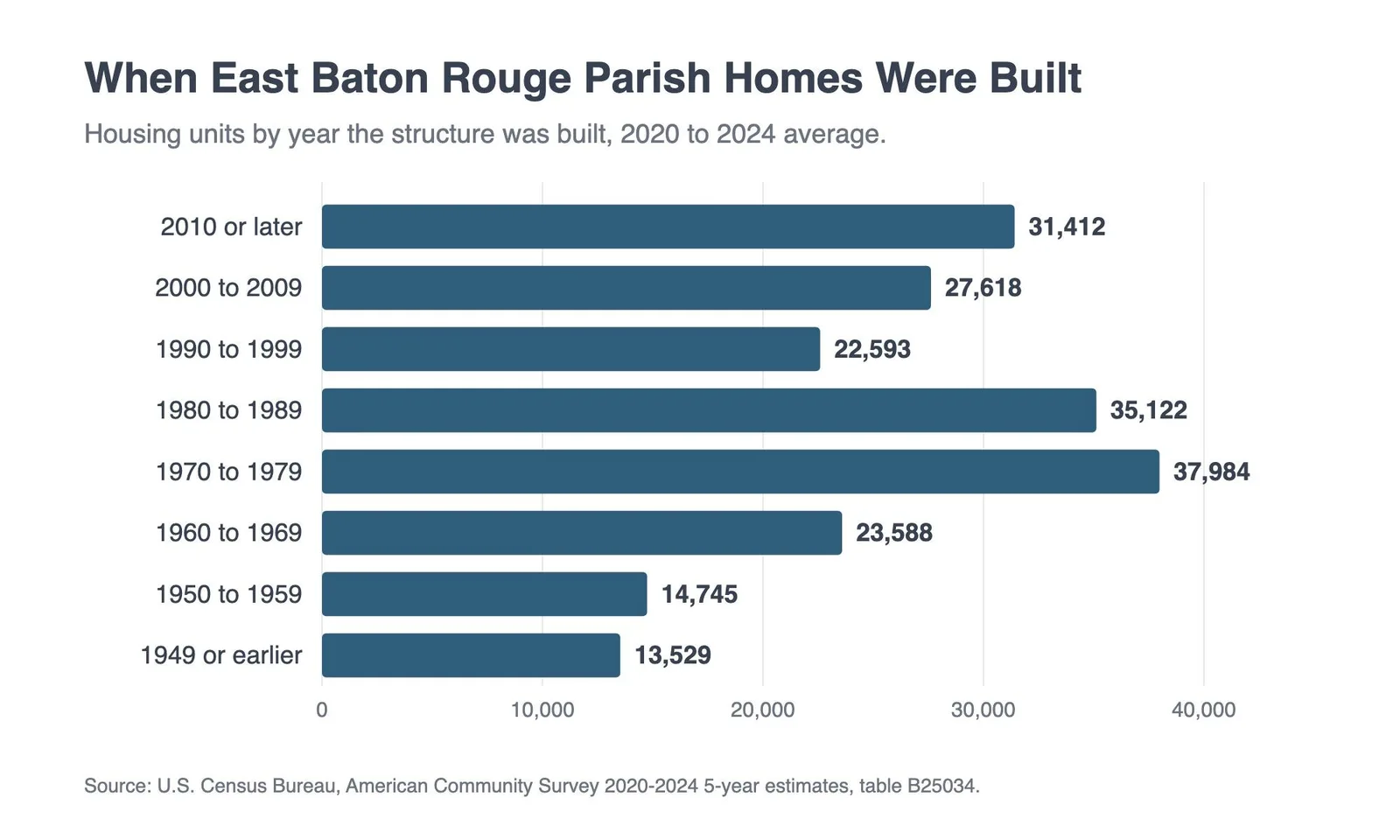
East Baton Rouge Parish housing units by year built.
Taken together, 124,968 units were built before 1990, about 60% of the parish total by our arithmetic. Fewer than one in six were built in 2010 or later.
The survey puts the median year built at 1984 for the parish. Louisiana’s median is 1983, and the national median is 1980, so East Baton Rouge is not unusually old. It is simply typical of a country where most homes were built decades ago.
A House’s Age Is Not Its Roof’s Age
The year a house was built does not tell anyone the age of its roof. Many older homes in the parish have been reroofed once or more, often after a storm.
What the age does tell is how long the rest of the structure has been exposed. Decking, flashing, vents, pipe boots, and the joints around chimneys and skylights do not always get replaced with the shingles. An older house can carry a newer roof over parts that have been in place for 40 years.
That is where many leaks start. Water rarely comes straight through a sound shingle. It finds a cracked boot, a dried patch around a vent, or a gap at a wall, and follows the framing inside.
Federal Disaster Declarations Covering the Parish
FEMA’s public file of disaster declarations lists every federal declaration back to 1953, by county and parish. It includes major disaster declarations, emergency declarations, and fire management assistance.
East Baton Rouge Parish appears in 47 declarations, starting with Hurricane Betsy in 1965. Of those, 29 are major disaster declarations, the broadest of the three types.
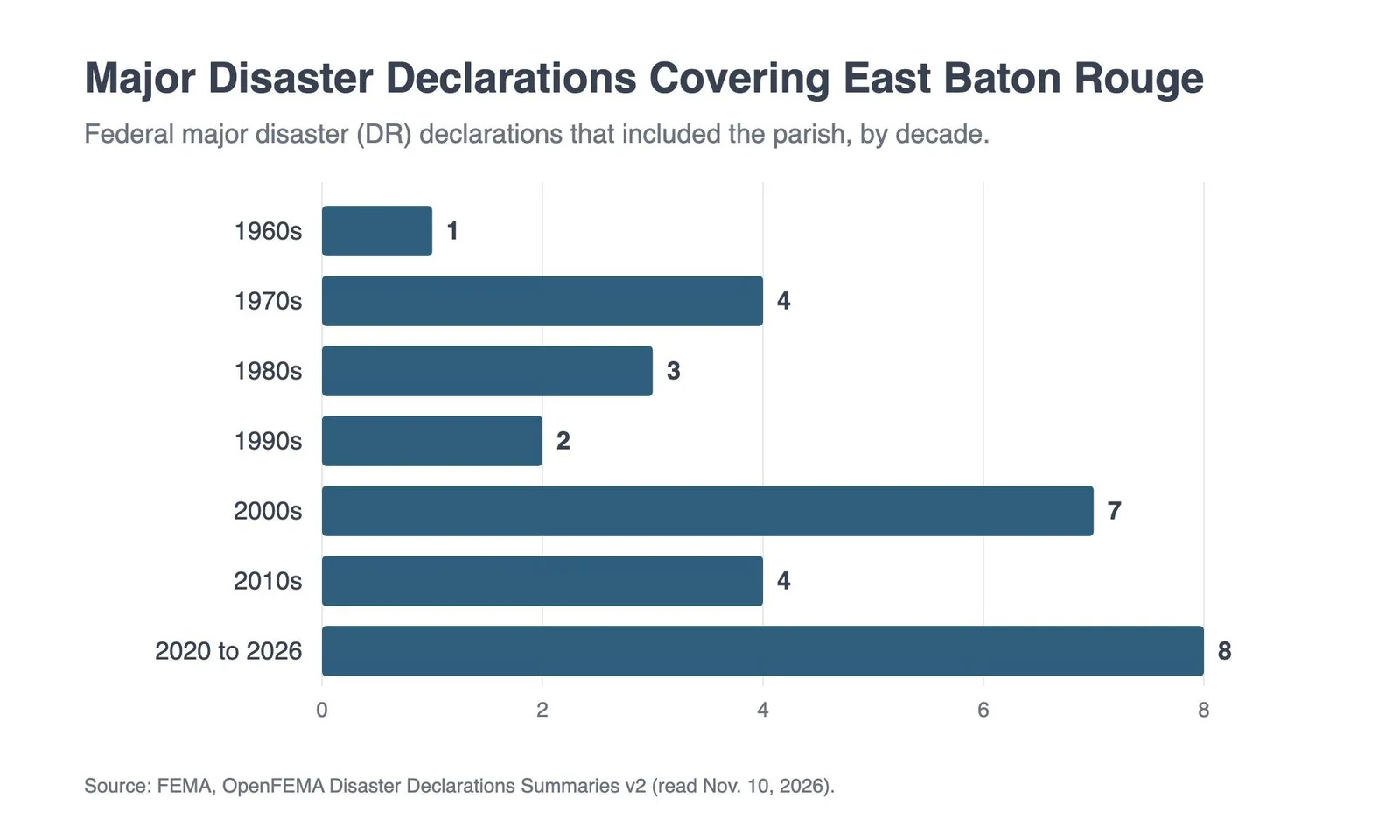
Major disaster declarations covering East Baton Rouge Parish, by decade.
The count has climbed. The parish saw 10 major disaster declarations from the 1960s through the 1990s combined. It has seen 19 since 2000.
The current decade already holds eight, more than any full decade before it. They include Hurricanes Laura and Delta in 2020, Zeta, declared in January 2021, Ida in August 2021, and Francine in 2024.
Emergency Declarations Fill In the Gaps
Major disasters are only part of the file. East Baton Rouge Parish also appears in 18 emergency declarations, a separate, more limited type that often comes before or alongside a storm.
Eleven of those 18 emergency declarations came in 2020 or later. Several of them followed storms that never became major disasters for the parish, including Tropical Storm Cristobal and Hurricane Sally in 2020 and Tropical Storm Nicholas in 2021.
The most recent entry in the file is an emergency declaration for a severe winter storm in January 2026. It is a reminder that roof damage here is not only a hurricane-season problem. Ice and freezing rain can load gutters, crack brittle shingles, and find the same weak spots that wind-driven rain does.
Wind and Water Lead the List
Not every declaration is about weather. One of the 19 since 2000 covered the COVID-19 pandemic.
The rest were storms or floods. By FEMA’s incident types, 13 were hurricanes, and one was a coastal storm, Tropical Storm Allison in 2001. Three were floods, including the August 2016 event, and one was the winter storm of February 2021.
For a roof, the pattern is plain. Most of the parish’s federal disasters this century have brought wind, rain, or both. Each one sends a wave of missing shingles, lifted flashing, and leaks across the area at the same time.
What to Look For After a Storm
A declaration is the extreme case. Many smaller storms do damage without making federal records. Homeowners can spot most problems from the ground and the attic.
- Look for missing, creased, or lifted shingles, especially near ridges and edges.
- Check vent stacks, pipe boots, and flashing for cracks or gaps.
- Watch for granules collecting at the bottom of downspouts.
- Look in the attic for damp insulation, stains, or daylight through the decking.
- Photograph everything before any temporary repair, for an insurance claim.
Localized damage is often a repair rather than a replacement. A small leak caught early can keep a sound roof in service for years.
Local Repair Work
Roofing contractors in the Baton Rouge area handle much of this work after each storm season.
Roof Rescue, a firefighter-owned roofer based in Zachary, describes repair work in Baton Rouge for leaks, storm damage, shingle replacement and flashing and vent problems, along with emergency tarping. The company says it provides documentation to help homeowners through an insurance claim.
Its recent project write-ups show the kind of work an older roof needs. One describes shingles woven in around a vent on a Greenwell Springs home where an old tar patch had cracked. Another describes seven worn pipe flashings replaced on a home in Baker, keeping a sound shingle roof in service without a full replacement.
What the Records Suggest
East Baton Rouge Parish is not short on storms or on older houses. The Census data shows a housing stock built mostly before 1990, and FEMA’s file shows major disasters arriving more often this century than in the last.
Neither record can say what shape any single roof is in. Together they make a practical case for checking a roof after every major storm, and for fixing small problems before the next one arrives.