
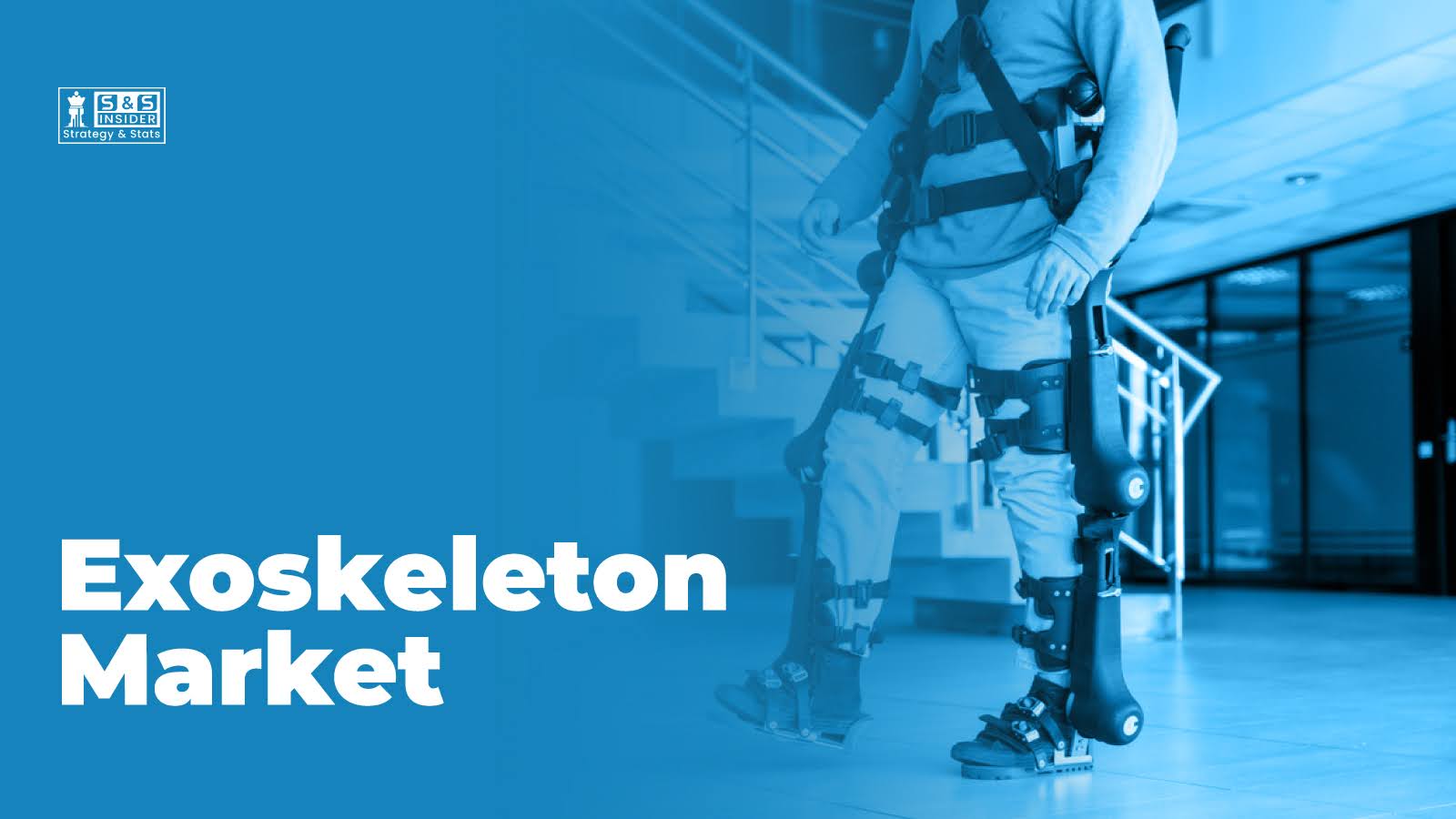
An exoskeleton is a wearable, external framework that augments, supports, or restores human movement and strength. Designed as either rigid mechanical structures or soft, textile-based “exosuits,” exoskeletons can be powered (using motors, hydraulics, or actuators) or passive (using springs and mechanical linkages). Their applications range from medical rehabilitation—helping stroke survivors and spinal cord injury patients relearn gait—to industrial use cases that reduce worker fatigue and prevent musculoskeletal injury, and to military systems that increase endurance and load-carrying capability. Modern exoskeletons increasingly integrate sensors, real-time control algorithms, and telemetry to deliver adaptive assistance tailored to the wearer’s movement and task.
Exoskeleton Market Analysis & Driving Factors
As per SNS Insider, “The Exoskeleton Market was valued at USD 454.95 million in 2024 and is expected to grow to USD 1575.88 million by 2032 and growing at a CAGR of 16.8% over the forecast period of 2025-2032.”
This rapid expansion is driven by converging technological improvements, expanding use-cases, and growing awareness of long-term cost savings in healthcare and industry. Key driving factors include an aging global population with rising demand for mobility-assistive devices; increasing prevalence of musculoskeletal disorders and neurological impairments that create a need for advanced rehabilitation solutions; employer and regulatory emphasis on workplace ergonomics and injury prevention; and growing military interest in soldier augmentation. Complementing these demand-side drivers are supply-side advances: lighter materials (carbon fiber, advanced polymers), more efficient actuators and batteries, improved sensors and machine learning control systems, and falling production costs as companies scale manufacturing.
Leading Trends in the Exoskeleton Industry
Soft exosuits and textile-based systems: A move away from bulky metal frames toward flexible, fabric-based exosuits is making wearable assistance lighter, more comfortable, and more acceptable for everyday use.
AI-driven adaptive control: Real-time machine learning algorithms allow exoskeletons to adapt assistance levels and timing to the wearer’s gait and fatigue state, improving efficacy and safety.
Industrial adoption for injury prevention: Instead of only treating injury, industries (logistics, manufacturing, construction) are deploying exoskeletons proactively to reduce strain and lower long-term workers’ compensation costs.
Integration with tele-rehab and remote monitoring: Exoskeletons increasingly come with cloud connectivity and clinician dashboards, enabling remote tracking of patient progress, data-driven therapy adjustments, and scalable telerehabilitation programs.
Modular and task-specific designs: Manufacturers are offering modular systems that can be configured for lifting, bending, or gait support—allowing a single platform to address multiple use-cases and simplifying procurement.
Battery and actuator improvements: Progress in lightweight batteries and compact, high-torque actuators is extending device run-time and enabling truly mobile, untethered systems — a critical factor for broader adoption outside the clinic.
Leading Regions in the Industry
The market is geographically diverse but exhibits clear regional leaders. North America (particularly the United States) is a dominant market due to strong venture capital funding, military procurement programs, advanced healthcare infrastructure, and early adoption by industrial players. Europe is a major market with robust healthcare reimbursement structures, strict workplace-safety regulations, and several established medical-device manufacturers driving adoption, especially in Germany, France, and the UK. Asia-Pacific—led by Japan, South Korea, and China—is the fastest-growing region, propelled by aging populations (Japan), substantial manufacturing sectors adopting industrial exoskeletons (South Korea, China), and government-backed robotics initiatives. Emerging markets in Latin America, the Middle East, and Africa are still nascent but show growing interest where industrialization and healthcare access create demand for scalable mobility and ergonomic solutions. Regional growth rates will vary: developed markets will expand steadily through replacement and clinical integration, while APAC will likely contribute disproportionately to volume growth over the coming decade.
Competitive Landscape & Key Players
The exoskeleton market is a mix of specialized startups, traditional medical-device firms branching into robotics, industrial OEMs, and defense contractors. Competition is segmented by end-use (medical rehabilitation, industrial ergonomics, military/defense, consumer assistance) and by technology approach (rigid vs. soft exoskeletons; full-body vs. upper- or lower-limb focused). Market dynamics include active M&A (larger players acquiring niche startups to integrate technology), partnerships between clinical institutions and manufacturers for clinical validation, and increasing licensing deals for control software and sensors.
Leading key players in the market include:
l Ekso Bionics — early pioneer in wearable robotics for rehab and industrial assistance.
l ReWalk Robotics — known for lower-limb systems targeted at spinal cord injury rehabilitation and personal mobility.
l Ottobock — established prosthetics and orthotics leader expanding into exoskeleton solutions.
l Cyberdyne — developer of the HAL (Hybrid Assistive Limb) system, prominent in clinical and research settings.
l Sarcos Robotics — developing full-body exoskeletons aimed at industrial and defense markets.
l Parker Hannifin (and other industrial OEMs) — active in developing and commercializing ergonomic industrial exoskeletons.
Beyond these names, a long tail of specialized firms and academic spin-offs is accelerating innovation; partnerships between universities, hospitals, and industry players are common to validate clinical outcomes and scale manufacturing.
Conclusion
Exoskeletons have shifted in a few short years from a fringe robotics novelty to a palpable technology with real commercial traction across medical, industrial, and defense sectors. The market’s projected growth—from USD 454.95 million in 2024 to USD 1575.88 million by 2032 at a 16.8% CAGR (2025–2032)—reflects both technological maturation and expanding demand driven by aging populations, workplace-safety mandates, and military interest. Current trends—soft exosuits, AI-driven adaptive control, industrial prevention programs, tele-rehab integration, modular designs, and better batteries—are lowering adoption barriers and broadening use-cases. Regionally, North America and Europe lead in market maturity, while Asia-Pacific offers the fastest growth potential. The competitive landscape is active and heterogeneous: established medical-device companies, robotics startups, and industrial OEMs vie for leadership through product innovation, clinical validation, and strategic partnerships. Taken together, these forces suggest exoskeletons will play an increasingly central role in rehabilitation pathways, ergonomic workplaces, and human augmentation strategies—moving the industry from specialized deployments to wider, practical adoption in the coming decade.