
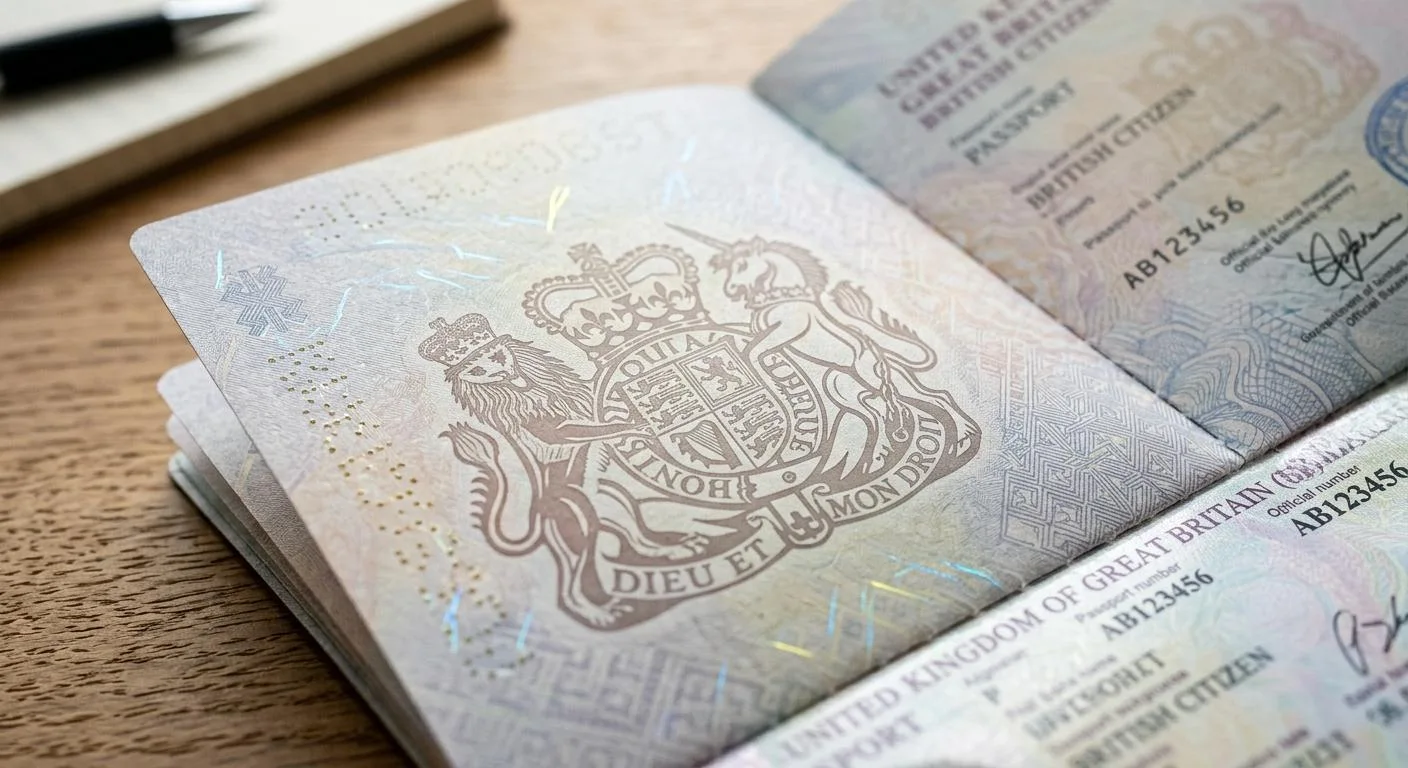
Variations introduced during paper manufacturing create embedded designs that differ from printed images.
WASHINGTON, DC, October 12, 2026 — Passport watermarks are among the oldest security techniques still used in modern travel documents, yet their effectiveness comes from a manufacturing principle that remains difficult to reproduce convincingly because the design is formed within the paper itself rather than added later through ordinary printing.
When an examiner holds a genuine passport page against transmitted light, the watermark can appear through variations in paper thickness and density, producing lighter and darker areas that reveal images, symbols, lettering, or repeating patterns integrated during the papermaking process.
A Watermark Is Created Before the Passport Is Printed
Unlike a visible graphic applied with ink, a traditional watermark develops during paper manufacturing, so the feature becomes part of the material structure before the passport receives printed backgrounds, page numbers, or other visible security elements.
Specialized papermaking equipment can alter fiber distribution and paper thickness in controlled areas, creating tonal variations that become visible when light passes through the finished sheet and reveals the intended design from within the material.
The International Civil Aviation Organization recognizes watermarks and related substrate protections within the broader framework of travel-document security, where materials, printing, personalization, electronics, and inspection methods work together to strengthen document integrity.
Thickness Creates the Visible Image
A watermark typically doesn’t rely on colored ink for its primary effect: lighter areas transmit more light, while denser areas transmit less, allowing the design to emerge from differences within the paper.
That physical relationship gives genuine watermarks a three-dimensional tonal quality that surface printing can struggle to imitate, especially when the authentic design includes gradual transitions between highlights, shadows, fine contours, and internal details.
A printed imitation may reproduce the general outline at a glance, but transmitted-light examination can reveal that the apparent image sits on the surface rather than existing naturally throughout the paper structure.
Multitone Watermarks Can Add Greater Complexity
Some security papers use multitone watermarks that create several levels of light and darkness, producing more detailed images than simple two-tone designs and making the finished feature harder to reproduce convincingly through ordinary commercial printing techniques.
Depending on the issuing authority’s document design and security requirements, a watermark can incorporate portraits, coats of arms, national symbols, architectural features, geometric designs, or combinations of several elements.
The more tonal complexity, the harder it is for a counterfeit reproduction to match both the visible image and the genuine paper’s physical behavior under transmitted illumination.
Watermarks Can Repeat Across the Page
A passport page may contain a single prominent watermark or a repeating pattern that extends across larger portions of the paper, allowing examiners to see whether the feature remains consistent through areas affected by printing, stamps, visas, or ordinary handling.
Repeating structures can also reveal page substitution because a replacement sheet made from ordinary paper will not necessarily show the same watermark design, orientation, spacing, tonal behavior, or relationship to surrounding security features.
For document examiners, this makes the watermark useful not only as an isolated feature but also as evidence of whether the page belongs within the original booklet construction.
Transmitted Light Is Essential for Proper Examination
Watermarks are best examined using transmitted light, where illumination passes through the paper from behind rather than reflecting off the surface, making thickness variations and internal structures much more visible.
A border officer or forensic examiner can use this method to compare the questioned page with an authentic reference specimen and assess whether the watermark displays the expected design, position, tonal transitions, and paper characteristics.
Because transmitted-light examination differs fundamentally from ordinary reflected-light viewing, a page that looks convincing on a desk can reveal substantial inconsistencies once light passes directly through the substrate.
Surface Printing Cannot Fully Reproduce Paper Structure
A counterfeiter might attempt to imitate a watermark by printing a pale image, applying chemicals, altering paper opacity, or using commercially available watermarked stationery, but each method can create characteristics that differ from genuine security-paper production.
Printed simulations may show hard edges, uniform tone, visible ink deposits, or incorrect contrast, while chemically altered areas may reveal staining, fiber damage, unusual fluorescence, or inconsistent paper texture under closer examination.
The challenge therefore extends beyond making an image visible, because the counterfeit must also reproduce the material behavior expected from a legitimate watermark embedded during controlled paper manufacture.
Paper Fibers and Watermarks Can Work Together
Security paper often combines watermarks with embedded fibers, specialized fluorescence, controlled paper composition, and other substrate protections, forcing anyone attempting to replace a page to reproduce several manufacturing characteristics simultaneously rather than copying one visible feature.
An examiner may therefore consider the watermark alongside fiber distribution, ultraviolet response, paper thickness, texture, opacity, and printing quality to determine whether the questioned page behaves consistently with an authentic passport specimen.
This combined approach strengthens examination because a counterfeit might imitate one characteristic while failing another that depends on a different manufacturing process.
Passport Watermarks Differ From Decorative Watermarks
The term watermark also commonly refers to translucent logos added digitally to photographs or documents, but those decorative overlays share little with security watermarks physically incorporated into passport paper.
Software can place a digital watermark over an image, while a traditional security-paper watermark results from controlled fiber distribution and thickness variation during manufacturing, creating a physical feature present even before printing begins.
Understanding this difference helps explain why a passport watermark cannot be accurately evaluated merely by asking whether a faint image appears somewhere on the page.
The Design Must Match the Correct Passport Generation
Governments periodically redesign passports, so legitimate documents from the same country can show different watermark patterns depending on the issuing year, booklet type, and passport generation.
Inspectors therefore need reliable reference information before deciding that an unfamiliar watermark is a problem, because comparing a newer passport with an older specimen can lead to misleading conclusions even when both documents are genuine.
The European Union’s PRADO reference system provides examples of authentic identity and travel documents and demonstrates how security substrates, watermarks, printing, optical features, and personalization can vary significantly among document generations.
Watermarks Can Help Identify Replacement Pages
If someone removes an original visa page and replaces it with another sheet, the substituted material must match not only the visible printing but also the watermark, paper composition, dimensions, binding characteristics, ultraviolet response, and surrounding page sequence.
A replacement page produced on ordinary paper may therefore become obvious under transmitted light even when its visible artwork initially resembles the original passport design with reasonable accuracy.
This is one reason apparently blank visa pages still carry significant security value: the substrate itself can show whether the page originated from the legitimate booklet manufacturing process.
Watermarks Can Intersect With Printed Designs
Passport designers can intentionally position printed security backgrounds over watermarked areas, creating a layered relationship between features produced during paper manufacture and those added later through specialized security printing.
An unauthorized reconstruction must then reproduce both the internal watermark and the surface design while preserving their correct alignment, scale, orientation, and visual interaction when the page is examined under different lighting conditions.
These relationships strengthen passport security because the examiner can assess whether independent manufacturing stages produced a coherent final document.
Normal Wear Can Affect Appearance
Water, folding, abrasion, contamination, heavy stamping, adhesive residue, and years of handling can change how a genuine passport page appears under transmitted light, so examiners should always evaluate unusual appearance within the document’s broader condition.
An examiner should consider whether a disturbance follows natural wear patterns or appears localized around information that someone might have attempted to alter, because the context of the damage can matter as much as the watermark itself.
This is another reason professional authentication relies on several independent features rather than treating any single irregularity as definitive proof of fraud.
Photographs Cannot Fully Capture Watermark Quality
A photograph taken against a bright window may show some form of watermark, but camera exposure, compression, glare, focus, white balance, and screen brightness can substantially change the feature’s apparent tonal structure.
Subtle depth transitions visible in the physical paper can disappear in a JPEG, while image enhancement can exaggerate edges or contrast that appear much softer during direct examination.
Remote photographs can therefore assist with preliminary review but cannot fully substitute for transmitted-light examination of the original passport page.
Image Printing Can Create Convincing but Flat Imitations
Modern printers can reproduce pale images with impressive visual accuracy, especially when counterfeiters start with high-resolution scans of authentic documents, yet those reproductions still differ fundamentally from the thickness variations built into paper during manufacture.
When light passes through a printed simulation, the image may behave like a layer of ink or toner rather than revealing the natural tonal transitions expected from an authentic security watermark.
Magnification can also reveal surface deposits, dot structures, or printing patterns that would not normally create the underlying watermark in genuine passport paper.
Manufacturing Security Begins Before Personalization
Watermarks demonstrate that passport security begins long before authorities add a holder’s photograph, name, passport number, machine-readable information, or electronic chip data to the finished document.
Security begins at the substrate stage, where manufacturers can control paper composition, fibers, thickness, fluorescence, and embedded designs before later stages add printing, binding, personalization, and electronic components.
This sequence creates multiple independent manufacturing layers, making unauthorized reproduction much harder than simply copying what appears on the finished page.
Watermarks Complement Modern Electronic Passports
The growing use of electronic chips and polycarbonate identity pages has not eliminated the importance of watermarked paper, especially because visa pages and other booklet components still rely heavily on traditional substrate protections.
Electronic authentication can establish important facts about protected chip data, but it cannot independently confirm that every paper page in the booklet remains original, unaltered, and correctly incorporated into the document.
Watermarks therefore continue to provide useful physical evidence within passports that combine older paper-security principles with sophisticated electronic and biometric technologies.
Traditional Security Still Has Modern Value
The longevity of watermark technology shows that security features don’t become obsolete simply because they predate digital systems; their usefulness depends on manufacturing difficulty, inspectability, and compatibility with other protections rather than technological novelty.
A feature that can be examined quickly with transmitted light while remaining difficult to reproduce faithfully can still provide substantial value, even in passports with contactless chips, laser engraving, digital signatures, and biometric facial images.
For border officers handling large numbers of travelers, simple physical tests can remain especially useful because they allow officers to quickly identify suspicious documents before more advanced examination begins.
Watermarks Support Layered Document Examination
A genuine watermark does not independently prove a passport remains valid, belongs to the presenter, or contains properly authenticated electronic information, but it provides another independent characteristic that should match the issuing authority’s expected document design.
When watermarks, security printing, booklet construction, electronic information, and biometric identity remain consistent, the inspector has a much stronger foundation for assessing the document than any single feature could provide on its own.
At Amicus International Consulting’s passport security resource, these relationships help explain why modern passport examination combines longstanding physical safeguards with newer electronic and cryptographic systems rather than replacing one generation of security entirely with another.
The Security Is Built Into the Material
The defining strength of a traditional passport watermark is that it does not merely decorate the page; it originates within the substrate and reflects manufacturing decisions made before the document receives visible security printing or personalized information.
That physical integration makes faithful reproduction harder while giving trained examiners a straightforward way to compare paper structure, tonal transitions, and embedded designs against the characteristics expected of an authentic document.
When a passport page is held up to transmitted light, the watermark reveals more than a hidden picture; it provides evidence of the paper’s origin, manufacturing process, and consistency with the secure materials chosen by the issuing authority.