
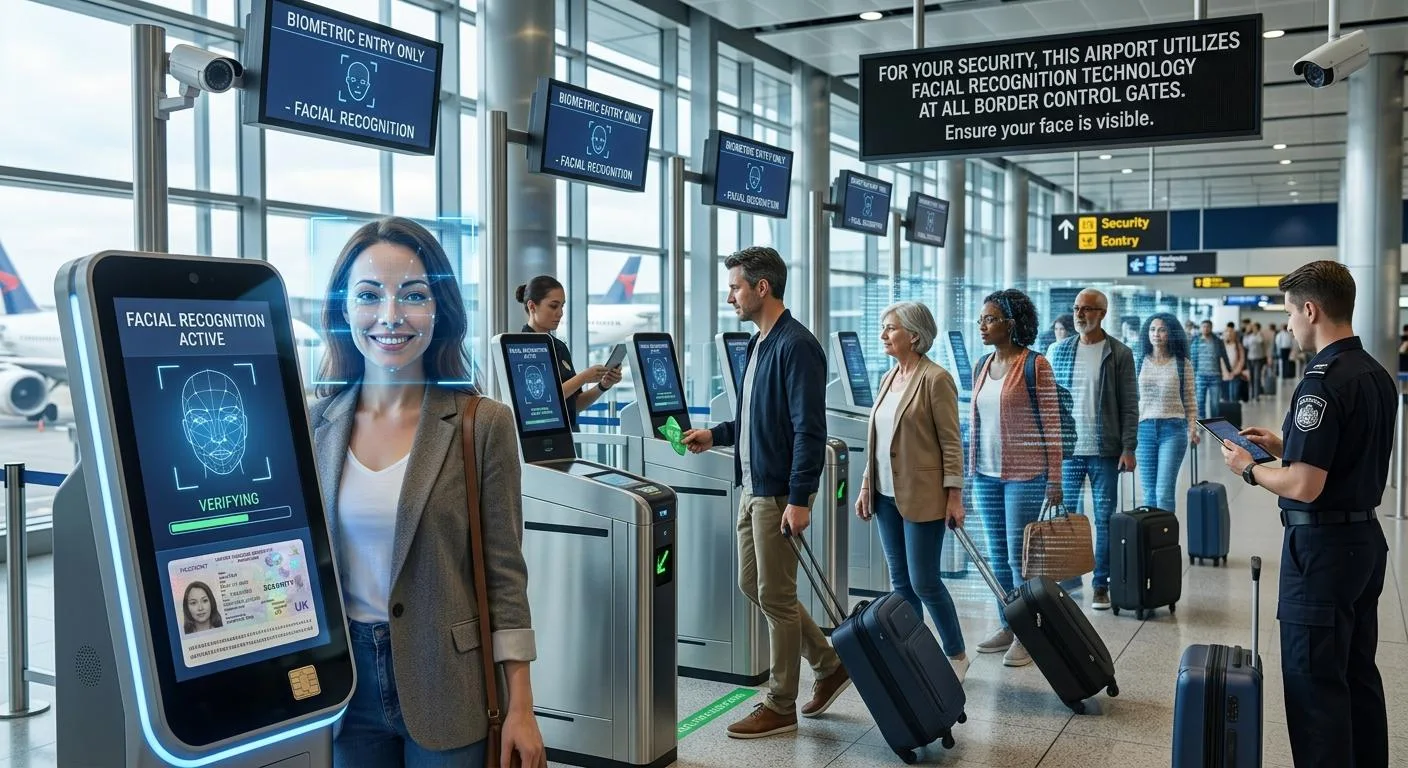
One examines electronic document credentials, while the other helps determine whether the traveler matches the passport photograph.
WASHINGTON, DC, October 15, 2026 — Electronic passport authentication and facial recognition often operate in the same border inspection, but they answer fundamentally different questions: one evaluates electronically protected document information, while the other compares a traveler to the biometric identity associated with that passport.
This distinction matters as airports expand automated border processing, because a successful chip authentication result does not prove the person presenting the passport is its legitimate holder, and a strong facial match does not independently prove the travel document itself is authentic.
Chip Authentication Examines the Electronic Document
An electronic passport contains a contactless integrated circuit that stores standardized biographical information, a facial image, and security data that compatible inspection equipment can examine to determine whether electronically protected information remains consistent with credentials associated with the issuing authority.
The International Civil Aviation Organization establishes an international machine-readable travel-document framework supporting electronic passports, including standardized biometric information and security mechanisms that let participating countries inspect documents issued by other governments using interoperable systems.
When properly implemented, electronic verification can provide evidence of the integrity and origin of protected chip information, giving border authorities greater confidence that important data were not simply rewritten after the legitimate passport personalization process.
Facial Recognition Examines the Relationship With the Holder
Facial recognition serves a different function because the system captures a live image of the traveler and compares it with a reference portrait associated with the passport, helping determine whether the person presenting the document matches the recorded holder.
ICAO identifies the facial image as the required primary biometric for interoperable electronic machine-readable travel documents, while fingerprint and iris information can be included as optional additional biometrics according to the systems and policies adopted by individual issuing authorities.
This comparison addresses possible impostor use, where another individual presents a genuine and technically authentic passport whose appearance does not sufficiently match the biometric reference stored or printed in the document.
One Check Cannot Replace the Other
A passport can contain perfectly authentic electronic information while an unauthorized person uses it, meaning successful chip verification alone cannot establish that the traveler at an inspection point is the individual to whom the government originally issued the document.
Conversely, a traveler might closely resemble the portrait on a suspicious document, so a strong facial comparison alone cannot establish whether the passport chip, digital signatures, physical materials, personalization, booklet construction, and government issuance records are legitimate.
The two technologies therefore become much more useful when authorities combine them, because electronic authentication strengthens confidence in the reference identity while facial comparison links that identity to the individual physically presenting the passport.
The Reference Photograph Must Be Trustworthy
Facial recognition depends heavily on the quality and integrity of the reference image, because an accurate comparison against an unreliable or improperly modified photograph provides far less meaningful evidence of the traveler’s legitimate connection to the document.
For electronic passports, inspection equipment can retrieve the facial image stored within the contactless chip and evaluate associated security information before using that portrait as the reference for a live biometric comparison.
ICAO materials describing the ePassport trust model specifically illustrate a sequence in which authorities verify chip data before processing the traveler through facial recognition, reflecting the importance of establishing confidence in the electronic reference before relying upon it for biometric matching.
Facial Verification Is Generally a One-to-One Comparison
In electronic passport inspection, facial verification generally involves a one-to-one comparison between the live biometric sample captured from the traveler and the reference image associated with the individual represented by the passport.
ICAO distinguishes biometric verification from identification by defining verification as a one-to-one comparison, while identification involves searching a submitted biometric against a collection of records representing multiple enrolled individuals.
This distinction matters because an airport eGate ordinarily does not need to determine who an unknown person might be when the traveler has already presented a passport claiming a particular identity for verification.
Document Authentication Does Not Determine Who Is Standing There
Chip authentication can establish important facts about protected electronic information, but cryptographic systems cannot look at the traveler and independently determine whether the physical person resembles the portrait stored within the authenticated passport.
That task belongs to biometric verification, whether performed automatically through facial comparison software, manually by a border officer, or through a combination in which automated results can trigger additional human examination when uncertainty remains.
Separating these functions helps explain why sophisticated border systems employ both technologies rather than treating a secure electronic passport as sufficient proof that whoever carries the booklet must automatically be its legitimate holder.
A Genuine Passport Can Still Be Used by an Impostor
Passport fraud does not always involve manufacturing a counterfeit booklet or electronically altering stored information, because an individual may attempt to travel using a genuine passport legitimately issued to another person who looks sufficiently similar.
In that situation, the chip could authenticate correctly, its digital signatures could remain intact, and every physical security feature could match legitimate government production, while the central problem would be the presenter’s identity rather than the document itself.
Facial comparison specifically addresses that vulnerability by testing whether the live traveler sufficiently resembles the portrait associated with the authenticated passport rather than assuming possession proves legitimate identity.
A Facial Match Cannot Authenticate Cryptographic Credentials
The reverse problem matters just as much because facial recognition software analyzes biometric similarity and cannot independently determine whether the contactless chip carries properly protected information linked to trusted issuing credentials.
Someone could theoretically present a suspicious document with a photograph that closely resembles the traveler, yet a convincing portrait cannot substitute for electronic authentication, physical document examination, or proper verification of lawful government issuance.
This separation prevents biometric resemblance from becoming an all-purpose authenticity test because looking like the person represented on a document does not prove that the document itself originated from the authority it claims.
Automated Gates Combine the Two Processes
Airport eGates can combine these technologies into one streamlined interaction by reading the passport, accessing electronic information, running appropriate document-security checks, capturing the traveler’s live facial image, and comparing it with the authenticated reference portrait.
From the traveler’s perspective, these separate technical operations can appear as one simple procedure involving a passport reader and camera, even though the underlying system answers several independent questions before allowing automated processing to continue.
ICAO has described automated border-control systems in which the passport reader extracts information from the chip, evaluates document-security information, and uses biometric data for verification before allowing an uncomplicated traveler to proceed through the gate.
European Border Rules Reflect This Separation
European border legislation provides a particularly clear example because applicable rules distinguish checking the authenticity and integrity of electronic passport chip data from electronically comparing the stored facial image with a live image of the traveler.
The relevant European Union border-control framework requires electronic passport chip authenticity and integrity checks when suitable certificates are available, while separately providing for facial-image verification when the electronically stored portrait can be accessed technically and legally.
This structure demonstrates that government border procedures themselves recognize document authentication and biometric holder verification as related but distinct operations whose combined results provide stronger identity assurance.
A Facial Match Is a Similarity Assessment
Facial recognition systems calculate biometric similarity rather than producing an infallible declaration of identity, meaning legitimate travelers can occasionally receive uncertain results when the live image differs from the stored portrait because of age, appearance changes, lighting, positioning, or image quality.
Border systems therefore use operational thresholds and referral procedures so that uncertain automated comparisons receive human review rather than being automatically treated as evidence that the traveler is using another person’s passport.
This limitation matters because biometric technology provides probabilistic comparison evidence, whereas electronic signature verification relies on fundamentally different cryptographic procedures focused on data integrity and trusted issuing credentials.
Chip Authentication Can Also Fail for Technical Reasons
An unsuccessful electronic verification result does not automatically establish that a passport is counterfeit, because certificate availability, reader compatibility, chip damage, software implementation, communication problems, or document-generation differences can occasionally interfere with electronic processing.
Professional systems therefore evaluate failures within context and can refer documents for additional physical or technical inspection instead of assuming that every unsuccessful electronic interaction proves fraudulent manufacture.
The same principle applies to biometrics, where a failed facial comparison and a failed chip check each require investigation based on the specific question the unsuccessful process was trying to answer.
Physical Passport Examination Adds Another Independent Check
Neither chip authentication nor facial recognition can completely replace physical examination because passports contain materials, laser engraving, optical devices, ultraviolet features, microprinting, binding structures, watermarks, perforations, and other characteristics that address forms of manipulation outside purely electronic verification.
A passport could contain authentic electronic information while showing unusual physical alterations elsewhere in the booklet, just as an apparently perfect physical document might reveal electronic inconsistencies when compatible equipment evaluates the embedded chip.
Layered inspection therefore becomes stronger precisely because separate technologies examine different characteristics instead of repeatedly testing the same property in slightly different ways.
Government Status Checks Perform Yet Another Function
Even successful chip authentication and facial comparison cannot establish whether the issuing authority later reported the passport lost, stolen, canceled, revoked, or otherwise unsuitable for travel after legitimate issuance.
Government document-status and immigration databases address those subsequent circumstances, meaning a passport can remain electronically authentic and continue matching its legitimate holder while nevertheless requiring intervention because its current status has changed.
This creates another important distinction in border inspection: document authenticity, holder identity, current passport status, and immigration admissibility are separate questions, even when automated systems process them in one rapid workflow.
Facial Recognition Does Not Search Every Database Automatically
The presence of facial-recognition technology at an airport should not automatically be interpreted as evidence that every captured traveler is being compared against every facial database available to government agencies, because system architectures, authorities, and purposes vary considerably.
A straightforward eGate verification can compare the live traveler directly with the portrait associated with the presented passport, which differs conceptually from a one-to-many biometric identification search against a large collection of unrelated identities.
Understanding that difference prevents the phrase facial recognition from obscuring the specific biometric operation that occurs during routine passport-holder verification.
The Electronic Portrait Has an Important Advantage
When border equipment obtains the reference portrait directly from authenticated electronic passport data, the system can avoid relying solely on a camera image of the printed photograph on the physical identity page.
The digitally stored portrait is designed for interoperable biometric use and can provide a standardized reference image suitable for one-to-one comparison, supporting automated processing while preserving the visible photograph for manual inspection by officers.
This dual representation gives authorities two related ways to examine identity while allowing cryptographic systems to protect the electronic version from unauthorized modification after legitimate personalization.
Aging Does Not Automatically Defeat Facial Verification
Passport photographs can remain in use for years, especially when adult travel documents have long validity periods, so facial-comparison systems must accommodate reasonable changes in appearance while still distinguishing genuine holders from sufficiently dissimilar individuals.
Hairstyle, facial hair, weight, cosmetics, eyewear, and normal aging can change visible appearance considerably without changing the underlying identity, requiring biometric algorithms and human officers to evaluate more stable facial characteristics rather than superficial details alone.
When automated confidence falls below the required threshold, referral to a trained officer provides an important safeguard against treating normal appearance changes as conclusive evidence of impostor use.
The Technologies Produce Different Types of Evidence
Cryptographic passport checks produce technical evidence concerning whether protected electronic information retains the expected relationship with trusted issuing credentials, whereas facial comparison produces biometric evidence concerning similarity between the traveler and the reference identity.
Those forms of evidence are not interchangeable, so their agreement is especially useful because the border system gets confirmation from mechanisms based on fundamentally different technologies, assumptions, and potential failure modes.
A manipulated document might pass a facial comparison, while an impostor carrying a genuine passport might pass electronic authentication, but satisfying both categories becomes harder when the document and holder must independently withstand scrutiny.
Automated Processing Still Requires Human Oversight
Border authorities generally retain mechanisms to refer travelers when automated checks cannot reach the required result, ensuring technology supports inspection rather than forcing uncertain or unusual cases into simplistic automated decisions.
An officer can examine the traveler, compare physical and electronic information, assess document condition, review immigration circumstances, and use additional systems when automated facial or electronic checks produce results requiring explanation.
Human oversight therefore remains especially important where different security signals disagree, because contradictory results can indicate technical problems, ordinary document damage, legitimate appearance changes, or circumstances requiring deeper investigation.
Consumer Passport Apps Usually Address Only Part of the Process
Smartphone apps can read many electronic passports and sometimes perform selected cryptographic checks, but consumer software generally does not reproduce the full biometric, database, document-reference, and immigration environment available at official border-control installations.
A successful consumer chip authentication can therefore provide useful information about the electronic passport without establishing whether a properly configured government facial-verification process at an international border would accept the current user.
Likewise, a commercial facial-comparison application cannot establish whether a passport’s electronic information carries valid government credentials simply because the software reports strong similarity between a photograph and the person using the application.
Photographs Cannot Reproduce the Entire Verification Process
A photograph of a passport can allow visual comparison with the traveler, yet it cannot independently demonstrate the cryptographic integrity of chip information, dynamic optical behavior, tactile characteristics, or numerous other features available when authorities inspect the original document.
Similarly, casual photographs of the traveler taken with a telephone do not necessarily reproduce the controlled capture conditions, biometric standards, camera geometry, and operational thresholds used in professional border-verification environments.
Remote document and facial comparisons can therefore support preliminary assessment but remain fundamentally different from the integrated examination authorities perform when they have both the original passport and the traveler.
The Distinction Matters Beyond Airport eGates
The difference between authenticating a credential and verifying its holder extends beyond passports because digital identity cards, residence documents, mobile credentials, and other secure identification systems increasingly separate questions about credential integrity from questions about the person presenting it.
A reliable identity system needs confidence both that an authorized institution created the credential and that the current presenter corresponds with the person to whom that institution issued it.
Electronic passports provide a particularly visible example because governments can perform both assessments during a single border interaction while relying upon technologies that remain conceptually and technically separate.
Strong Identity Verification Depends on Agreement
The most persuasive automated result occurs when protected chip information validates appropriately, the physical passport matches the expected document generation, and the live traveler matches the authenticated facial image associated with the recorded identity.
Additional government checks can then address passport status, immigration eligibility, and other matters that neither cryptography nor facial recognition was designed to resolve independently.
Through Amicus International Consulting’s passport security resource, readers can examine how these separate technologies fit alongside polycarbonate materials, laser engraving, access controls, optical features, and other protections within contemporary passport verification.
Different Jobs Create Stronger Combined Security
Passport chip authentication and facial recognition strengthen border inspection because they don’t perform the same job: one examines electronically protected document information, while the other evaluates whether the traveler matches the biometric identity represented by that document.
When both results align with physical passport characteristics and relevant government records, authorities rely on several independent sources of evidence rather than on a single technology to answer every authenticity, identity, and validity question.
Modern passport verification therefore works best as a coordinated process in which cryptography establishes confidence in protected electronic credentials, biometric comparison connects those credentials with the traveler, and additional physical and governmental checks address the remaining dimensions of document integrity and border eligibility.