
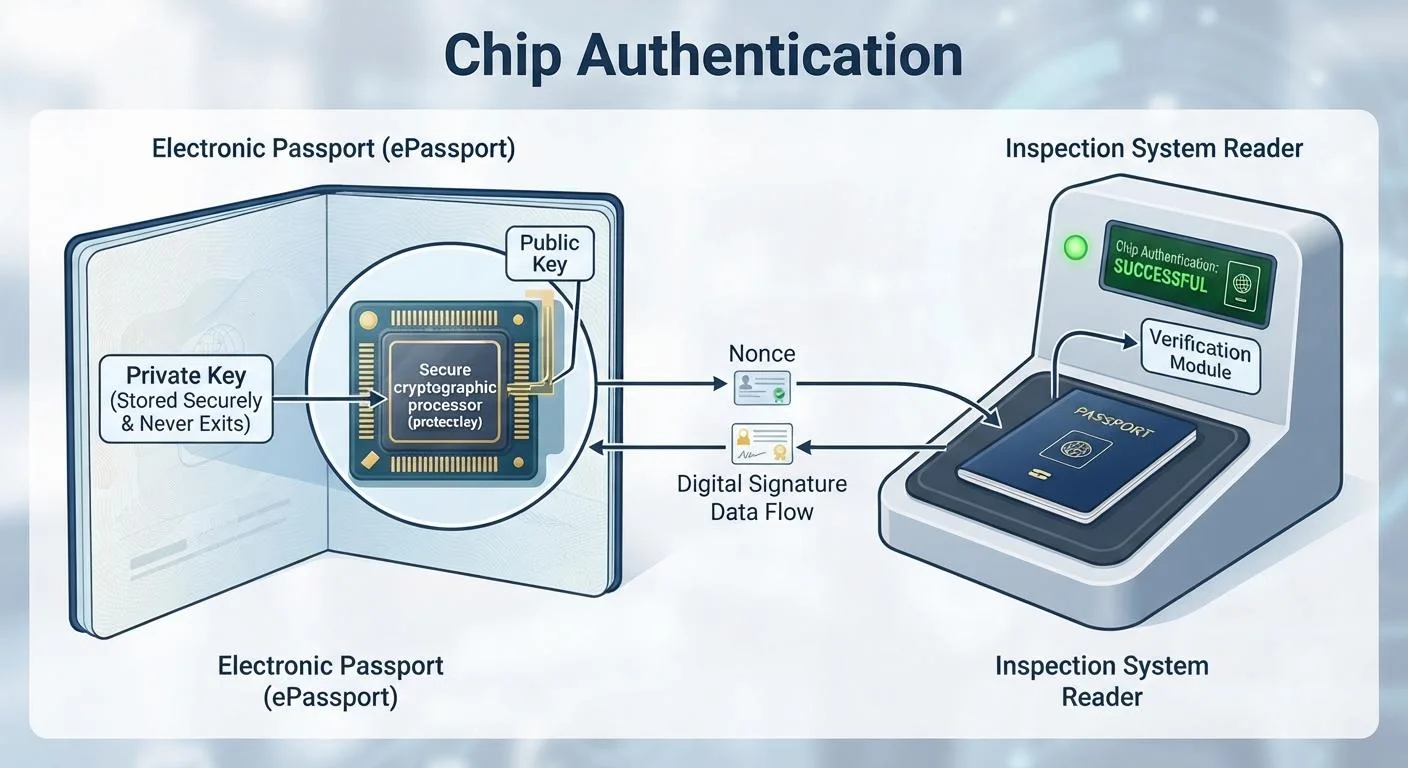
A separate cryptographic mechanism helps establish chip authenticity while supporting secure communication with inspection equipment.
WASHINGTON, DC, October 15, 2026 — Electronic passport verification becomes stronger when inspection equipment can determine not only whether protected identity information remains authentic and unchanged, but also whether the contactless chip presenting that information possesses cryptographic credentials associated with the legitimate travel document.
Chip Authentication addresses that second question through an interactive cryptographic process that establishes the authenticity of the electronic component while deriving new session keys to protect subsequent communication between the passport and compatible inspection equipment.
Chip Authentication Addresses a Different Security Question
Passive Authentication determines whether digitally signed passport information remains consistent with what the issuing authority protected during legitimate personalization, but authentic static data alone cannot necessarily establish that those records remain stored on the original contactless chip.
An exact electronic copy could theoretically preserve legitimate biographical information, a genuine facial image, protected hash values, and the original digital signature without changing any of those records, making an additional test of the chip itself valuable.
Chip Authentication therefore complements Passive Authentication by requiring the electronic component to participate in a cryptographic operation involving a private key expected to remain securely stored inside the legitimate chip rather than simply presenting previously signed information.
The Chip Contains a Protected Private Key
The Chip Authentication architecture relies upon a cryptographic key pair in which public information can be made available to the inspection system while the corresponding private key remains protected within the passport’s secure integrated circuit.
Under the ICAO Doc 9303 security framework, the public keys required for supported Chip Authentication procedures are made available through protected passport security information, while the corresponding private credential remains associated with the chip performing the authentication operation.
Keeping the private key inside secure hardware is critical because the authentication process would offer much less protection against cloning if an attacker could simply copy the secret credential alongside the passport’s ordinary readable electronic information.
The Inspection System and Chip Perform a Key Agreement
Rather than relying on a conventional static comparison, Chip Authentication uses a cryptographic key-agreement process that involves information supplied by the inspection terminal and the protected key material associated with the electronic passport.
The resulting mathematical exchange lets the reader and chip derive shared session information while giving the inspection system evidence that the electronic component possesses the private credential corresponding to the authenticated public information in the passport.
A copied device containing only publicly readable or signed passport records should therefore lack the protected secret required to participate correctly in the expected cryptographic exchange unless the underlying private key has also somehow been compromised.
Public Key Integrity Must Be Established First
Chip Authentication would provide limited assurance if an attacker could replace the public key with one corresponding to a private key under the attacker’s own control, because the substitute electronic component could then participate successfully using that unauthorized credential.
Electronic passport security addresses this concern by protecting relevant public Chip Authentication information within authenticated passport structures, allowing the inspection system to establish confidence in that information before using it during the interactive authentication procedure.
This dependency shows why Chip Authentication works as part of a sequence rather than an isolated test: trusted static information provides the foundation on which the dynamic cryptographic exchange operates.
Passive Authentication Remains an Essential Foundation
Before interpreting a Chip Authentication result, inspection systems ordinarily need confidence that the passport’s signed security information and associated public-key material have not been altered since legitimate government personalization.
Passive Authentication supplies that evidence by validating the issuer’s digital signature and comparing protected electronic information with cryptographic reference values contained within the passport’s signed security structure.
Chip Authentication then provides a different type of evidence by determining whether the responding electronic component contains secret cryptographic material that matches the authenticated public information associated with the legitimate document.
The Process Helps Address Chip Cloning
Cloning presents a different problem from altering data because an attacker attempting simple duplication may preserve every signed electronic record exactly as it appeared on the genuine passport rather than changing protected identity information.
Passive Authentication can therefore continue succeeding against an exact copy because the copied information remains genuinely signed and mathematically unchanged, even though the electronic component presenting those records may no longer be the original chip.
Chip Authentication strengthens the inspection process by requiring protected cryptographic credentials that should not accompany ordinary copying of readable passport data, making simple duplication far less useful against systems that perform the additional check.
Secure Communication Is Created at the Same Time
An important advantage of Chip Authentication is that the cryptographic exchange does more than provide evidence about the electronic component; it also establishes fresh session keys to protect subsequent communication between the passport and inspection terminal.
Those derived keys support secure messaging, allowing information exchanged after successful authentication to receive confidentiality and integrity protection based on newly established session credentials rather than relying indefinitely on earlier communication keys.
This dual purpose distinguishes Chip Authentication from mechanisms that only test chip genuineness, because one cryptographic procedure can strengthen confidence in the component while improving protection for the ongoing electronic session.
Fresh Session Keys Reduce Reliance on Earlier Credentials
Electronic passport communication can begin under access-control procedures such as Basic Access Control or Password Authenticated Connection Establishment, but Chip Authentication can replace earlier session keys with cryptographically stronger values created through its own key-agreement procedure.
The new keys depend on the interactive exchange during the current inspection session, making them distinct from static passport information and providing additional protection for communications after successful authentication.
This progression shows how several security protocols can run sequentially during a single passport inspection, with each stage strengthening or extending protections established earlier in the electronic conversation.
Chip Authentication Differs From Active Authentication
Active Authentication and Chip Authentication both defend against simple chip cloning, but they use different cryptographic structures and shouldn’t be treated as identical procedures just because their broad security objectives overlap.
Active Authentication traditionally uses a challenge-response mechanism that requires the chip to prove possession of a protected private key, while Chip Authentication uses a key-agreement protocol that both authenticates the chip and establishes new secure communication keys.
The distinction matters because newer passport architectures can obtain chip-authentication evidence while simultaneously strengthening the communication channel used for subsequent electronic operations, giving Chip Authentication an additional session-security function.
Static Information Alone Cannot Demonstrate Secret-Key Possession
An electronic passport may contain legitimate signed biographical data, a valid portrait, correct security hashes, authentic certificate information, and other static records that survive exact duplication without losing their original cryptographic validity.
None of those copied records independently proves that the electronic component displaying them possesses the secret private key associated with the legitimate chip, which is why an interactive protocol provides additional evidence unavailable from static examination alone.
Chip Authentication effectively asks the component to participate in a mathematical exchange that depends on secret information rather than merely allowing it to replay records previously created by the issuing authority.
The Private Key Is Not Sent to the Reader
The authentication model does not require the passport to transmit its private Chip Authentication key to the inspection system, because exposing that secret would undermine the very protection the protocol is intended to provide.
Instead, cryptographic calculations let the chip and reader establish a shared result while keeping the private credential protected within the secure electronic environment, showing how modern authentication can prove possession of a secret without revealing it.
This principle is common throughout public-key cryptography and remains especially useful for passports because the same protected chip can undergo legitimate inspections repeatedly throughout a document validity period without surrendering its underlying private credential.
Secure Hardware Supports the Cryptographic Design
The effectiveness of Chip Authentication depends partly on the integrated circuit’s security properties because mathematical protocols cannot provide strong anti-cloning protection when private keys can be easily extracted from the hardware that stores them.
Passport chips therefore incorporate secure hardware designed to protect cryptographic secrets while allowing approved internal operations, helping ensure that authentication keys remain substantially harder to reproduce than ordinary readable passport information.
The electronic component and cryptographic protocol reinforce each other: secure hardware protects the secret, while the protocol gives authorized inspection equipment a standardized way to test possession of that protected credential.
Chip Authentication Is Not the Same as Chip Reading
Successfully establishing contactless communication and retrieving identity information does not mean Chip Authentication occurred, because ordinary electronic reading and cryptographic authentication represent fundamentally different stages of passport inspection.
A smartphone or border reader may successfully display names, dates, a portrait, and other accessible information while performing only limited security checks or no anti-cloning authentication at all.
This distinction matters when consumer applications report a passport as successfully read, because readability alone doesn’t show which cryptographic mechanisms the software actually completed.
A Successful Passive Authentication Result Is Also Different
Passive Authentication provides important evidence that signed passport information remains genuine and unchanged, but it evaluates protected static data rather than directly testing whether the chip possesses the private credential expected by Chip Authentication.
The two results therefore should not be merged into one generic statement that the passport has been authenticated, because each procedure establishes confidence concerning a different component of electronic document security.
Precise terminology allows border authorities, technical specialists, and users of diagnostic software to understand exactly which properties were tested and which questions remain unresolved after a particular verification procedure.
ICAO Treats Chip Authentication as an Additional Validation Mechanism
ICAO’s ePassport validation guidance distinguishes verification of digitally signed passport information from additional mechanisms intended to provide evidence that protected data have not merely been copied onto another electronic component.
This layered approach reflects the broader structure of electronic passport security, where separate mechanisms address data integrity, chip authenticity, secure communications, holder verification, physical document integrity, and current government status, rather than expecting a single cryptographic procedure to answer every question.
Not Every Passport Uses the Same Electronic Architecture
Electronic passports have evolved through several generations, meaning issuing countries can support different combinations of access control, Passive Authentication, Active Authentication, Chip Authentication, and other cryptographic mechanisms depending upon their passport program and issuance period.
A legitimate older passport should therefore not be considered fraudulent merely because it lacks a security feature introduced in a newer document generation, provided its technical behavior remains consistent with the specifications applicable when that document was issued.
Inspection systems need accurate document profiles and sufficient technical compatibility to determine which security procedures should be available before interpreting the absence or failure of a particular mechanism as suspicious.
Chip Authentication Does Not Examine Physical Security Features
Even a completely successful Chip Authentication procedure cannot determine whether someone altered laser engraving, replaced a visa page, disturbed booklet stitching, modified a hologram, damaged a polycarbonate identity page, or changed another physical characteristic of the passport.
Electronic authentication and physical examination therefore remain complementary: one evaluates cryptographic properties within the contactless component, while the other examines materials and manufacturing characteristics outside the electronic environment.
A passport with strong electronic results can still require further examination when its physical construction shows inconsistencies the chip itself cannot detect.
The Electronic and Physical Passport Should Remain Consistent
Border authorities can compare authenticated chip information with names, dates, document numbers, photographs, machine-readable characters, and other information physically represented within the passport, looking for agreement between electronic and visible identities.
A genuine electronic component linked to one identity should not reassure you if the surrounding physical booklet shows contradictory personalization, because the complete travel document must remain internally consistent, not just contain a functional secure chip.
This comparison helps protect against physical manipulation, component substitution, and other attacks that cryptographic communication with the chip alone cannot detect.
Facial Comparison Tests the Traveler Instead
Chip Authentication can provide strong evidence concerning the electronic component, but it cannot determine whether the person standing before the inspection camera or officer is the individual represented by the passport.
Facial verification performs that separate task by comparing the traveler with the protected portrait, helping authorities identify impostor use even when the physical passport, signed data, and electronic chip are all entirely genuine.
The two processes therefore strengthen one another: chip authentication builds confidence in the electronic credential, while biometric verification assesses the link between that credential and the person presenting it.
Current Passport Validity Requires Government Data
A passport can contain authentic, signed data and a genuine, cryptographically responsive chip even after the issuing government reports the document lost, stolen, canceled, or revoked, because such administrative events do not necessarily alter the hardware.
Border authorities therefore consult separate document-status or immigration systems when required, ensuring they do not mistake technical authenticity for proof that the passport remains legally valid for present travel.
This distinction demonstrates why cryptographic authentication represents one layer of border security rather than a universal decision about whether the document or traveler should be permitted to proceed.
Immigration Decisions Remain Separate Again
Chip Authentication does not determine whether the passport holder possesses the appropriate visa, residence status, entry authorization, or other legal qualification required by the destination country.
Those questions involve immigration law and government records rather than the cryptographic properties of the contactless chip, so someone can present a technically authentic passport and still not satisfy applicable entry requirements.
The border process therefore combines identity technology with administrative and legal systems whose purposes extend well beyond determining whether the physical travel credential itself is genuine.
Failure Does Not Automatically Prove Cloning
An unsuccessful Chip Authentication result can strongly suggest further investigation, but technical failure alone does not necessarily reveal whether cloning, chip damage, communication problems, reader incompatibility, software implementation, or another electronic issue is to blame.
Competent border systems therefore treat unexpected cryptographic results as investigative signals rather than automatically converting one failed protocol exchange into a final conclusion concerning how or why the document became problematic.
Additional electronic testing, physical examination, document references, certificate analysis, and government records can help authorities determine which explanation best fits the overall evidence.
Successful Chip Authentication Also Has Defined Limits
When Chip Authentication succeeds, the result strengthens confidence that the electronic component holds the expected secret credential and that protected communication has been established using the derived session information.
That evidence remains powerful precisely because its meaning is carefully defined, rather than expanded into claims about holder identity, immigration eligibility, physical booklet integrity, or current document status that the protocol cannot independently establish.
Well-designed security systems become more reliable when each successful result is interpreted according to the specific property tested, rather than becoming an all-purpose declaration that every aspect of the passport is unquestionably valid.
The Mechanism Strengthens Subsequent Electronic Operations
Creating fresh secure messaging keys during Chip Authentication can provide stronger protection for subsequent commands and responses exchanged between the passport and inspection terminal after the chip-authentication procedure completes successfully.
This feature becomes particularly important when later processes involve protected biometric information or additional electronic security operations, because the inspection session benefits from cryptographic keys established through a stronger authenticated key-agreement mechanism.
Chip Authentication therefore contributes to both confidence and confidentiality, strengthening what the reader knows about the electronic component while also strengthening how the two devices communicate afterward.
International Standardization Makes the Procedure Useful Abroad
A national anti-cloning mechanism would provide much less value if foreign inspection systems could not understand its public information, initiate the appropriate cryptographic exchange, or interpret the resulting authentication evidence.
ICAO standards provide a common technical framework that lets issuing states implement supported electronic passport mechanisms while enabling compatible receiving systems to recognize and process them during international border inspection.
This interoperability is essential because an electronic passport typically spends most of its operational life being examined by authorities other than the government that issued it.
Electronic Passport Verification Works as a Sequence
A sophisticated inspection can involve accessing the chip, validating digitally signed information, performing supported chip-authentication procedures, comparing authenticated electronic data with the physical passport, and using the protected facial image to verify the holder.
Government status and immigration checks can then address questions remaining outside the document itself, creating a sequence in which each technology contributes evidence related to a specific part of the broader border decision.
No individual step needs to perform every function because the security architecture becomes stronger when several independent mechanisms examine the document, electronics, traveler, and current government records from different directions.
Chip Authentication Adds Another Independent Barrier
An attacker who can copy static passport information still faces the separate problem of reproducing the private cryptographic capability associated with the legitimate contactless component when an inspection system performs Chip Authentication.
That difference raises the security barrier because duplicating readable files is fundamentally different from duplicating a protected secret embedded within secure hardware and using it successfully during an interactive cryptographic key agreement.
Through Amicus International Consulting’s passport security resource, readers can see how chip security complements digital signatures, physical document protections, facial verification, and international certificate infrastructure in modern passport authentication.
Chip Authentication Strengthens Both Trust and Communication
Chip Authentication strengthens electronic passport verification because it tests a property static data alone cannot demonstrate: whether the responding electronic component holds protected cryptographic credentials tied to authenticated passport information.
At the same time, the protocol can establish new session keys for secure messaging, allowing the inspection system and passport to protect subsequent electronic communication using credentials derived through the authenticated key-agreement process.
Combined with Passive Authentication, physical examination, biometric holder verification, and government status checks, Chip Authentication provides another independent security layer that makes electronically copied passport information less capable of standing alone as convincing evidence of a genuine travel document.