
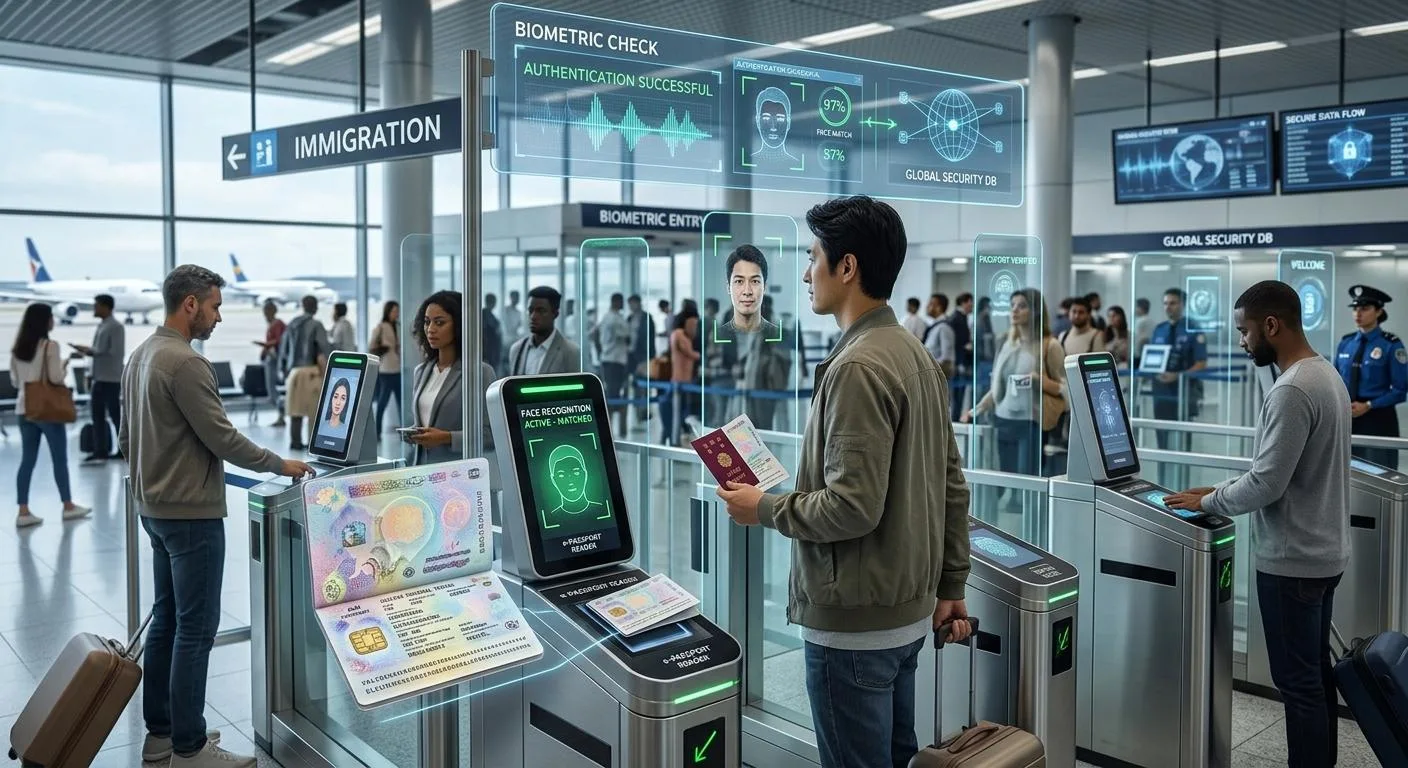
Advanced passport designs, electronic authentication and biometric identity checks are reshaping international border security as governments respond to document fraud with stronger physical safeguards, secure issuance procedures and faster verification systems.
WASHINGTON, DC, November 12, 2026 — Governments are strengthening passport security through advanced materials, electronic authentication, and biometric screening as document counterfeiters continue to challenge international border systems, forcing authorities to improve both the physical protection of travel credentials and the reliability of identity verification.
The international response increasingly recognizes that a convincing passport is not necessarily authentic, while a genuine document may still be misused by an impostor or obtained through fraudulent applications involving inaccurate citizenship records and misleading personal information.
Recent security upgrades in the United States and Japan, combined with new international electronic verification infrastructure introduced in 2026, demonstrate how governments are investing in multiple defenses rather than relying exclusively on security printing or traditional visual inspection.
The central challenge is creating passports that resist unauthorized alteration while remaining practical to authenticate, particularly as international travel expands, older document generations remain valid, and border authorities encounter increasingly varied forms of identity fraud.
Modern Passport Security Requires Multiple Layers of Protection
Contemporary passport security combines specialized materials, advanced printing, electronically protected information and identity verification systems, providing several independent opportunities to examine whether a travel document was legitimately issued and belongs to the person presenting it.
These safeguards address different risks because physical security features can reveal suspicious alterations, electronic authentication can verify protected information and biometric comparisons can help determine whether a passport holder corresponds to an authorized reference image.
No single method independently establishes every aspect of document authenticity, citizenship or admissibility, making layered verification increasingly important as authorities confront counterfeit booklets, stolen genuine passports and fraudulent applications involving otherwise legitimate government production systems.
United States Strengthens Its Next-Generation Passport
The U.S. State Department began issuing its next-generation passport book in 2021, introducing stronger construction and enhanced security features intended to make counterfeiting and unauthorized modification more difficult while supporting reliable examination by foreign border authorities.
According to the State Department’s official explanation of passport security features, the redesigned document incorporates a polycarbonate data page, laser engraving, updated artwork, specialized security fibers, and perforated identification numbers throughout the booklet.
The department also introduced a commemorative version celebrating America’s 250th anniversary in 2026, illustrating how governments can update document artwork while maintaining the underlying security architecture established for the current passport generation.
Earlier American passport books remain valid until their expiration dates, meaning inspection officers must recognize legitimate differences between document generations rather than interpreting every unfamiliar design element as evidence of a counterfeit.
Polycarbonate Identity Pages Make Alteration More Difficult
Polycarbonate identity pages offer advantages over conventional paper-based personalization because protected information can be integrated into durable material structures, making certain forms of portrait substitution and unauthorized alteration harder to carry out without leaving detectable inconsistencies.
Laser engraving lets governments embed photographs and personal details into the document structure, giving trained inspectors multiple features to check when determining whether an identity page matches the correct government-issued design.
However, material sophistication alone does not establish authenticity because counterfeiters may imitate visible characteristics, while legitimate passport generations can contain different materials depending on their issuing authority, production period and official document category.
Japan Centralizes Passport Production to Improve Security
Japan introduced a redesigned passport in March 2025, incorporating polycarbonate identity pages and laser-personalized photographs while moving sensitive production operations into centralized facilities operated through the country’s National Printing Bureau.
As The Japan Times reported when Japan introduced the updated passport, authorities combined strengthened anti-counterfeiting features with revised application procedures, while confirming that existing passports would remain valid until their normal expiration dates.
Centralizing production can support greater consistency in manufacturing, equipment oversight and document personalization, although the effectiveness of such arrangements ultimately depends on appropriate staffing, secure government records and effective controls over authorized issuance.
The Japanese changes show that passport protection involves more than the finished booklet because authorities must also secure the administrative and production processes that establish identity and create official credentials.
Electronic Passport Chips Add Cryptographic Protection
Electronic passports contain contactless chips that store protected identity information, including a digital facial image, allowing compatible inspection equipment to verify data integrity and assess whether an authorized government issuing authority signed the relevant information.
Passive Authentication provides an important safeguard by using trusted digital certificates to determine whether protected passport information originated from a recognized issuer and remained unchanged after personalization, strengthening verification beyond the document’s visible appearance.
Additional electronic security mechanisms may provide protection against particular forms of chip misuse, although the checks available during an inspection depend on the issuing country’s technical specifications and the capabilities of the equipment involved.
A successful electronic reading does not automatically establish that a passport is genuine, since retrieving information from a chip differs from validating its digital signature against the appropriate issuing-authority trust information.
International Passport Verification Receives a Major Upgrade
The International Civil Aviation Organization launched its next-generation Public Key Directory on March 27, 2026, modernizing the international infrastructure participating authorities use to exchange digital certificates for authenticating electronic passports and supported travel credentials.
The upgraded system allows authorized organizations to obtain trusted issuing-authority information, helping compatible inspection equipment determine whether electronically protected travel-document data corresponds to information signed by a recognized government.
Importantly, the directory distributes cryptographic trust information rather than maintaining a universal database of travelers’ passport records, enabling electronic authentication without requiring centralized storage of each individual’s biographical information.
The modernization also creates opportunities for future digital travel credentials and more efficient document verification, although participating governments must maintain compatible systems, appropriate certificate procedures and personnel capable of interpreting authentication results.
Biometric Screening Adds Another Security Layer
Facial recognition and other authorized biometric technologies can complement passport authentication by comparing travelers with trusted reference images, helping officials determine whether someone other than the rightful holder is presenting a genuine travel document.
This capability addresses a key limitation of document examination: stolen passports can contain authentic security printing and valid electronic signatures while still being improperly used during international travel.
However, biometric comparisons can produce uncertain results when reference images are outdated, lighting conditions are unfavorable or technical limitations interfere with matching, requiring professional assessment before authorities reach consequential conclusions about identity fraud.
Border agencies must also address privacy protections, appropriate data retention and procedures for correcting inaccurate identity associations, recognizing that improved technological screening should operate alongside established legal safeguards for travelers.
Physical and Digital Authentication Perform Different Functions
Passport inspectors must distinguish between visual document examination, electronic data authentication and verification of the presenter because these processes evaluate different aspects of security and cannot be treated as interchangeable guarantees.
As explained in Amicus International Consulting’s guide to modern passport security and counterfeit detection, comprehensive examination requires understanding how physical safeguards, electronically protected information and identity comparisons contribute to determining whether a travel credential is authentic.
A passport may show the expected physical characteristics while containing suspicious personal information, just as an electronically authenticated document may require further review when its presenter does not match the recorded identity.
The most dependable inspection procedures therefore evaluate relevant findings together, allowing trained personnel to distinguish confirmed inconsistencies from technical problems with innocent explanations.
Secure Issuance Remains Essential to Passport Integrity
A sophisticated passport can still become problematic when an applicant obtains it through fraudulent supporting evidence, because the finished booklet may contain authentic materials and valid government signatures despite an inaccurate underlying identity record.
Governments must consequently protect birth records, citizenship evidence, application procedures and passport personalization systems, ensuring that official credentials are issued only after the required identity and eligibility information has been appropriately assessed.
Centralized manufacturing, restricted access to production equipment and documented inventory controls can complement these safeguards, although no administrative arrangement independently eliminates the possibility of fraud or misconduct.
The ongoing challenge is protecting the full identity lifecycle rather than focusing only on the visible document, since weaknesses during enrollment can undermine the reliability of even the most advanced passport technology.
Older Valid Passports Present Additional Verification Challenges
Governments introduce redesigned passports gradually, leaving several legitimate document generations in circulation simultaneously, which means officers must understand differences in construction, electronic capabilities and security artwork without assuming that older credentials are automatically suspicious.
A passport issued before the introduction of polycarbonate identification pages may remain perfectly valid, making accurate reference information and training essential when border personnel encounter documents with unfamiliar designs or limited electronic functionality.
Inspection systems also need procedures for damaged booklets and unsuccessful chip readings, because technical problems or ordinary wear alone do not establish that a document was forged or intentionally altered.
Digital Travel Credentials Could Reshape Future Inspections
International organizations and government partners are exploring digital travel credentials that would allow eligible travelers to present authenticated information electronically, potentially supporting advance verification and reducing repeated handling of passport booklets at participating checkpoints.
These emerging systems are different from ordinary smartphone photographs because their intended security depends on protected information, recognized issuing authorities and technical procedures that establish whether the credential corresponds to a legitimate government record.
However, digital travel credentials cannot automatically replace physical passports everywhere, since governments retain responsibility for determining acceptable travel documents and must accommodate people who lack compatible devices or encounter technical difficulties.
International Cooperation Strengthens Counterfeit Detection
Passport security increasingly depends on cooperation among issuing governments, border agencies and international aviation organizations, particularly when foreign officers must authenticate documents produced under unfamiliar national procedures or different technical standards.
Trusted certificate-sharing arrangements and recognized document specifications can support consistent inspection, while international law enforcement cooperation may help authorities investigate suspected identity fraud involving stolen credentials or criminal activity spanning several countries.
These efforts require accurate information and appropriate legal safeguards, ensuring that technical findings and intelligence reports support reliable decisions without unnecessarily exposing legitimate travelers to mistaken allegations arising from incomplete records.
Counterfeit Passport Investigations Extend Beyond Airports
Fraudulent identification can also support financial deception when criminals present counterfeit passports or government-style credentials to organizations that rely on identification documents during account applications and regulated transactions.
The expansion of remote identity verification creates additional challenges because an uploaded image may resemble a genuine passport without possessing the physical protections or authenticated electronic information available through professional document examination.
Financial institutions and other organizations therefore need proportionate verification procedures that reflect their actual technical capabilities, while avoiding claims that an ordinary image review provides the same assurance as official electronic passport authentication.
The Security Race Requires Continuous Investment
The evolving nature of document crime means governments must regularly evaluate passport design, issuance procedures and inspection technology, recognizing that improved physical security can coexist with new risks involving identity theft and fraudulent applications.
International technical standards help authorities respond consistently, but successful implementation also requires equipment maintenance, professional training and clear procedures for resolving uncertain verification results without unnecessarily disrupting legitimate international travel.
Ultimately, strengthening passport security is an ongoing responsibility shared by governments, technology providers, and border agencies, with the strongest protection coming from trustworthy issuance records, sophisticated documents, and coordinated verification systems rather than any single security feature.
Passport Security Must Balance Speed With Accuracy
Airport authorities face pressure to process large passenger volumes while maintaining meaningful document checks, creating a need for verification equipment that delivers dependable results without unnecessary delays for travelers presenting legitimate credentials.
Faster electronic processing can support inspection efficiency, but an automated response should identify what was actually verified, allowing officers to understand whether a result concerns document authenticity, biometric similarity or information retrieved from another system.
The importance of this distinction becomes apparent when a passport chip cannot be read or a facial comparison remains inconclusive, since such outcomes may require additional examination rather than immediate classification as fraud.
Future Passports Will Depend on Trusted Identity Systems
As countries introduce new document generations, authorities will need to strengthen the connections among secure passport production, official identity databases and international verification infrastructure while ensuring that legitimate travelers retain practical access to necessary services.
The continuing competition between security improvements and criminal imitation will therefore be determined not simply by the sophistication of passport materials, but by the reliability of the institutions responsible for issuing and authenticating government credentials.
For international border security, the objective remains a system that makes fraudulent identities harder to establish and genuine documents easier to verify, while protecting personal information and maintaining confidence in lawful global travel.