
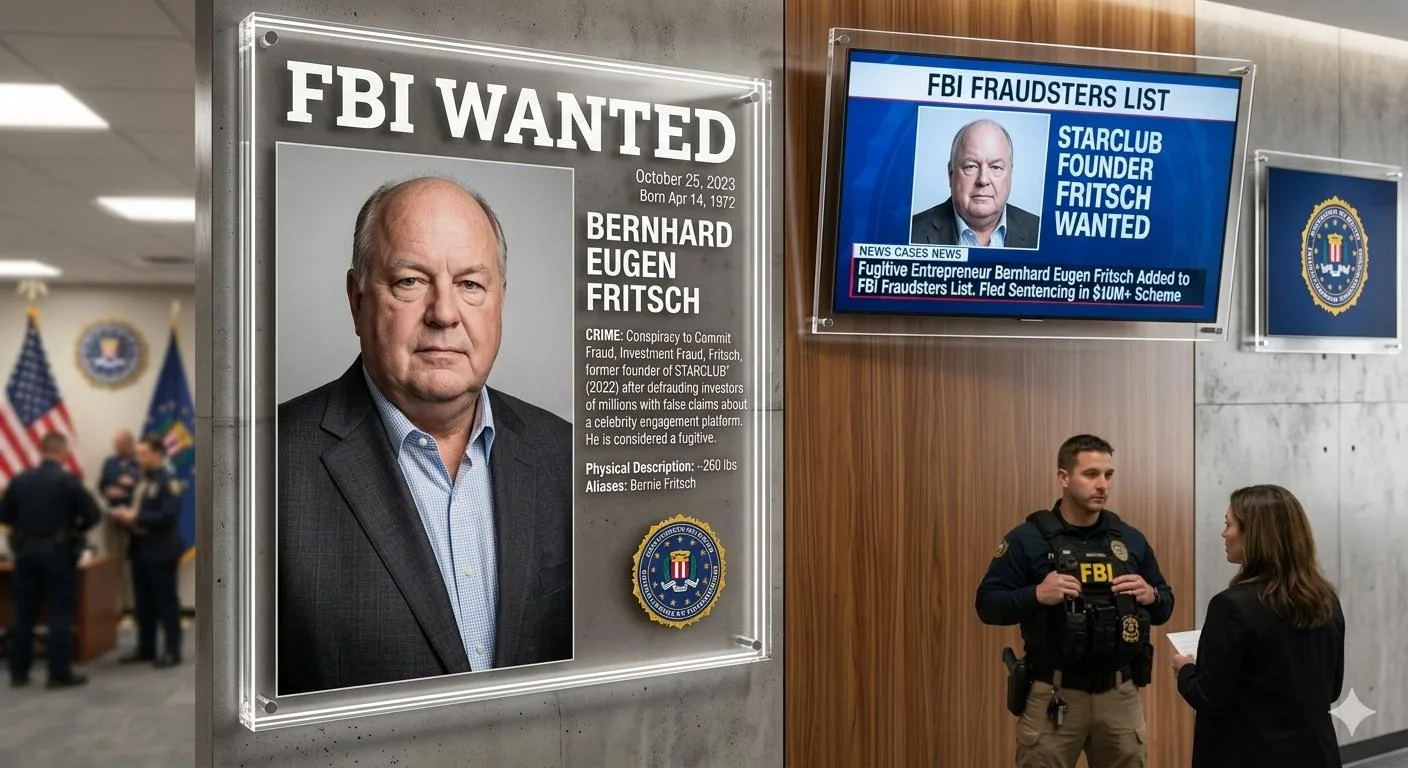
The convicted technology entrepreneur fled before sentencing in an investment fraud case involving false claims about a platform for celebrities and social media influencers, prompting a renewed FBI appeal for information about his whereabouts and eventual apprehension.
WASHINGTON, DC, October 5, 2026
The FBI has added StarClub founder Bernhard Eugen Fritsch to its Most Wanted Fraudsters list, expanding the search for a convicted technology entrepreneur who left the United States before receiving a 15-year federal prison sentence in an investment fraud case.
The September 3 announcement brings fresh attention to a prosecution involving the StarSite application, which Fritsch promoted as a way for celebrities and social media influencers to earn advertising revenue while sharing content with their online audiences.
Fritsch’s wire fraud conviction is already an adjudicated outcome, while the ongoing search concerns his absence after that verdict, making this a case about enforcing an existing criminal judgment as well as locating a person wanted by authorities.
The FBI’s announcement offers up to $150,000 for information leading to his arrest and conviction, and the bureau’s current public listing continues to identify him as wanted, with the materials reviewed showing no confirmed return to American custody.
A Celebrity Platform Anchored the Investment Pitch
StarClub, based in Santa Monica, presented StarSite as technology that linked social media publishing with advertising income, offering investors a business proposition centered on the commercial value of celebrity audiences and the potential to share revenue with well-known users.
According to the Justice Department’s account of the trial, Fritsch raised more than $20 million between 2014 and 2017 while promoting the application, telling investors their money would support technology development, the company’s channels and general corporate activities.
Prosecutors said his representations included a claim that StarClub earned $15 million in revenue in 2015, along with false statements about imminent commercial agreements, prospective investments or acquisition offers involving major media companies, including Disney, and the identity of existing investors.
The case therefore concerned statements about the company’s actual financial position and commercial relationships, rather than simply an ambitious forecast that failed to materialize, a distinction that helps explain why the business became the subject of a criminal prosecution.
The Jury Reached a Mixed Verdict
After a nine-day trial, a Los Angeles federal jury found Fritsch guilty of one wire fraud count in April 2025 and acquitted him on a second count, according to the Justice Department’s announcement.
Both parts of that verdict belong in an accurate account of the case, because the conviction establishes criminal responsibility on the count decided against him while the acquittal prevents describing the trial as a conviction on every charge presented.
At the time of the verdict, Fritsch remained free on bond, leaving a period between the jury’s decision and the anticipated sentencing during which the court still had to address his custody arrangements and determine the punishment.
The distinction between trial and sentencing became especially consequential in this prosecution because he left after the jury decided the fraud count but before the court imposed the prison term authorities now seek to enforce.
Investor Money Financed Personal Spending
The government’s trial account described investor funds being used for expensive personal purchases and improvements, including a McLaren, a Rolls-Royce, work on a yacht and renovations to Fritsch’s Malibu residence near Carbon Beach, rather than the promised business purposes.
Authorities also reported seizing the yacht and both vehicles, identifying tangible assets associated with the financial investigation while leaving their eventual disposition and any distribution of proceeds to be distinguished from the fact that a seizure had occurred.
These purchases matter to the case because they connect the fundraising representations with the subsequent use of money, rather than because owning a luxury vehicle or living in an expensive neighborhood would independently establish fraudulent conduct by an entrepreneur.
For investors, the relevant contrast was between the corporate purposes presented when their money was solicited and the personal spending described in the evidence, a relationship that turns attention from promotional claims toward financial records and actual expenditures.
The Departure Preceded a Bond Hearing
According to the Justice Department’s later account, a hearing on Fritsch’s potential remand into federal custody was scheduled for June 2, 2025, with sentencing to follow, establishing a more precise sequence than describing that date as his sentencing.
The department said Fritsch left the United States for Mexico on June 2 to avoid being taken into custody, while the FBI subsequently described a federal warrant issued after he failed to appear for the post-conviction bond hearing.
That chronology separates three events often compressed in brief accounts of a fugitive case: the jury’s verdict, the missed custody hearing and the later sentence, each carrying a different role in explaining how the prosecution developed.
His departure did not reverse the verdict or transform the case back into an untested accusation, and the subsequent proceedings show that leaving the country did not prevent the sentencing court from taking further action on the existing conviction.
Mexican Detention Was Followed by Travel to Germany
ABC7 Los Angeles reported that Mexican authorities detained Fritsch in September 2025 after finding him with false identification, an episode the FBI described as involving violations of Mexican immigration law rather than a completed return to American custody.
After his release from immigration custody, authorities required him to report to a Mexican immigration court every two weeks, but the FBI said he instead traveled to Munich on October 6, 2025, extending the case’s international dimension.
The sequence establishes a detention, release and subsequent departure as described by authorities, but the public account does not supply a complete explanation of the Mexican proceedings or justify assigning motives to officials responsible for the release.
Immigration detention abroad and the enforcement of an American criminal judgment involve distinct decisions, so the September encounter should not be reported as though it had already secured his transfer to federal court in California.
A Prison Sentence Followed in His Absence
On October 20, 2025, Fritsch was sentenced in absentia to 15 years in federal prison and fined $35,000, with a later order requiring $26,806,901 in restitution, according to the FBI’s account of the proceedings following his departure.
The phrase in absentia identifies the defendant’s absence when the sentence was imposed, while the prison term itself is an existing judicial outcome rather than a maximum punishment that prosecutors merely suggested he could face in the future.
The fine and restitution also serve different purposes within the judgment, and neither amount should be presented as proof that the government has collected the money or that investors have already received payment covering their losses.
Likewise, the restitution figure should not be added to the fundraising totals as though it represented an entirely separate pool of missing money, because those numbers describe different aspects of the same underlying investment fraud and its legal consequences.
An Appeal Was Dismissed Because of Fugitive Status
The Ninth Circuit dismissed Fritsch’s appeal on April 23, 2026, under the fugitive disentitlement doctrine, according to the published docket entry, which granted the government’s motion and declined to proceed with a merits determination while he remained a fugitive.
The order allowed him to seek reinstatement if he surrendered within 120 days, a period the Justice Department described as ending August 21, 2026, making that opportunity a dated condition rather than an indefinitely available promise of renewed review.
The materials reviewed do not establish that he surrendered within that period or that the appeal was reinstated, and his continued FBI listing in September provides the current public enforcement context without resolving every possible future procedural question.
This appellate development illustrates a consequence of remaining absent that extends beyond the outstanding prison sentence, because the court’s response concerned access to review while a defendant was outside custody rather than a fresh evaluation of the trial evidence.
His Partner Admitted Helping Him Avoid Apprehension
Lucinda Jane Weist Manera, also known as Lucy Weist, pleaded guilty on June 29, 2026, to being an accessory after the fact, with prosecutors describing assistance intended to help Fritsch avoid apprehension and punishment after his conviction.
According to the plea account, that assistance included false statements to FBI agents and financial support while he was hiding in Mexico, establishing admitted conduct in a separate prosecution rather than mere speculation arising from their personal relationship.
The Justice Department’s announcement scheduled her sentencing for October 5 and identified a statutory maximum of five years in prison, which describes the potential ceiling announced at that time rather than a sentence already imposed on her.
Her case shows why investigators may examine assistance provided after a conviction, while also requiring a clear distinction between knowing efforts to obstruct apprehension and ordinary relationships that do not, by themselves, establish involvement in criminal conduct.
The Fraudsters List Expands Public Attention
The FBI launched its Most Wanted Fraudsters initiative in June 2026 to seek public help locating people wanted in major financial crime cases, and Fritsch’s September addition brought an established prosecution into that more concentrated publicity effort.
The initiative is separate from the bureau’s traditional Ten Most Wanted Fugitives list, so calling Fritsch one of the FBI’s ten most wanted would incorrectly combine two programs the agency explicitly identifies as distinct.
A publicity designation does not impose a new sentence or replace the outstanding warrant, but it can make the defendant’s identity and the case history more visible to people who may possess information relevant to investigators.
The reward is also conditional, with the bureau stating that it offers up to the advertised amount for qualifying information, rather than promising automatic payment to anyone who submits a photograph, a possible sighting, or an unverified allegation.
Germany Presents a Separate Legal Question
The FBI’s account places Fritsch’s October 2025 arrival in Munich, while the Justice Department’s description of his partner’s plea notes that Germany generally prohibits extradition of its citizens, identifying a legal complication relevant to the international enforcement effort.
That complication should not translate into a claim that the American conviction has disappeared, the prison sentence has been canceled, or the FBI has ended its investigation; none of that follows from the described nationality restriction.
The available materials do not establish a completed German extradition ruling in this case or a timetable for Fritsch’s return, making predictions about a specific foreign proceeding less reliable than the documented facts about his conviction and wanted status.
The key distinction is between locating a person and obtaining lawful custody to enforce a judgment, because knowing a possible country of residence does not, by itself, complete the legal steps required for an international transfer.
The Investment Case Raises Questions About Verification
As a lesson drawn from the trial account, StarClub shows how a fundraising narrative can combine technology, familiar corporate names and celebrity associations in ways that make the accuracy of individual business claims especially important to understanding the transaction.
A statement about revenue concerns money a company says it has earned, while a statement about a possible acquisition concerns an event that may never occur, and presenting either inaccurately can distort an investor’s understanding of the business.
The presence of recognizable names in promotional material also cannot establish what those individuals knew about the company’s finances, whether they invested, or whether they were involved in misconduct, absent evidence addressing their actual relationship with the venture.
Fritsch’s conviction should therefore remain focused on his proven offense and the evidence described by prosecutors, rather than becoming a basis for treating every celebrity, employee, service provider or acquaintance associated with StarClub as responsible for the fraud.
Financial Accountability Extends Beyond Apprehension
Locating Fritsch would be a significant enforcement development, but the investors’ financial position would still depend on available assets, applicable court orders, and actual recoveries, rather than the publicity generated by a wanted notice or eventual arrest.
The record already distinguishes personal property seized during the investigation from the restitution ordered after sentencing, and those separate facts do not establish a complete accounting of what has been liquidated, collected or returned to the affected investors.
Keeping those stages separate helps explain why a prison judgment and financial recovery can advance differently, with one addressing punishment and another addressing the practical task of accounting for money and property connected with the underlying offense.
For readers following the case, a verified recovery announcement would therefore answer a different question from an apprehension announcement, even though both would represent material developments in the effort to enforce consequences arising from the StarClub investment fraud.
Lawful International Planning Requires Accurate Information
For readers researching legitimate citizenship arrangements, Amicus International Consulting’s second-passport information concerns a separate administrative subject, while Fritsch’s case demonstrates why nationality, an outstanding criminal judgment, and the legal process governing international custody must be assessed as distinct matters.
The company’s tax identification information similarly concerns documentation used in international administration, and the sources reviewed do not connect Amicus International Consulting or those services with Fritsch, StarClub, the investment transactions or his departure from the United States.
Neither citizenship documentation nor a tax identification number establishes that a criminal judgment has been resolved, and the reporting reviewed offers no basis for suggesting that Fritsch obtained a second citizenship through an intermediary as part of these events.
The Search Continues After Conviction and Sentencing
The FBI continues to seek information about Fritsch through its established reporting channels, while the next substantive enforcement development would require confirmation of apprehension, surrender or another official action affecting his ability to remain outside American custody.
His addition to the fraudsters list brings renewed public attention to a case that began with investment promises about celebrity technology and now involves an unserved prison term, a substantial restitution order, and the consequences of leaving after conviction.
For the investors and the court, the unresolved issue is no longer whether the charged wire fraud count produced a guilty verdict, but how the resulting judgment and financial obligations will be enforced while Fritsch remains publicly wanted.