
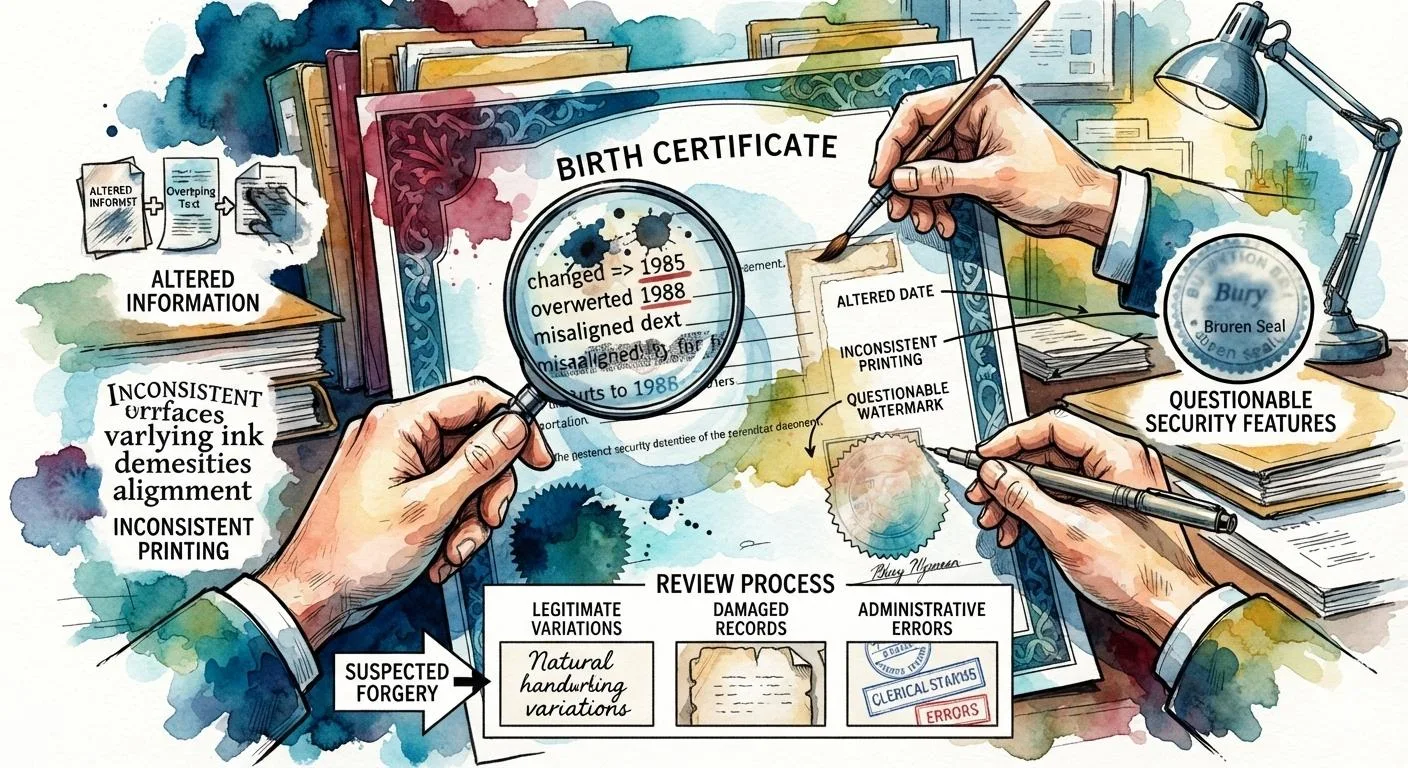
Document examination can reveal altered information, inconsistent printing and questionable security features in birth certificates or naturalization records submitted as citizenship evidence, while further review helps distinguish suspected forgery from legitimate variations, damaged records and administrative errors.
WASHINGTON, DC, October 4, 2026 — Identifying a forged citizenship document requires more than deciding whether a certificate looks official, because passport review must consider the document’s origin, physical characteristics, recorded information, and connection to the individual applying for a travel document.
An unfamiliar design or uneven printing can justify closer examination without proving forgery, while a professionally produced certificate can still contain false information or belong to someone other than the person presenting it as their own.
The challenge is to determine what the evidence supports by combining document review with an assessment of the applicant’s identity and citizenship, rather than treating an isolated visual feature as a conclusive answer about eligibility or intent.
For legitimate applicants, understanding those distinctions helps explain why officials may request additional documentation, particularly when an older certificate, an unexplained correction or an unsuitable copy leaves questions that the original application does not adequately resolve.
Document Authenticity Is Only One Question
A citizenship document must be evaluated according to what it establishes, because verifying that a certificate came from a legitimate issuing authority does not automatically prove that the applicant is the person described in its contents.
A counterfeit certificate, an altered genuine certificate, and an authentic certificate used by an impostor present different evidentiary problems, even though each could appear within an application that falsely claims entitlement to a United States passport.
The first concerns whether the document was genuinely issued, the second concerns whether its contents were improperly changed, and the third concerns whether its presenter owns the identity or citizenship history associated with the record.
Keeping those categories separate matters because the evidence needed to resolve one question may not answer another, making a complete application review broader than the physical inspection of a birth certificate or naturalization document alone.
Passport Review and Forensic Examination Have Different Roles
Historical Government Accountability Office reporting describes passport specialists reviewing citizenship and identity evidence, requesting additional information and referring applications for further examination when concerns remain, demonstrating that initial review and specialized analysis need not be the same activity.
That historical description should not be treated as a current operational manual, but it illustrates why an application can move beyond its initial examination when a question requires additional expertise, evidence or confirmation before officials reach a decision.
Forensic document examination is a distinct discipline, and the Texas Department of Public Safety describes its purpose as examining and comparing documents to assess matters including origin, authenticity, and authorship, rather than relying solely on an examiner’s first visual impression.
That description explains the broader field without establishing that Texas examiners review federal passport applications, or that every passport specialist performs laboratory analysis when assessing the documents submitted by someone seeking a United States travel document.
Altered Information Can Undermine a Genuine Record
An authentic document can become unreliable if someone improperly changes information after issuance, creating a distinction between the legitimacy of the original certificate and the accuracy of the version later presented to a government agency.
At a general level, document examination can consider whether entries appear to have been changed, removed or added, with the significance of any apparent alteration depending on the document’s history and the circumstances under which it was issued.
An examiner must also distinguish an unauthorized modification from a legitimate official correction, because the appearance of changed information does not, by itself, establish who changed it, whether the change was permitted, or whether the underlying information is false.
For applicants, the practical implication is straightforward: address errors in an official record through the responsible authority’s procedures, preserving the distinction between an authorized correction and a private edit made to improve the application.
A Correct Fact Does Not Authorize a Private Edit
Someone may believe that a certificate contains an obvious spelling mistake, but that belief does not make personally editing the document an appropriate substitute for obtaining the correction or supporting evidence required by the issuing authority.
The same concern applies to modifying a digital image before printing it, because the resulting page may no longer faithfully represent the official record even when the person making the change believes the replacement information is accurate.
A truthful explanation should describe the discrepancy and identify the evidence supporting the correct information, allowing officials to evaluate the issue without encountering a document whose contents were privately changed after issuance.
This approach preserves both the record and its history, which can be important when determining whether the problem originated with the issuing office, a later administrative entry or the information supplied in the passport application itself.
Printing Differences Require an Appropriate Comparison
Inconsistent printing can raise questions about how a document was produced, but a meaningful assessment requires an appropriate understanding of the document type rather than comparison with an unrelated certificate or an image found through an informal internet search.
A reviewer considering differences in text, layout or other printed elements must establish whether those differences are unexpected for the relevant document, because appearance becomes useful evidence only when the basis for comparison is itself reliable.
A mismatch with one sample cannot establish forgery if the sample does not represent the same issuing authority or document version, making context necessary before an apparent design difference supports a conclusion about authenticity.
This is also why applicants should avoid attempting their own definitive authentication from photographs online, since a visual comparison may omit the information needed to distinguish an unfamiliar genuine record from a document that was never legitimately issued.
Poor Appearance Does Not Necessarily Mean Counterfeit
Wear, damage or reproduction quality can affect how a document appears, so an unclear or unattractive certificate may present an evidentiary problem without establishing that someone fabricated it or knowingly submitted false citizenship information to obtain a passport.
Conversely, polished presentation does not demonstrate lawful issuance, because the question is whether the document genuinely represents an authoritative record rather than whether its paper, lettering or overall design appears convincing to an untrained observer.
The distinction matters when applicants use intermediaries to obtain records, since professional packaging, elaborate assurances and official-looking presentation should not replace verification that the document came through the legitimate process of the authority responsible for issuing it.
Applicants should focus on obtaining the appropriate official record and following submission instructions, leaving technical conclusions about authenticity to the relevant authorities rather than trying to make a questionable document appear more acceptable through cosmetic changes.
Security Features Must Be Understood in Context
Security features can support document authentication, but their evidentiary value depends on whether they fit the document being examined, not on the assumption that every genuine certificate must display identical protective elements.
The State Department’s citizenship-evidence guidance illustrates this point by noting that some birth certificates have a watermark while others do not, so the absence of that feature is insufficient grounds to declare every such document false.
That example does not provide a universal authentication rule, because meeting a visible requirement is different from establishing that the document was legitimately issued and accurately records the citizenship evidence attributed to its named subject.
A reliable assessment therefore considers the document as a whole and in its proper context, avoiding the mistake of treating one expected feature as proof of authenticity or one unfamiliar feature as proof of forgery.
A Checklist Cannot Replace an Evidentiary Decision
Published application requirements help people identify the documents they need, but satisfying those requirements on the face of a page does not independently resolve questions about its origin, contents or connection to the person applying.
An official seal, for example, has significance because of the issuing authority it represents, so the substantive question is whether the document genuinely comes from that authority rather than whether an image resembling a seal appears somewhere.
The same principle applies to signatures and identifying information, which must be evaluated as parts of an authentic record instead of isolated visual elements that automatically establish citizenship when reproduced together on a document presented for review.
The Issuing Authority Provides Essential Context
A birth certificate and a naturalization certificate involve different official processes, so the issuing authority matters when determining what the document purports to establish and where to direct questions about its contents.
The State Department instructs applicants who need replacement citizenship evidence to obtain it from the issuing office, reinforcing the importance of the official source rather than an independently recreated version of the missing record.
For naturalization and citizenship certificates, USCIS identifies Form N-565 as the application for specific replacement or correction circumstances, with eligibility and supporting requirements depending on the reason the person needs a new document.
An applicant should therefore identify the document and the problem before choosing a correction process, because replacing a missing certificate, correcting an administrative error, and establishing citizenship for the first time are not interchangeable tasks.
A Record’s Origin Matters More Than a Seller’s Assurance
A private service may help with administrative steps, but the resulting document’s significance still depends on the lawful issuing process and the accuracy of the information it records about the individual concerned.
A claim that a certificate is “verified” should therefore be understood in light of what was actually checked, because confirmation of delivery, appearance, or a reference number does not necessarily establish every fact relevant to passport eligibility.
Applicants should ask which government authority issued the document and what official process produced it, and preserve receipts and correspondence that explain legitimate administrative assistance without assuming a private guarantee binds the government reviewing the passport application.
Counterfeit Supporting Records Remain a Document-Security Concern
In July 2026, Global News reported a Quebec police operation against a laboratory producing counterfeit passports and birth certificates, illustrating why supporting records deserve scrutiny alongside the travel documents that applicants ultimately seek from issuing authorities.
That Canadian report does not explain how American passport specialists identified any particular document, but it offers a separate example of why the origin of supporting paperwork matters in discussions of identity and document security.
The broader evidentiary issue is that a false supporting record can present information as officially established when it is not, potentially making later documents appear grounded in a legitimate history that has never actually been demonstrated.
Reviewing the foundation of an application therefore matters even when a genuine government office issues the final document, because lawful production of a passport cannot make false underlying claims accurate after the fact.
Document Review Must Also Establish Who Is Applying
Even a certificate that withstands examination does not independently resolve whether the applicant is its rightful subject, which is why citizenship evidence must be understood alongside identification and the information supplied throughout the passport application process.
A genuine document associated with another person presents an identity-ownership problem, while a counterfeit document presents an authenticity problem, and confusing those categories can obscure the evidence needed to explain what is wrong with the application.
Photographic identification and other application details contribute to that separate inquiry, allowing officials to assess whether the historical record actually belongs to the individual seeking to rely on it as evidence of citizenship or identity.
For legitimate applicants, an unexplained difference between records should be addressed accurately through appropriate documentation, rather than assuming that proving one certificate genuine automatically establishes every connection necessary to support issuance of the requested passport.
Questionable Paperwork Does Not Establish Criminal Intent
An unacceptable document, a suspected forgery and a proven criminal offense describe different findings, so a request for additional evidence should not automatically be characterized as an accusation that the applicant knowingly attempted to deceive passport officials.
The condition of a document alone may not establish who created or changed it, making the applicant’s conduct and knowledge separate questions from whether the paper itself is reliable evidence for the application being evaluated.
An applicant may have received an unsuitable document through a misunderstanding or an intermediary, but that possibility also requires factual examination rather than an automatic assumption that every presenter either knew of a problem or was entirely unaware.
Accurate reporting should identify what authorities have determined, distinguish an unresolved authenticity question from a formal allegation, and preserve the difference between evidence that merits investigation and a conclusion established through the relevant legal process.
Responding to a Request for More Evidence
State Department guidance explains that officials may contact applicants when additional information is necessary, so the appropriate response begins with identifying the specific document or question described in the correspondence rather than guessing why processing has paused.
Applicants should follow the stated instructions and keep copies of their responses, especially when obtaining a replacement record or explaining an official correction that must clearly connect to the information already submitted for review.
If the concern is unclear or involves a complicated citizenship history, official clarification or qualified legal assistance can help identify the relevant evidence, although neither professional advice nor a replacement document can guarantee a particular application outcome.
Lawful Planning Depends on Authentic, Accurate Evidence
Cross-border planning can involve several types of government documentation, making it important to distinguish lawful citizenship eligibility from the possession of papers that merely appear to establish an identity, birthplace or personal history without valid support.
Amicus International Consulting’s second-passport services page discusses citizenship and passport planning, a field in which clients should understand the actual legal basis of eligibility and verify that supporting records come from the appropriate authorities through legitimate procedures.
The same care applies to Amicus International Consulting’s tax identification number services, because an administrative identifier has a defined purpose and cannot independently authenticate a birth certificate, establish naturalization or validate an invented account of someone’s personal history.
For applicants, the strongest preparation is to obtain authentic records, preserve their contents, explain genuine discrepancies, and follow official correction procedures, allowing passport officials to assess both the documents and the truthful identity claims those documents are intended to support.