
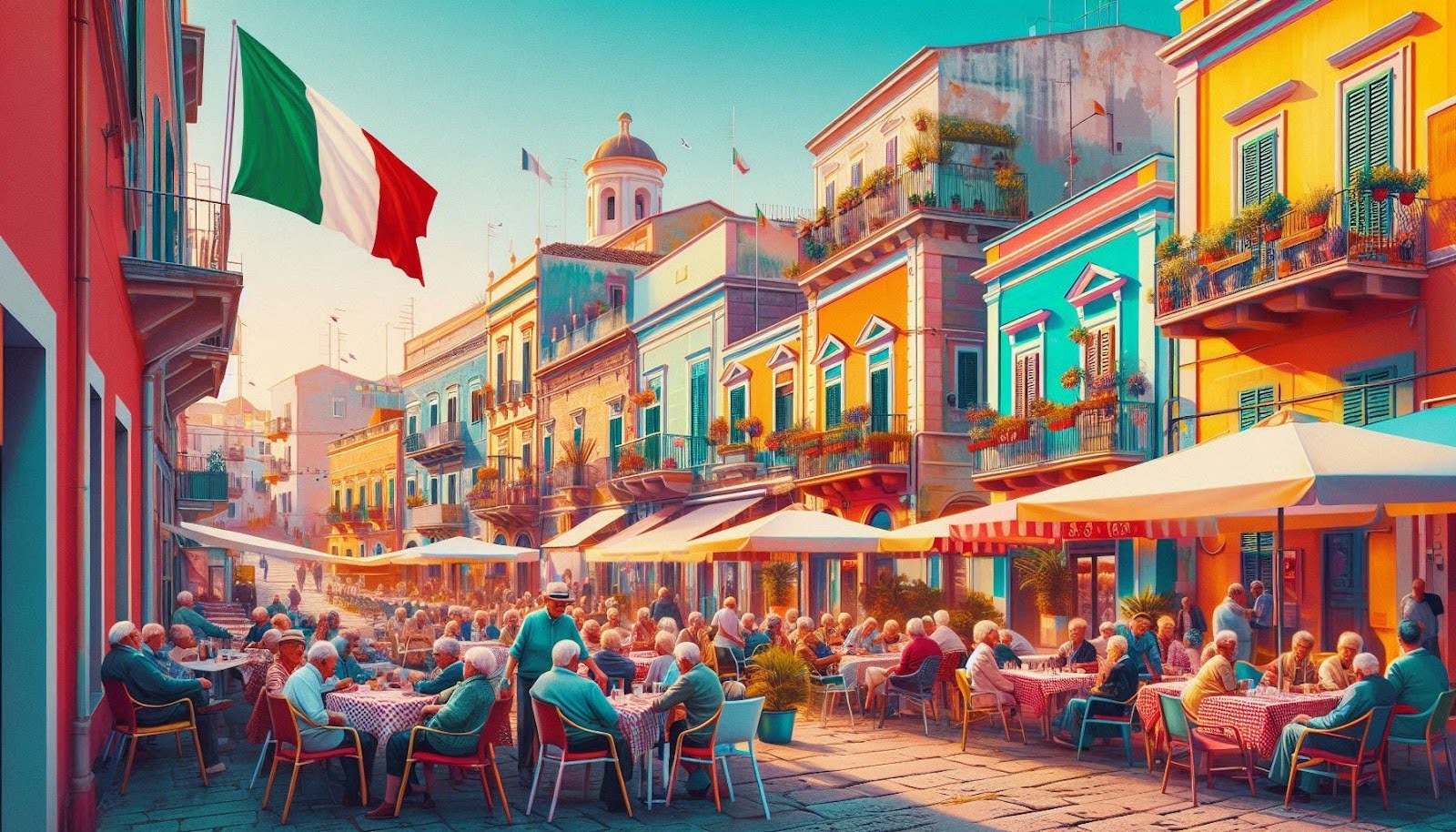
Why affordability, routine, and understated living can feel like a reset, and what paperwork still follows you.
WASHINGTON, DC.
Southern Italy is not where most people go to be “somebody.” It is where you go to be a person again.
That difference matters to retirees and late-career movers who are quietly tired of living in places where every interaction feels transactional, every neighborhood feels optimized, and your identity is constantly mirrored back at you through work, status, and noise. In much of the Mezzogiorno, the south’s broad cultural and economic arc, the social world still revolves around routine. A morning coffee that is actually a ritual. A market that is still a market. A neighbor who asks how you are and expects the answer to take more than five seconds.
For newcomers, that can feel like a reset, not because you are hiding, but because you are no longer the main character. The strongest “privacy” Southern Italy offers is social cover through normalcy. You are one more person walking to the bakery, learning the rhythm, becoming a regular. That kind of invisibility is healthy. It is not secrecy. It is relief.
But Southern Italy is also where romantic retirement fantasies get stress tested by paperwork, infrastructure, and the reality that a calm life abroad still comes with formal obligations. The south can feel slower, warmer, and more forgiving day to day, but the legal and administrative system is still Italy. And Italy, for all its beauty, runs on documents.
Why the south feels like a reset, even when you are not trying to reinvent yourself
Northern Italy can feel brisk and professionally keyed in, especially in the orbit of Milan and the industrial north. The South is different. It is not better in every category, but it offers a lifestyle that can be emotionally easier for people who want to downshift without turning their lives into a project.
Part of that is the pace. In many southern cities and towns, you can still live by the sun instead of by the calendar. The day has shape. There is time for errands to take time. There is room for conversations that are not efficient.
Part of it is cultural continuity. Southern Italy is famously social, but it is also socially structured. There are cues and habits that repeat. When you step into those patterns, you stop standing out. You do not have to be interesting. You just have to be consistent.
And part of it is what retirees rarely say directly: in places where life is less performative, you can stop performing too. If you have spent decades in a role-heavy world, executive, caregiver, high-pressure profession, you might not realize how exhausted you are until you live somewhere that does not demand a persona.
That is the “reset” many newcomers describe. It is not a new identity. It is a quieter version of the same one.
Affordability is real, but it is not a magic trick
Southern Italy can still be more affordable than many parts of North America and much of Western Europe, especially once you step away from the most famous coastal hotspots and second-home enclaves. But affordability is not just rent or purchase price. It is the total cost of running a life.
Some of the savings are straightforward. Daily expenses can be gentler. Eating out can be less punishing. A simple life, walk, coffee, market, park, can feel natural instead of like a budgeting decision.
Some of the costs are less obvious. Older housing stock can mean maintenance. Renovations can take longer than expected. Reliable contractors can be harder to book in smaller towns. A “cheap” apartment can become expensive if it needs constant work.
Affordability, in the south, is best treated as a stability feature, not a bargain hunt. If you can lower your monthly burn rate without downgrading your quality of life, you gain resilience. That resilience is what makes a retirement move feel safe.
Social cover: the underrated reason newcomers blend in
The phrase “social cover” can sound like you are trying to disappear. In Southern Italy, it means something simpler.
In many southern communities, there is an established public life. People do things outside. They repeat routes. They see each other. When you become part of that visible routine, you stop being a novelty.
There is also an important paradox: the South can be more communal, but that does not always translate into intrusive attention. If you behave respectfully and predictably, you can be left alone in the best way. You are acknowledged, but you are not interrogated.
This is why retirees who succeed often prioritize being a regular over being adventurous. They pick one café and go often. They shop locally. They learn basic phrases and use them consistently. They show up at the same time for the same walk. They become familiar without forcing closeness.
It is privacy through belonging, not privacy through avoidance.
The geography that makes slow living workable
Southern Italy is not one place. It is a patchwork of regions with different strengths: Puglia’s white towns and long coast, Sicily’s cities and countryside, Calabria’s dramatic shoreline and interior villages, Basilicata’s rugged quiet, Campania’s intensity and beauty.
The practical way to choose is not by postcard. It is by logistics.
A workable retirement base tends to have:
A walkable daily life
A reliable grocery and pharmacy ecosystem
A train or bus link that actually fits your habits
A regional medical hub within reach
A real year-round community, not a seasonal shell
For many newcomers, the best compromise is a mid-sized southern city or a town within easy reach of one. Bari, Lecce, Palermo, Catania, Salerno, even parts of Naples’ wider orbit if you choose carefully, can offer the services you need while still letting you live in a calmer neighborhood rhythm.
The quiet dream works best when the backup systems are close.
Medical backups: the detail that determines whether you stay
Retirees can tolerate a lot, slower bureaucracy, cultural differences, language frustration, but they do not tolerate feeling medically stranded.
Southern Italy can provide excellent care, but it is uneven by area, and access to specialists and advanced diagnostics often concentrates in larger cities. On the coast and in smaller towns, basic care may be straightforward, while more complex needs can require travel.
The retirees who thrive often build a hub-and-spoke plan without calling it that. They live in a calmer town, but they keep a clear relationship with a larger city for:
specialist care
major imaging and diagnostics
hospital networks for emergencies
administrative tasks that are easier in bigger centers
This is not pessimism. It is maturity. A calm retirement is not one where nothing goes wrong. It is one where you have already decided what you will do when something does.
The paperwork that still follows you, even in paradise
Here is the part many people want to skip. You cannot.
Even if your day-to-day life becomes simple, your legal life does not. Italy requires structure, and the structure touches everything from housing to banking to health care.
Newcomers typically deal with a chain of steps that can include visa documentation, residence registration, and local identifiers that become essential for basic tasks. One of the most practical examples is the Italian tax identification number, the codice fiscale. You will run into it when you try to sign a lease, set up utilities, access services, or engage with official systems. Italy’s revenue agency lays out how foreign citizens can obtain it through its official guidance on the tax identification number for foreign citizens.
The deeper point is not the number itself. It is what it represents: Italy wants you legible in the system.
That can feel like friction at first. But for retirees seeking stability, it is also what makes life predictable once you are inside the framework. When your paperwork is clean, the country becomes easier to live in.
A reset does not cancel your old obligations
Many newcomers underestimate how much “paperwork follows you” across borders.
If you are American, you carry ongoing tax filing obligations. If you have pensions, investment accounts, or property income, your financial life will be reviewed through multiple lenses: bank compliance, tax residency rules, and sometimes reporting regimes that feel tedious until they become urgent.
If you are Canadian, your exit and non-residency planning may matter depending on the nature of your income and ties. If you keep a home, keep substantial financial relationships, or travel back frequently, you may need a clear position on what your move means.
Italy adds its own layer: once you are resident, it expects you to behave like a resident. That can mean registering, documenting, and planning around timelines that do not care about your personal schedule.
This is why the phrase “low drama retirement” should include the legal and financial side. The calm life is built by making sure the boring parts do not explode.
The South’s future is shifting, and retirees should notice
Southern Italy has long been framed as under-resourced or left behind. That narrative is changing in parts of the south, and it matters for retirees because services follow economic trajectories.
When the south stabilizes, you often see improvements that directly affect quality of life: better internal mobility, better public service continuity, and more year-round economic life that supports local businesses and professionals. Reuters explored this theme in reporting on how the historically poorer south has been seeing signs of a brighter future as some workers return and conditions shift in certain areas, a context that helps explain why some towns are feeling more livable and resilient than they did in prior decades, as described in this Reuters report.
The retiree takeaway is not that every town is suddenly booming. It is that you should evaluate a place as it is now, not as it was ten years ago, and not as a stereotype. Some towns are hollowing out. Some are quietly strengthening. You can often feel the difference by spending time there in winter, not just in high season.
Understated living is a skill, and the South rewards it
Southern Italy is not a place where you win by being loud.
Retirees who build the calmest lives tend to adopt a few habits quickly:
They choose residential neighborhoods over tourist corridors.
They keep their routines simple and repeatable.
They show respect for local rhythms, meal times, noise norms, and community expectations.
They learn enough Italian to reduce daily friction, even if they will never be fluent.
They avoid turning every inconvenience into a dramatic story.
This is not about blending in for its own sake. It is about lowering the temperature of your life.
In a place where people already value daily continuity, understated living earns your space. You do not have to explain yourself constantly. You can be present without being scrutinized.
Where professional guidance actually helps, without turning retirement into a corporate project
Some retirees enjoy doing everything themselves. Others want to enjoy the move and minimize risk.
The places where professional support tends to have real value are not the romantic parts. They are the compliance and sequencing parts, documentation flow, identifiers, banking readiness, and the cross border coherence that keeps your life stable.
AMICUS INTERNATIONAL CONSULTING often frames this as documentation hygiene, making sure the identifiers and records you need for real life abroad are established properly and remain consistent across jurisdictions, a focus reflected in its overview of tax identification number planning. The point is not to complicate your life. It is to prevent preventable problems, the kind that turn a peaceful retirement into an administrative firefight.
If you are moving to the south for calm, it makes sense to protect the calm.
The bottom line
Southern Italy can feel like a reset because it offers a slower pace and a kind of social cover that comes from routine life, not from hiding. You can live quietly in public. You can be one more person at the café, one more walker on the evening street, one more neighbor learning the rhythm.
But the serenity only holds if you respect what still follows you: residency structure, local identifiers, banking compliance, and the reality that your former life does not vanish just because your new view includes olive trees and sea light.
The best southern Italy retirements are not the ones built on fantasy. They are built on ordinary days, clean paperwork, and a location choice that puts medical depth within reach. Do that, and the south gives you what you came for, not a dramatic reinvention, just a quieter life that finally feels like yours.