
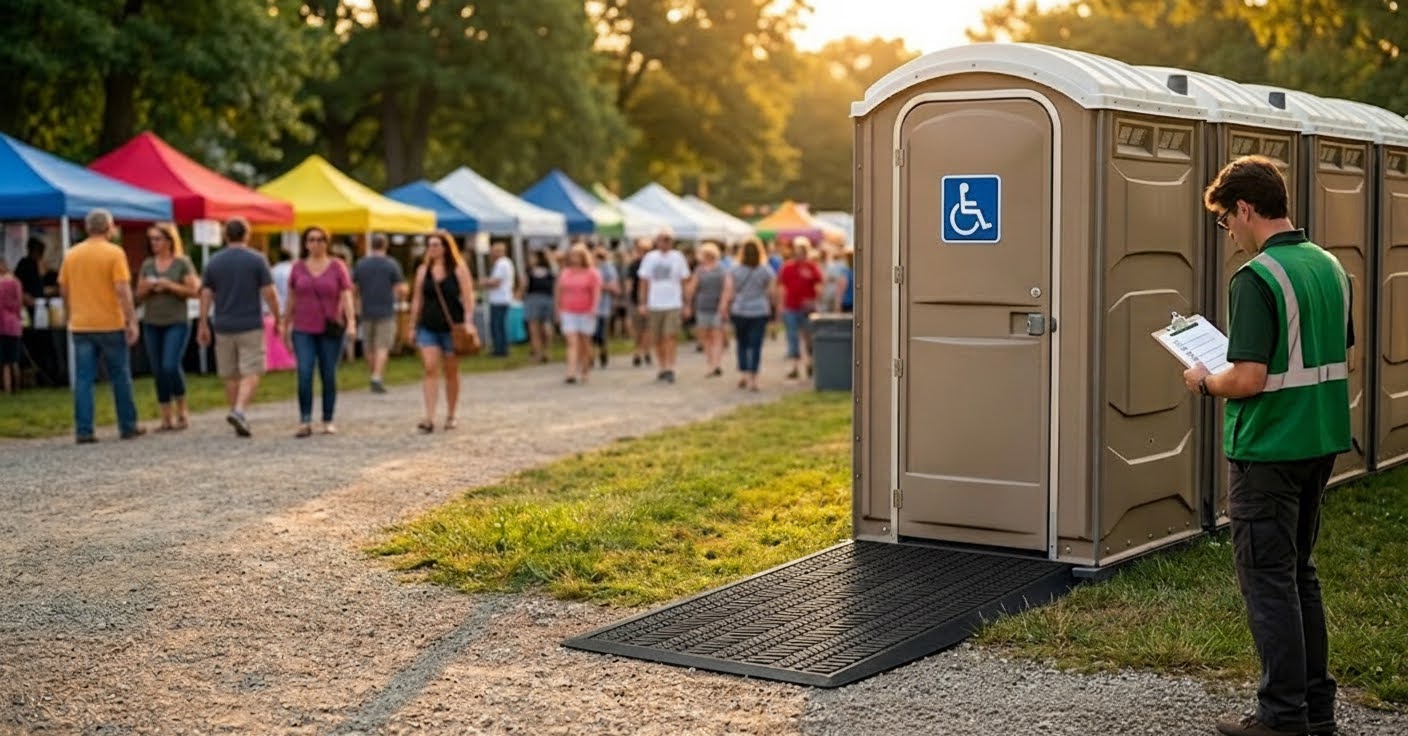
A practical guide for event planners and site managers who want fewer complaints, fewer delays, and cleaner operations
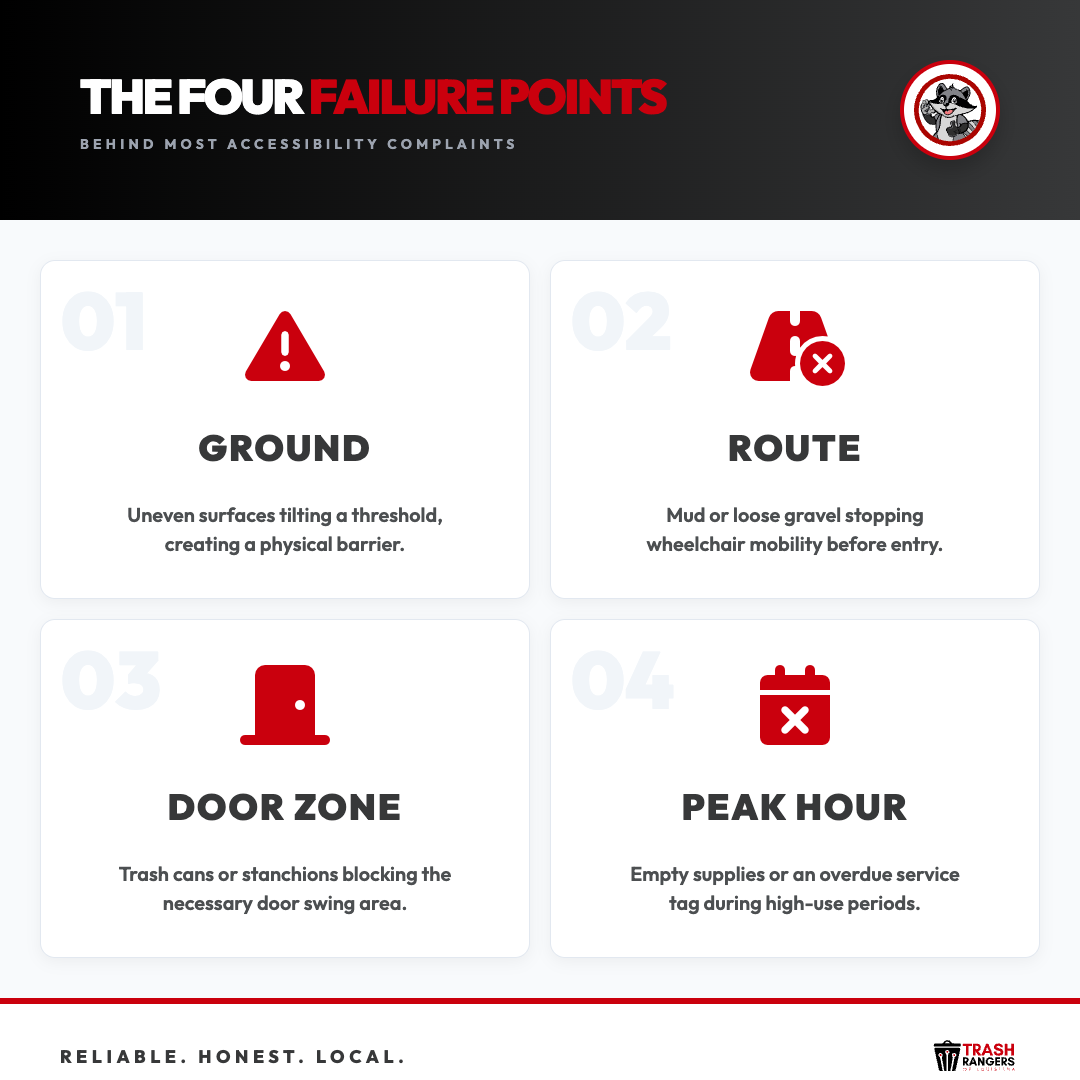
Temporary restroom accessibility breaks down in the same predictable ways: unstable ground, a poor approach route, blocked door space, and no plan for peak-hour servicing. The label on the unit does not fix any of that. Layout and operations fix it.
Planners keep getting sold the same comforting idea: order an “ADA-ready” portable toilet, and the access problem is taken care of. In real deployments, that mindset creates the worst outcomes. People end up searching. Lines form in the wrong places. A unit gets blocked by barriers or sits on churned ground. Then staff scrambles to solve a problem that should have been solved on a map.
What “ADA ready” can mean, and why it is not enough
In the U.S., accessibility planning often references the 2010 ADA Standards for Accessible Design. Even though the standards are written for built elements, the usability concepts translate well to temporary environments because they focus on what a person needs to do in the space: enter, turn, position, transfer, and exit.
The U.S. Access Board guidance helps translate that into restroom decisions with practical emphasis on turning space and door maneuvering clearances. If you want the quick reality check, read the Access Board toilet room guide here: ADA guide for toilet rooms and portable units.
Here is the part vendors rarely say out loud: a well-designed portable unit can still fail your event if the route and placement do. That is why temporary restroom accessibility is a logistics problem first.
The four failure points that cause most accessibility complaints
- Ground: Uneven ground tilts thresholds and floors. That makes entry and transfers riskier and slower.
- Route: A wheelchair does not move across loose gravel or churned grass like a boot. Mud and slope turn “accessible” into “not happening.”
- Door zone: The unit can be perfect inside, yet fail because there is no clear space in front of the door, or fencing, stanchions, or trash cans block the swing.
- Peak hour conditions: A unit that is out of supplies or degraded by traffic becomes less usable. Service frequency becomes an access variable.
The layout first checklist planners should use
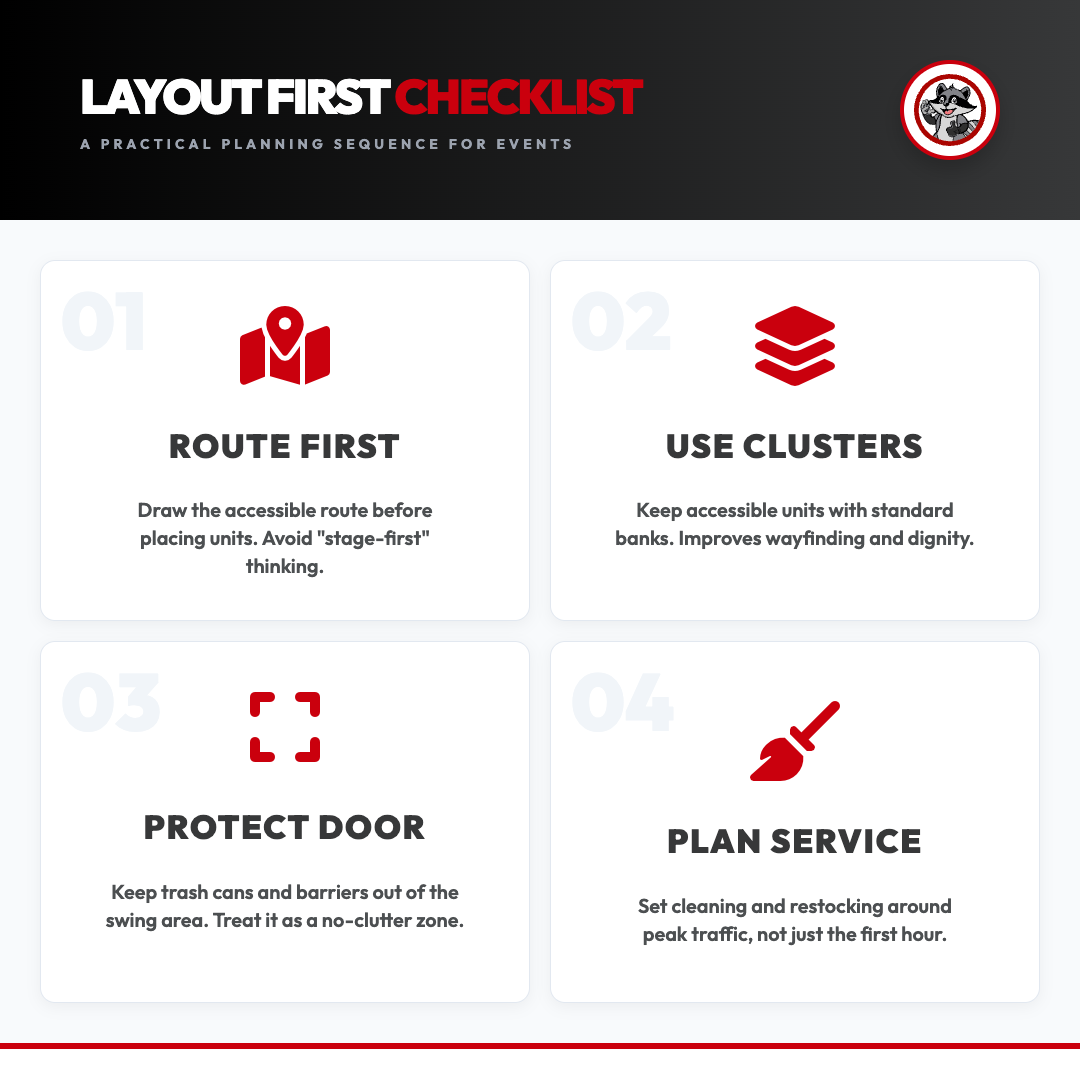
Use this sequence. It is boring. It works. It saves you from event day chaos.
For a quick, plain language reality check on the gap between marketing and field performance, read What “ADA Ready” Actually Means for Temporary Restrooms. It reinforces the same point this checklist is built around: placement and the approach route decide usability.
Step 1: Draw the route before you place the restrooms
Start with the accessible route to the restroom bank. Do not start with “put it near the stage.” Choose stable surfaces. If you use temporary mats, secure the edges to prevent them from becoming barriers. Place signs at decision points, not at the destination.
If you want a practical, temporary event planning reference that treats access as a system, the ADA National Network guide, Planning guide for accessible temporary event, is worth keeping on hand.
Step 2: Use clusters, not isolated placements
Portable restrooms usually arrive in banks. Keep the accessible unit in the same bank as standard units. That improves wayfinding and dignity. It also makes servicing easier. Isolated placements get forgotten, blocked, or turned into storage.
Step 3: Protect the door zone
The most common unforced error is placing the unit where the door opens into a squeezed corridor created by fencing or queue rails. Leave clear space in front of the door. Keep trash cans and barriers out of the swing area. Treat the door zone like a no-clutter area.
Step 4: Plan for the afternoon, not the first hour
If you want temporary restroom accessibility to remain true all day, include service expectations in the vendor scope. Set cleaning and restock intervals around peak traffic. Require a rapid response plan. A unit that becomes unsanitary or runs out of supplies becomes less usable, and the burden lands hardest on the people who need more time and space.
Baton Rouge signal: vendors are selling features, planners must demand outcomes
In February 2026, Baton Rouge-based provider Trash Rangers announced ADA-compliant portable toilet rentals aimed at event organizers, contractors, and site managers. The features described are the ones planners want to see: step-free entry, a reinforced flat floor, interior space for maneuvering, and heavy-duty handrails, paired with local delivery and scheduled maintenance.
Features matter. Outcomes matter more. The way you get outcomes is simple: place units on stable ground, protect the route, protect the door zone, and plan service intervals that match real crowd demand.
The takeaway: stop buying labels, start buying deployment plans
Temporary restroom accessibility is not a product spec. It is a deployment plan. If you treat it that way, you get smoother crowd flow, fewer complaints, and fewer staff interventions. If you treat it like a checkbox, you buy yourself a preventable mess.