
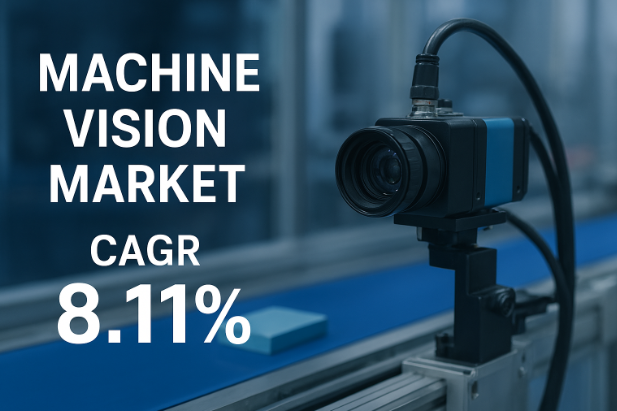
The Machine Vision Market is rapidly evolving as industries worldwide shift toward automation, precision manufacturing, and digital transformation. With the integration of artificial intelligence (AI), deep learning, and robotics, machine vision systems are becoming more intelligent and capable of performing complex inspection, identification, and guidance tasks. These systems, consisting of cameras, sensors, software, and processors, enable machines to “see” and make data-driven decisions with minimal human intervention. From automotive production lines to healthcare diagnostics and agricultural sorting, machine vision is redefining the boundaries of accuracy and productivity across sectors.
Machine Vision Market Size and Growth Forecast
As per the SNS Insider, the Machine Vision Market Size was estimated at USD 12.75 billion in 2024 and is projected to reach USD 23.78 billion by 2032, expanding at a CAGR of 8.11% from 2025 to 2032. This remarkable growth is driven by the accelerating demand for automation and quality control in manufacturing and logistics. Companies are increasingly deploying machine vision systems to enhance product inspection, reduce human error, and improve operational efficiency. The rising adoption of smart cameras, embedded vision, and AI-based algorithms is expected to further boost market expansion during the forecast period.
Leading Machine Vision Companies are:
Cognex Corporation, Basler AG, Texas Instruments, ViDi Systems SA, Sick AG, KUKA Robotics, LMI Technologies, MVTec Software GmbH, FLIR Systems, Microchip Technology Inc., Omron Corporation, Keyence Corporation, National Instruments, Sony Corporation, Teledyne Technologies, Advanced Illumination, SensoPart Industriesensorik, Allied Vision Technologies, Universal Robots, Intel Corporation.
Key Drivers Fueling Machine Vision Market Growth
Several key factors are propelling the growth of the Machine Vision Market. Firstly, the surge in industrial automation across sectors such as automotive, electronics, packaging, and pharmaceuticals is a primary driver. Manufacturers rely on machine vision for defect detection, alignment verification, and assembly validation to ensure precision and consistency. Secondly, the integration of AI and deep learning has significantly enhanced the analytical capabilities of vision systems, enabling them to handle complex recognition tasks like facial detection, object tracking, and pattern recognition. Moreover, the rise of smart factories and Industry 4.0 initiatives has spurred adoption, as machine vision systems play a critical role in predictive maintenance and real-time process monitoring.
Technological Advancements Shaping the Machine Vision Market
Technological innovation is transforming the Machine Vision Market landscape. Advances in 3D imaging, hyperspectral imaging, and edge computing are enabling faster and more accurate data processing. 3D vision systems are becoming essential in applications where depth perception and spatial accuracy are required, such as robotics and autonomous vehicles. Meanwhile, hyperspectral imaging allows for the detailed analysis of materials beyond the visible spectrum, proving valuable in food inspection, pharmaceuticals, and agriculture. Additionally, the miniaturization of cameras and the availability of low-cost image sensors are making machine vision solutions more affordable and accessible for small and medium-sized enterprises (SMEs).
Machine Vision Market Applications Across Industries
The versatility of machine vision technology makes it applicable to a wide range of industries. In the automotive sector, it is used for inspecting welds, detecting assembly defects, and verifying part alignment. The electronics and semiconductor industry deploys machine vision systems for wafer inspection, component placement, and solder joint analysis. In pharmaceuticals and healthcare, machine vision ensures product integrity, packaging accuracy, and patient safety. Even in agriculture, machine vision is used for crop inspection, sorting, and yield optimization. The technology’s ability to enhance accuracy, reduce waste, and speed up production processes continues to attract global investments.
Regional Insights: Machine Vision Market Trends by Geography
The Machine Vision Market demonstrates strong regional growth patterns worldwide. North America leads in technological innovation due to the early adoption of automation and AI technologies across industries. The United States is a major contributor, driven by advancements in robotics, automotive manufacturing, and semiconductor production. Europe follows closely, with Germany, the UK, and France investing heavily in industrial automation under their smart manufacturing policies. Meanwhile, Asia-Pacific is the fastest-growing region, fueled by the massive manufacturing bases in China, Japan, South Korea, and India. Increasing government initiatives to digitize factories and enhance productivity are accelerating market expansion in this region. Additionally, emerging economies in Southeast Asia are rapidly integrating vision-based automation to compete in global supply chains.
Challenges and Opportunities in the Machine Vision Market
Despite its strong growth prospects, the Machine Vision Market faces certain challenges. High implementation costs, complex system integration, and the need for specialized expertise can limit adoption among smaller enterprises. Furthermore, maintaining consistent performance under varying environmental conditions such as lighting, vibration, and temperature remains a technical challenge. However, these obstacles also present new opportunities for innovation. The development of plug-and-play systems, user-friendly software, and AI-driven adaptive vision solutions can significantly reduce barriers to entry. The growing emphasis on sustainability and energy efficiency also offers a path for machine vision developers to create greener, more efficient solutions that align with global ESG goals.
Future Outlook of the Machine Vision Market
The future of the Machine Vision Market looks promising as AI, IoT, and robotics continue to converge. The rise of edge AI—processing data locally within vision devices—will enable faster, real-time decision-making, critical for autonomous systems and robotics. Moreover, cloud-based vision analytics and predictive maintenance will enhance performance tracking and quality assurance in industries. As manufacturing environments become increasingly intelligent and connected, machine vision will remain a cornerstone technology driving automation, safety, and innovation worldwide.
Frequently Asked Questions (FAQs)
Q1. What is the CAGR of the Machine Vision Market during 2025–2032?
The Machine Vision Market is projected to grow at a CAGR of 8.11% from 2025 to 2032, reflecting strong momentum driven by automation, AI integration, and industrial innovation.
Q2. What is the forecast period and expected market size of the Machine Vision Market?
The forecast period spans 2025 to 2032, with the market expected to reach USD 23.78 billion by 2032, up from USD 12.75 billion in 2024, showcasing robust global adoption.
Q3. Which region is witnessing the fastest growth in the Machine Vision Market?
The Asia-Pacific region is experiencing the fastest growth, driven by extensive manufacturing activity, government-led digital transformation initiatives, and increasing investments in industrial automation.