
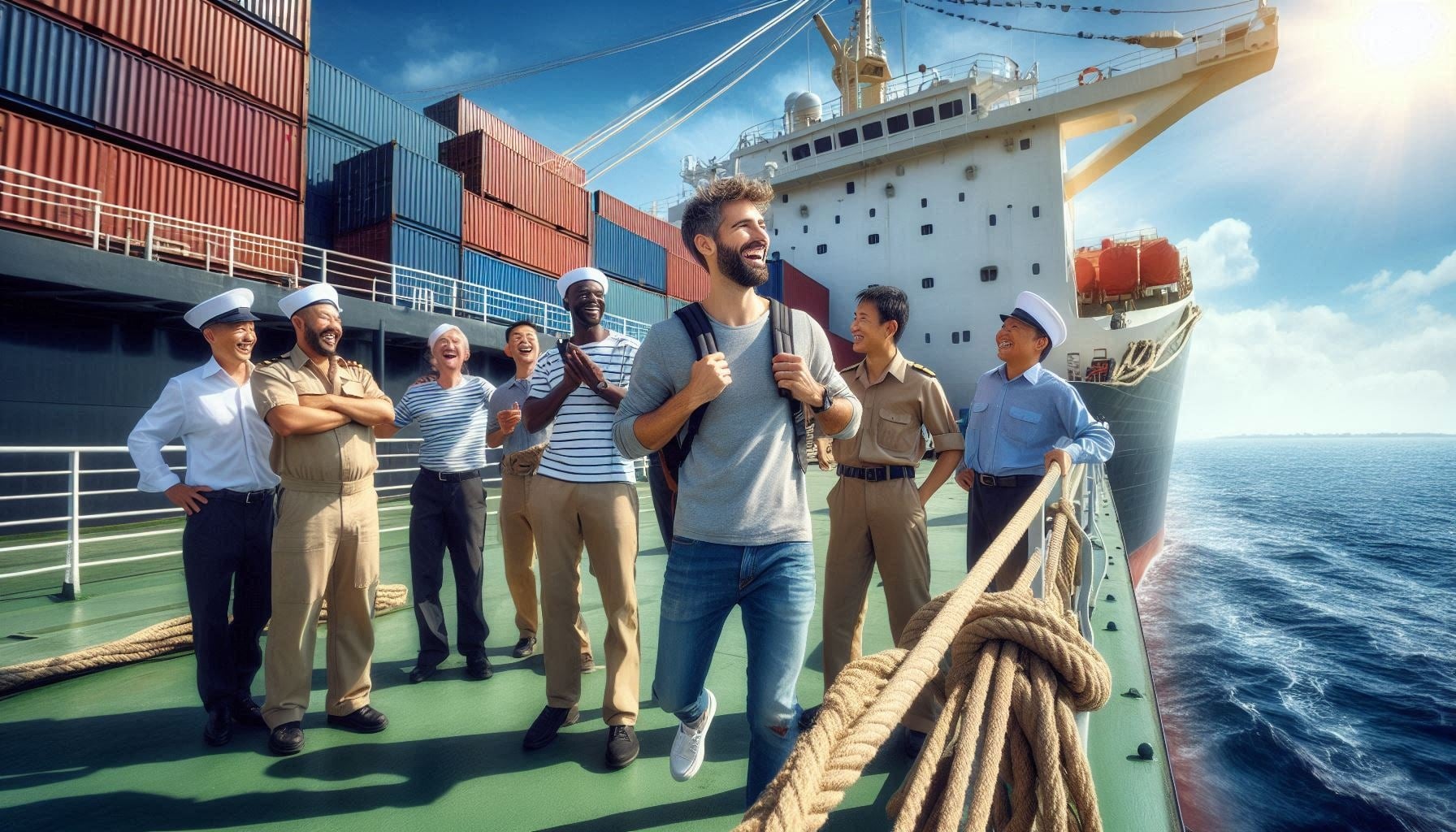
Barbecues, bridge tours and shared moments can turn a cargo ship voyage into a small floating community, provided passengers understand respect, boundaries and the working nature of life at sea.
WASHINGTON, DC, Freighter travel is often described in terms of silence, solitude, and slow horizons, yet one of its most surprising pleasures is the small shipboard community that can form among passengers, officers, and crew during long days at sea.
A cargo ship creates community because there are so few people aboard.
Unlike cruise ships, where thousands of passengers can move through restaurants, theatres, pools and shopping decks without ever learning one another’s names, freighter voyages often create intimacy because the human circle is small, practical and repeated.
A passenger may see the same faces at breakfast, lunch, dinner, deck walks, permitted bridge visits, and quiet conversations near the rail, which allows familiarity to form slowly without the forced enthusiasm of organized tourism.
That small scale changes the emotional experience of travel because social contact feels less like networking or entertainment and more like ordinary human recognition inside a contained maritime environment.
The result can be a rare balance between solitude and connection, in which a traveler spends long hours alone with the sea yet still briefly belongs to a recognizable community aboard the vessel.
For people tired of crowded tourism, that balance is powerful because the ship offers privacy without total isolation and companionship without the noise of mass travel.
The mess room often becomes the heart of social life.
The mess room is usually the most important shared space because meals create a recurring rhythm in which passengers, officers, and sometimes crew members gather around practical food, fixed timing, and the ordinary structure of shipboard life.
The setting is not theatrical, because there are no formal dining costumes, staged service rituals or endless menu choices designed to make the passenger feel like the center of the voyage.
Instead, the meal becomes valuable because it is simple, repeated and real, allowing conversation to develop naturally around weather, route changes, port calls, cargo operations, and life at sea.
A traveler who listens carefully may learn more about global trade, crew sacrifice and maritime discipline over one practical dinner than from several days of polished shore excursions.
That social rhythm is one reason freighter travel can feel more human than more luxurious forms of travel, because the shared table reflects working life rather than passenger spectacle.
The crew’s friendliness should never be mistaken for leisure duty.
Freighter passengers often remember warm conversations with captains, officers, stewards, engineers, cadets, and deck crew, but those interactions happen inside a workplace where safety, navigation, machinery, and cargo remain the priority.
A respectful passenger understands that crew members are not entertainers, guides or hospitality staff assigned to deliver emotional value, even when they are generous with stories, advice or informal shipboard kindness.
That distinction matters because the crew may be working through watches, inspections, maintenance, port preparations, weather decisions, and long periods away from family, while the passenger is experiencing the same voyage as a time for rest or discovery.
The best social moments arise when passengers respect timing, avoid intrusive questions, follow rules, and allow conversations to happen naturally rather than demanding access or attention.
A cargo ship can become friendly, but it remains a disciplined environment, and the strongest shipboard relationships begin with the passenger understanding that work comes before sociability.
Bridge tours can become unforgettable because they reveal responsibility.
A bridge visit, when permitted by the captain and conditions, can become one of the most memorable social moments of a freighter voyage because it shows passengers the careful attention behind what might otherwise feel like effortless movement.
The passenger may see charts, radar, communications equipment, route planning, weather monitoring, and officers maintaining watch with a calm seriousness that transforms the ocean from scenery into a managed operating environment.
The experience is often less dramatic than outsiders imagine, yet that quiet professionalism is precisely what makes it impressive because safety depends on constant vigilance rather than cinematic excitement.
A bridge tour also creates an unusual educational exchange, where the passenger begins to understand how the ship’s route, speed, fuel, traffic, port timing, and weather decisions connect to the larger logistics system.
When handled respectfully, the bridge visit becomes a shared moment of trust, because the passenger is allowed into a space where the ship’s responsibility is most visible.
Barbecues at sea become memorable because they are simple.
On some voyages, the crew may organize a barbecue, a shared meal, or an informal gathering when weather, schedule, and workload allow, creating a moment that passengers often remember long after the crossing ends.
The pleasure is not elaborate hospitality, because the event may be modest, practical and dependent on shipboard conditions, but the setting gives it emotional force.
Eating outside at sea, surrounded by containers, crew members, wind, and horizon, can feel more meaningful than a formal dinner because the moment belongs to the ship’s real life rather than a tourism script.
These gatherings can soften the boundaries between passengers and crew without erasing them, allowing people to share stories, laughter, and ordinary warmth aboard a vessel that usually operates on a disciplined routine.
A barbecue aboard a freighter is memorable precisely because it is not guaranteed, not staged, and not part of a package designed to make travelers feel entertained.
Fellow passengers can become temporary companions in slowness.
Because freighter voyages carry few passengers, the social relationships among travelers can become surprisingly important, especially during long sea days when everyone is adjusting to the quiet, limited connectivity, and the ship’s slower pace.
Passengers may include retirees, writers, researchers, maritime enthusiasts, privacy-minded professionals, slow travelers, relocation clients, or people recovering from burnout who have chosen the freighter for reasons that ordinary tourists may not understand.
The shared decision to travel slowly creates an immediate point of recognition because everyone aboard has accepted uncertainty, limited entertainment, practical comfort, and a journey governed by cargo rather than convenience.
Conversations can become deeper than expected because the setting strips away many of the usual distractions, leaving people time to explain why they chose the sea over another flight.
The result is a temporary community built not on constant activity but on shared patience, repeated meals, and the strange intimacy of crossing distance together.
The social fabric depends on respecting private space.
Freighter travel appeals to people who often value quiet, reflection and privacy, which means shipboard sociability works best when passengers understand that companionship should never become intrusion.
A person may enjoy dinner conversation but still want long hours alone in the cabin, on deck or in a permitted quiet area where the sea can do its private work.
This balance requires sensitivity because a small ship can make people highly visible to one another, and the absence of crowds can intensify both connection and the need for boundaries.
Passengers should avoid assuming that shared travel means constant availability, especially when fellow travelers may be using the voyage for grief, recovery, writing, relocation, reflection, or personal transition.
The healthiest freighter community is one where people can be warmly recognized without being socially trapped, giving everyone room to move between solitude and contact.
Shipboard hierarchy shapes every social interaction.
A freighter is not a casual hostel or a small expedition cruise because the vessel operates under hierarchy, responsibility, and maritime discipline that passengers must understand before interpreting social cues.
The captain bears ultimate responsibility for the ship; officers manage navigation and operations; engineers maintain the machinery; and crew members handle practical tasks that keep the vessel safe and functional.
This hierarchy does not prevent warmth, but it does define when conversations happen, which spaces are available, and how passengers should behave around operational areas.
A passenger who respects hierarchy will be welcomed more easily than someone who treats the ship like a floating guesthouse where every door, deck, or conversation is available on demand.
The social side of the sea depends on humility because the passenger is entering an organized professional world, not a leisure environment built around personal preference.
The ship creates conversations that ordinary travel rarely allows.
Air travel compresses strangers into proximity without meaningful contact, while cruise travel often surrounds passengers with entertainment that reduces the need for genuine conversation.
Freighter travel creates a different space because the limited number of people, long days and shared routine allow conversations to unfold slowly, often without agenda or performance.
Passengers may hear about seafaring families, training routes, weather stories, port experiences, career paths, loneliness, global trade disruptions, and the emotional reality of working for months away from home.
Those conversations can change how travelers understand the objects they buy, the ports they pass, and the hidden labor that keeps consumer life moving across the world.
The social gift of a freighter voyage is that it turns global logistics into human stories, connecting the passenger not only to the sea but to the people who live by its demands.
Cultural exchange happens quietly aboard multinational crews.
Many cargo vessels operate with multinational crews, which means passengers may encounter a small but complex social world shaped by different languages, religions, food traditions, maritime training systems, and family obligations.
This quiet multicultural environment can be more educational than formal tourism because the exchange occurs through ordinary shipboard life rather than curated cultural programming.
A passenger may learn how crew members manage long contracts, send money home, celebrate holidays at sea, maintain friendships across routes, or preserve dignity inside a demanding global industry.
The lesson is not romantic, because seafaring can involve loneliness, fatigue, and sacrifice, but it is deeply human for travelers willing to listen without turning crew life into exotic content.
The freighter becomes a small floating workplace where globalization is not an abstract economic concept but a lived experience shared by people from different countries under a single operational rhythm.
Social life changes when the internet fades.
Limited connectivity can make shipboard relationships feel more present because passengers are less able to disappear into phones, feeds, streaming platforms, or constant remote obligations.
At first, that reduction may feel uncomfortable because modern travelers often use devices to manage boredom, avoid awkwardness, or maintain emotional distance in unfamiliar environments.
After several days, the absence of constant digital escape can make small conversations feel more vivid because people begin to notice voices, routines, gestures, and shared silences with unusual attention.
A simple chat after dinner, a quiet exchange on deck, or a shared moment watching the weather can feel meaningful because the mind is no longer divided between the person present and the world online.
That is why freighter travel can feel socially restorative, because it allows human contact to return to a slower pace that digital life often interrupts before it can deepen.
The voyage can support lawful privacy while still allowing connection.
Freighter travel is often attractive to privacy-minded travelers because it reduces exposure to crowded airports, hotel lobbies, mass tourism zones, rideshare systems, and the constant public circulation of ordinary international movement.
A detailed discussion of freighter travel, privacy and slow mobility explains how cargo ship travel can support lawful discretion when paired with accurate documents, proper planning, and full compliance.
That privacy does not mean social isolation, because a low-profile journey can still include respectful conversation, crew interaction, shared meals, and human warmth inside the controlled environment of the ship.
The distinction matters because lawful privacy is not disappearance, secrecy from authorities or avoidance of obligations, but thoughtful reduction of unnecessary exposure while preserving valid records and compliant movement.
A freighter voyage shows that privacy and community are not opposites, because a person can travel quietly while still participating respectfully in a small shipboard society.
Safety rules protect the social atmosphere.
Shipboard community depends on trust, and trust depends on passengers following safety instructions, respecting restricted areas, and understanding that commercial vessels contain risks unfamiliar to ordinary travelers.
The U.S. State Department’s maritime safety guidance underscores the seriousness of sea travel, including preparation for open-water travel, security risks, and changing conditions.
Passengers who ignore boundaries, wander into cargo zones, photograph restricted areas or treat crew instructions casually can damage the atmosphere because they create extra work and concern for people responsible for safety.
Responsible behavior allows the crew to relax socially when appropriate, because passengers who respect the rules are easier to trust within the vessel’s daily rhythm.
The social side of the sea is therefore not separate from discipline, because friendship aboard a working ship grows best when everyone understands the environment.
Shared observation can become its own language.
Some of the strongest communal moments at sea are not built through conversation, but through shared observation of weather, sunrise, passing ships, port approaches, or the sudden appearance of wildlife.
Passengers and crew may stand near one another in silence, watching the same horizon, and the moment can feel communal even without many words.
This kind of shared attention is rare in modern travel because most experiences are quickly mediated through phones, commentary, posting, and the pressure to make every moment individually useful.
On a freighter, the sea often does the opposite, giving people something vast enough to observe together without needing to own it through explanation.
Those quiet shared moments can be the emotional center of the voyage, because community sometimes forms when people simply look in the same direction for long enough.
The passenger learns to become socially low-maintenance.
Successful freighter passengers are usually self-sufficient, patient and socially low-maintenance because they understand that the crew cannot manage passenger emotions, boredom or expectations the way a cruise staff might.
They bring books, offline work, flexible plans, realistic expectations, and enough emotional maturity to enjoy long hours without needing constant reassurance or entertainment.
This self-sufficiency improves social connections because passengers who can comfortably be alone are less likely to demand attention from crew or fellow travelers.
The best shipboard community forms when everyone contributes calm, respect and curiosity rather than neediness, complaint or entitlement.
Freighter travel, therefore, teaches a valuable social skill, the ability to belong lightly in a temporary community without requiring that community to solve every discomfort.
Social memories often outlast the itinerary.
Many freighter passengers remember the people more vividly than the exact route because a quiet voyage gives ordinary interactions unusual emotional weight.
A conversation with a cadet about training, a steward remembering a passenger’s coffee preference, a captain explaining weather routing, or a fellow traveler sharing a reason for choosing the sea can remain in memory for years.
These moments matter because they arise naturally from the ship’s shared routine, not from entertainment programming designed to produce memorable experiences on command.
The voyage may include a few formal events, yet its social texture can be richer than more crowded forms of travel because each encounter has room to breathe.
A freighter’s community is temporary, but temporary does not mean shallow when people meet in a place where time has slowed enough for attention to return.
The social side can also support life transitions.
People often choose freighter travel during sabbaticals, relocations, retirements, career changes or personal resets, and the small shipboard community can provide gentle contact during a period of private transition.
For travelers considering more secure international living, professional, anonymous living planning can support lawful privacy, relocation planning, and reduced public exposure without conflating discretion with evasion.
That planning context matters because some passengers are not merely taking a holiday, but using the voyage to think through residence, mobility, identity continuity, family security, or long-term jurisdictional choices.
Shipboard conversations can be especially valuable during such transitions because fellow passengers and crew often bring perspectives from different countries, careers, and life stages.
The voyage becomes social not because it is busy, but because it places people together in a setting where honest reflection feels more natural than ordinary travel allows.
The bottom line is that freighter voyages create community through repetition, respect and shared distance.
The social side of freighter travel is not built from entertainment schedules, nightlife or cruise-style programming, but from repeated meals, bridge visits, deck conversations, occasional barbecues, and shared observation of the sea.
Passengers meet crew members and fellow travelers in a working environment where kindness can be real, but boundaries, hierarchy and safety must always be respected.
The small number of people aboard can create a temporary community that feels surprisingly meaningful because everyone is moving slowly through the same weather, distance and routine.
For privacy-minded or burned-out travelers, that human scale offers connection without crowds and companionship without performance, which may be one of the voyage’s most underrated gifts.
For the public record, freighter travel proves that solitude and community can coexist at sea, because a cargo vessel can give travelers both the quiet they came for and the human moments they did not know they needed.