

For down-ballot races especially, a candidate’s website is often the only substantial information a voter will find.
Before a voter ever shakes a candidate’s hand at a fish fry or sees the first yard sign, they do something far more decisive: they search the candidate’s name. The 2026 election cycle is filling ballots from congressional races down to school boards, parish councils, and judgeships, and for every one of those candidates, the first impression is increasingly digital. Pew Research Center’s 2024 data shows that digital sources — news sites, social media, and search combined — have overtaken television as the leading source of election news for U.S. adults. An undecided voter’s entire research process may happen on a phone.
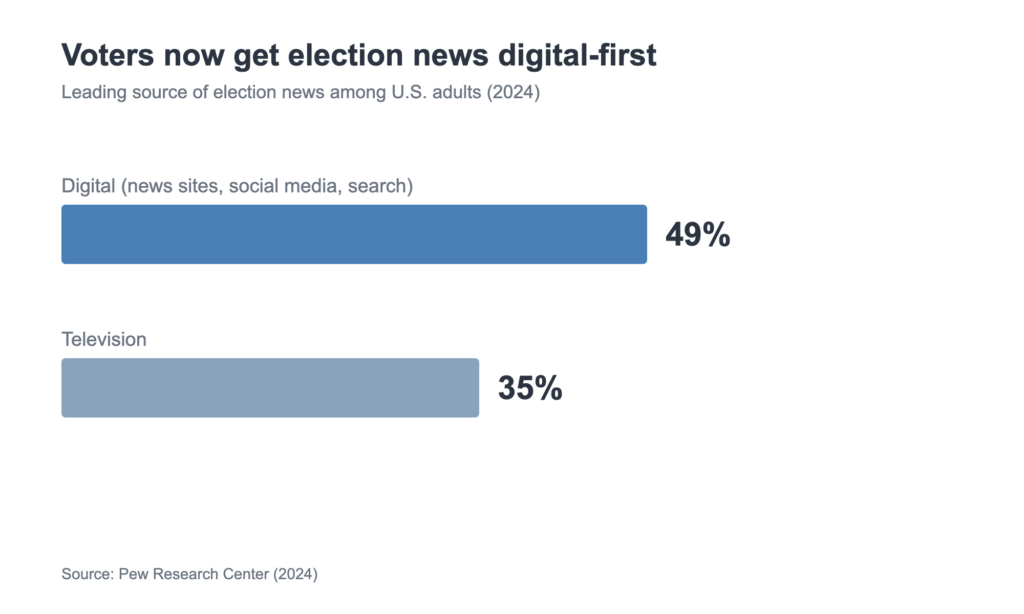
Counting news sites, social media, and search together, digital is now the top election news channel.
The Afterthought Problem
Despite that, the campaign website remains one of the most neglected pieces of campaign infrastructure. It is routinely assigned to a volunteer, launched weeks after the campaign announcement, and abandoned once the social accounts get traction. That is a costly mistake — especially in local races. As local news coverage has thinned across much of the country, a down-ballot candidate’s website is often the only substantial source of information a voter will find about them. If it is missing, outdated, or broken on a phone, that absence is the message.
What a Campaign Site Actually Has to Do
A campaign website has a job description unlike any other site. It has to launch fast, because campaigns are sprints measured in weeks. It has to take donations flawlessly on a phone — ActBlue reported processing $1.55 billion from nearly seven million donors in a single quarter of 2024, with almost three-quarters of contributions made on mobile devices. It has to satisfy compliance requirements that ordinary businesses never think about: disclaimers, contribution rules, and reporting obligations that vary by state and office. And it has to be updatable in minutes, because a campaign that cannot respond to a news cycle on its own platform cedes the story to everyone else.
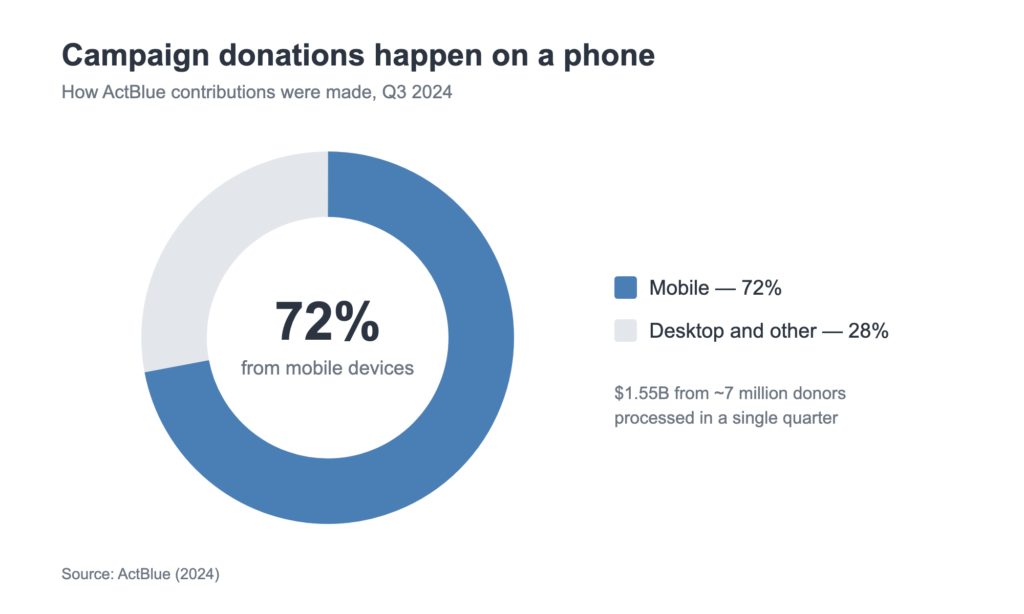
When donations arrive by phone, a donation page that stumbles on mobile is a fundraising problem.
Security belongs on that list too. Candidate websites attract hostility that the average small-business site never sees, and a defaced or hijacked campaign site in October is a campaign crisis, not an IT ticket. Hardened hosting, HTTPS everywhere, and disciplined access control are baseline requirements, not upgrades.
Treating the Website as Core Infrastructure
Our team recently published a practical checklist of political campaign website essentials — from launch-week priorities to donation flow and accessibility — after watching candidates lose precious early weeks to avoidable rebuilds. The pattern behind most of those failures is the same: the website was treated as a brochure instead of as the campaign’s one piece of owned media.
That pattern is also why BlakSheep Creative offers purpose-built web design for political campaigns and candidates, with fast turnarounds, compliance-aware builds, and the kind of update speed a news cycle demands. The agency’s roots are in Louisiana — a state that takes its politics seriously — but the lessons apply to any race in the country.
The yard signs come down in November. The search results do not. Candidates who treat their digital presence as core infrastructure — funded, professional, and live from day one — are buying themselves an advantage that compounds for the entire race, and often into the next one.
Clint L. Sanchez is the founder of BlakSheep Creative, a Louisiana-based digital marketing agency serving service businesses, aviation companies, and professional firms nationwide. A veteran firefighter turned marketer, he writes about practical digital strategy for industries that traditional marketing overlooks.
By Clint L. Sanchez, BlakSheep Creative