
The American school system asks students to commit to a direction somewhere around junior year, when course selection, testing strategy and college applications converge into one high-stakes stretch of eleven months. The assumption underneath that timing is that sixteen is when a young person becomes capable of the decision.
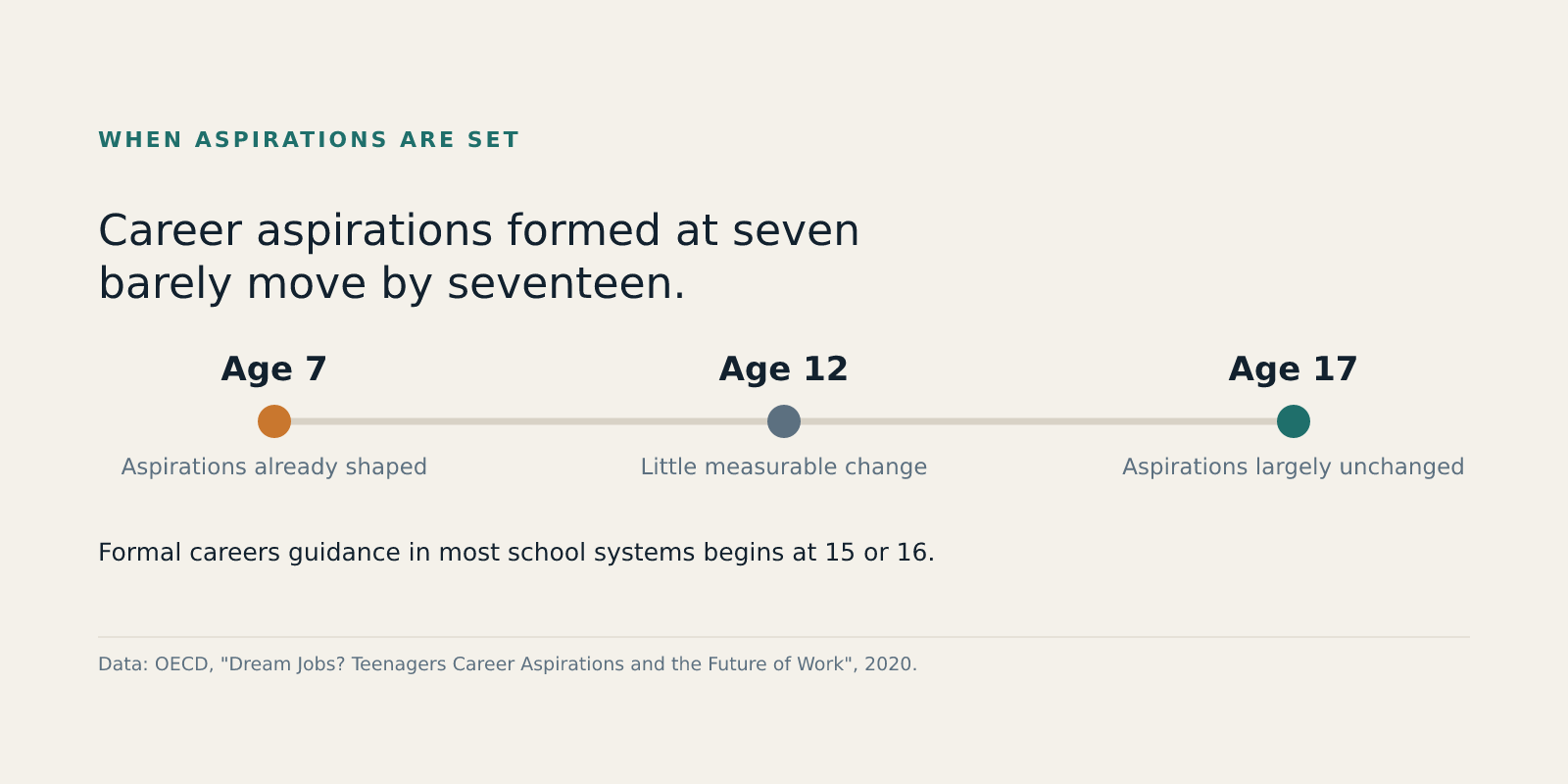
Research on aspiration suggests the timing has the causality backwards. The OECD’s 2020 report Dream Jobs? found that the career aspirations of seven-year-olds already reflect gender stereotypes and social background, and that those aspirations move very little by the age of seventeen. Whatever junior year produces, it is mostly ratifying a shortlist assembled in primary school.
Elizabeth Tweedale, founder of the online coding school Coco Coders, heard the same thing from school leaders. Her team interviewed high school principals across the United States before designing the company’s curriculum, and two problems recurred: students arriving without basic technical fluency, and students arriving with no mental map of the professional world.
“They don’t even start looking at life after graduation until they are 16 or 17,” Tweedale said. “By then, they are faced with an overwhelming paradox of choice and almost zero context.”
Context is the operative word. The number of available paths is not the constraint. A student can access more information about careers than any previous generation and still be choosing between four jobs, because those are the four they can picture from the inside.
The 2018 Education and Employers study Drawing the Future, which surveyed more than 20,000 primary school children, found that under one percent had learned about their chosen job from someone who visited their school. Television, social media and family occupation accounted for almost all of it, which is a narrow and self-reproducing sample of an economy with thousands of roles in it.
For counsellors, the implication is uncomfortable. A single well-run junior-year programme is competing against a decade of accumulated impression, across a caseload that leaves little room for individual exploration.
Coco Coders’ response operates outside the school day. Its programme runs ten-week foundation blocks followed by four-week deep dives anchored on real technology, teaching school-age children. The intent is to widen the shortlist before it hardens, by showing students the technical systems behind industries they already care about.
Details of the curriculum are at cococoders.com.
About Coco Coders
Coco Coders is an online coding school founded in 2016 by Elizabeth Tweedale. It teaches Scratch, Python, HTML, CSS and JavaScript to school-age children through live interactive classes in group and private formats, and works with students in the United States, the United Kingdom and internationally. Course information is published at cococoders.com.