
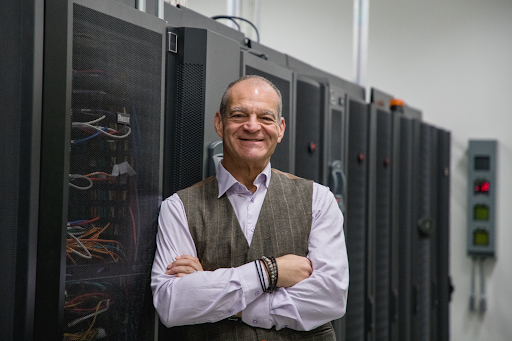
By Pete Sacco
The land stretches flat and empty under a pale November sky, 1,000 acres of former empty wasteland in the Permian Basin region of West Texas that will soon consume more electricity than Iceland. My development partner gestures toward the distant tree line where natural gas pipelines converge, enough capacity to generate 4,000 megawatts of power. “This is where AI happens now,” he says, with an entrepreneur’s mix of excitement and exhaustion. “Out here. Away from the grid.”
We’re standing at ground zero of artificial intelligence’s least discussed paradox: the same technology promising computational abundance requires building the most resource-intensive infrastructure in human history. A single AI data center campus drawing four gigawatts equals the output of four nuclear plants, twice the Hoover Dam, enough to power 3.3 million homes. We’re constructing these facilities at unprecedented scale and speed, racing to support a computational paradigm that physics suggests shouldn’t exist in its current form much longer.
It’s an expensive bet on a potentially obsolete technology. And it may be exactly what humanity needs to cross the bridge into what economists call the zero marginal cost society—where the economics of scarcity that have governed civilization for 10,000 years finally break down.
The question isn’t whether we’re heading toward material abundance. The question is whether we can navigate the messy, dangerous, transformative transition period between scarcity and plenty. And right now, that transition looks like billion-dollar data centers consuming small nations’ worth of electricity to power chips that violate every principle of thermodynamic efficiency.
We’re building the last great infrastructure of the scarcity era. What comes next changes everything.
The GPU Trap
After nearly three decades building data centers and microgrids, I’ve learned that infrastructure reveals truth. You can’t hide behind abstractions when you’re sourcing megawatts and managing heat loads. The physics is unforgiving.
Modern AI runs on graphics processing units—GPUs—originally designed to render video game graphics, now repurposed for the parallel mathematical operations that train large language models. A single rack of Nvidia H100 chips draws 60-80 kilowatts of power and generates heat equivalent to a commercial kitchen operating at full capacity. Next-generation B200 configurations push 120-150 kilowatts. Next-generation designs exceed 500 kilowatts per rack.
For context, traditional enterprise server racks draw 5-10 kilowatts. The jump isn’t incremental—it’s a phase change in energy density that the data center industry wasn’t built to handle. AI caught the data center industry off guard and rendered useless, the thousands of data centers designed and built to handle IT loads as opposed to AI/HPC workloads.
This creates a cascade of impossibilities. Higher power density requires sophisticated liquid cooling—direct-to-chip cold plates, immersion systems, rear-door heat exchangers that most facilities operators have never deployed at scale. Liquid cooling requires additional power for pumps and redundancy. More power requires stronger grid connections. Stronger grid connections in major metropolitan markets face 3-5 year interconnection queues. AI development cycles don’t wait three years.
So we do what my partner described: we build away from the grid. Behind-the-meter microgrids with dedicated natural gas generation. Nuclear plant partnerships. Remote sites near hydroelectric dams. Anywhere we can secure power on timelines that match venture capital expectations rather than utility planning cycles.
The economics are stark. A 50-megawatt AI facility drawing from the traditional grid faces $75-150 million in utility infrastructure upgrades and 4-6 year timelines. A behind-the-meter microgrid costs $120-200 million but can be operational in 18-24 months. For companies where six-month delays mean competitive extinction, the premium is irrelevant.
But here’s what keeps me up at night: I don’t believe GPUs represent the final architecture for AI at scale. In fact, I’m increasingly convinced they represent a thermodynamic dead end we’re building around out of necessity, not wisdom.
The Physics Revolution Hiding in Plain Sight
The human brain performs computations that would require megawatts in current GPU architectures. It does this on roughly 20 watts—the power draw of a dim lightbulb. This isn’t just impressive efficiency. It’s evidence that we’re computing the wrong way.
Current AI operates on deterministic, brute-force computation: throwing massive amounts of power at mathematical problems through parallel processing. It works. It produces remarkable results. And it’s thermodynamically primitive.
Nature doesn’t compute this way. Biological intelligence operates on non-deterministic, probabilistic principles—leveraging entropy, fluctuations, and the physics of noise rather than fighting against them. The brain isn’t a precision instrument executing deterministic algorithms. It’s a thermodynamic system that uses physical randomness as a computational resource.
A growing number of physicists and AI researchers recognize that future computation may look more like biology than like electronics. Guillaume Verdon, a quantum physicist who previously led Google’s quantum computing effort, founded Extropic to explore exactly this possibility.
Extropic’s approach—thermodynamic computing—doesn’t fight entropy. It harnesses it. Their Thermodynamic Scaling Units (TSUs) leverage the physics of fluctuations and entropy to perform AI computations at room temperature with energy efficiency potentially exceeding GPUs by four orders of magnitude. Ten thousand times more efficient than current architectures.
If Extropic’s roadmap holds and TSUs reach commercial availability by 2026-2027—a timeline Verdon has publicly committed to—the entire power consumption calculus changes overnight. The 4-gigawatt data center campus I’m planning becomes oversized infrastructure for a computational paradigm that no longer dominates.
This is the paradox facing every infrastructure developer and utility planner: we’re building for today’s GPU reality while knowing that alternative physics approaches could radically reduce power requirements within a presidential term.
Build for current demand and risk stranded assets worth billions. Underinvest and lose the AI race during the critical transition period when GPUs still dominate.
There’s no safe answer. Only calculated bets on transition speed.
When Abundance Becomes Inevitable
Every exponential technology follows the same trajectory: initial scarcity and high costs give way to radical abundance and near-zero marginal costs.
We saw it with computing power—from million-dollar mainframes to smartphones more powerful than the computers that sent humans to the moon. We saw it with bandwidth, storage, digital photography, search, and now generative AI. What once required enormous capital and resources becomes too cheap to meter.
Economist Jeremy Rifkin has spent decades studying this pattern. In “The Zero Marginal Cost Society,” he argues we’re entering a new economic paradigm where the marginal cost of producing goods and services approaches zero. When production costs collapse toward zero, market capitalism—which depends on scarcity and exchange value—gives way to collaborative commons where access matters more than ownership.
This isn’t abstract theory. It’s extrapolation from curves already in motion.
Computational power becomes cheaper and more distributed with each paradigm shift. Thermodynamic computing could reduce power requirements by 10,000x. Quantum computing promises exponential advantages for specific problem classes. Photonic processors eliminate electronic heat generation entirely. Each represents another step toward computational abundance—where processing power becomes effectively free.
Now extend the logic. Peter Diamandis and Ray Kurzweil describe convergence: when AI, robotics, nanotechnology, and unlimited clean energy combine, the cost of producing most physical goods approaches zero.
Imagine molecular assemblers—nanotechnology that rearranges atoms, as described in Eric Drexler’s “Engines of Creation.” Feed them raw materials (abundant), energy (fusion, advanced solar, small modular reactors—eventually free), information (open source—free), and manufacturing capital costs collapse with advanced robotics and eventual nanotech.
In that world, you drop a molecular assembler on the ground and tell it to build an electric vehicle. It pulls atoms from the environment, uses freely available energy, and assembles the car atom by atom. The vehicle materializes. The marginal cost of production: near zero.
This isn’t science fiction—it’s engineering problems we’re actively solving. The question isn’t whether we reach material abundance. The question is timeline and what happens during the transition.
The Messy Middle
Here’s where theory meets the dirt under my boots on that Texas field.
We’re in the messy middle. The transition period where old scarcity economics collide with emerging abundance. Where we’re building billion-dollar facilities to support a computational paradigm we suspect is thermodynamically obsolete, because it’s the only paradigm that works today.
This transition may last five years. It may last fifty. Nobody knows.
What we do know: current infrastructure decisions lock in 20-30 year capital commitments. Utilities need to commit billions to grid expansion 5-10 years ahead of demand. AI adoption curves are measured in quarters. Thermodynamic computing could arrive in two years or twenty.
You can’t plan for that kind of uncertainty using traditional forecasting. You can’t even price it properly.
Yet decisions must be made. Data centers must be built. Power must be sourced. AI companies need compute today, not when thermodynamic processors mature. The market doesn’t wait for perfect information.
This explains the scrambling that looks chaotic from outside but makes perfect sense when you’re in the middle of it:
Microsoft announces plans to restart Three Mile Island’s Unit 1 nuclear reactor—a facility dormant since 2019—to power AI workloads. Amazon spends $650 million acquiring a data center campus next to a nuclear facility in Pennsylvania. Google makes unprecedented investments in geothermal and next-generation nuclear partnerships.
These aren’t PR moves. They’re strategic positioning for a transition nobody can predict.
The companies that solve infrastructure while maintaining architectural flexibility will shape what abundance actually looks like. The ones that don’t will find themselves watching competitors deploy more efficient architectures simply because they secured better power purchase agreements and built more adaptable facilities.
But there’s a deeper question hiding beneath the infrastructure scrambling: what do we do when abundance arrives?
The Hardest Part Isn’t Material
When basic material needs are solved and work becomes optional, identity fractures for those who derived meaning from economic production.
Rifkin describes this clearly: in a zero marginal cost society, market forces lose relevance as goods become nearly free and abundant. Scarcity shifts from material goods to what can’t be replicated: experiences, creativity, meaning, genuine human connection, time, attention.
Diamandis frames it practically: “When anyone can live like a king, the question becomes: What is human progress?”
The shift moves from “work for income” to “work for personal fulfillment.” What’s scarce in this world? Time. Attention. Creative achievement. Status in communities you care about. The work itself becomes the reward.
This unlocks massive creativity and eliminates hunger and disease. But it also forces us to reckon with identity in a post-work world.
I’ve spent my career building physical infrastructure—data centers, power generation and distribution, cooling systems. Tangible things that solve concrete problems. But the more I engage with this transition, the more I recognize that the hardest infrastructure to build isn’t physical.
The real work is building consciousness infrastructure to handle abundance wisely.
Abundance without wisdom becomes empty consumption. Technology without meaning becomes hollow optimization. Unlimited computational power directed at trivial problems is civilizational waste.
This is why my work increasingly bridges technology and consciousness. The infrastructure challenges are ultimately human challenges. We need both the physical foundation for abundance and the wisdom to use it well.
Building the Bridge
I’m currently developing Gray Wolf Data Centers—AI-optimized facilities designed specifically for this transition period. The Connecticut sites combine behind-the-meter power generation, colocation facilities optimized for current GPU workloads, and providing flexible AI/HPC architectures designed to accommodate next-generation compute technologies as they emerge.
The goal isn’t just to solve today’s problems. It’s to build infrastructure that remains relevant regardless of which physics paradigm ultimately dominates.
This is what Diamandis means by “owning the means of production” during the transition. Not hoarding resources, but participating in building the abundance infrastructure rather than just consuming it. As computation becomes abundant, competitive advantage shifts to those who built the foundation.
It’s also about developing what Diamandis calls “non-replicable capabilities”—creative synthesis, navigating ambiguity, building trust, leading through transformation. As material goods demonetize, value accrues to what can’t be automated or replicated.
Infrastructure development in this transition period requires exactly these capabilities. You’re building for futures you can’t fully see. You’re making billion-dollar bets on transition timelines nobody can predict. You’re navigating utility planning cycles from the 1970s while responding to AI development speeds measured in weeks.
It requires technical expertise, strategic foresight, and philosophical clarity about what we’re building toward.
The Three Horizons
Let me make this concrete. AI leadership over the next three decades will be determined by success across three distinct time horizons:
Near-term (2025-2030): The GPU Scramble
Success means securing power, cooling, and infrastructure at scale fastest. The constraint isn’t ideas or capital. It’s megawatts and permits. Winners will be those who solve behind-the-meter power generation, navigate utility interconnection queues, and deploy liquid cooling at scale. This is traditional infrastructure competition—expensive, capital-intensive, boring, essential.
Medium-term (2030-2040): The Physics Transition
Success means architectural flexibility as computational paradigms evolve from GPUs to thermodynamic and other alternative physics processors, quantum systems, photonic computing, and technologies we haven’t imagined yet. Winners will be those who built modular infrastructure that adapts as physics evolves. This requires different thinking—not optimizing for current best practices but designing for future paradigm shifts.
Long-term (2040+): The Abundance Navigation
Success means wisdom about deployment as computation approaches zero marginal cost. When processing power is effectively free and AI systems can generate solutions to most technical problems, leadership belongs to those who ask the right questions and direct unlimited capability toward meaningful challenges. This isn’t a technology problem. It’s a consciousness problem.
Most organizations optimize for the near-term and ignore the other two horizons. A few visionaries focus on the long-term and fail to survive the near-term. Almost nobody is building strategies that work across all three.
That’s the bridge we need to cross.
What This Means for You
If you’re a tech leader or investor, your AI strategy needs multiple time horizons simultaneously:
Solve today’s constraints. The GPU scramble is real. Power access, cooling capacity, and infrastructure flexibility determine competitive viability right now. If you can’t deploy models because you lack compute, philosophical clarity about abundance doesn’t help.
Build for architectural uncertainty. The physics of computation is shifting. Thermodynamic computing, quantum systems, photonic processors—we don’t know which paradigm dominates in 2035. Build infrastructure and strategies that remain viable across multiple futures. Avoid lock-in to current architectures.
Develop wisdom infrastructure. Start asking now: what would we do with unlimited computational power? What problems are worth solving? What does human progress mean when material scarcity ends? These aren’t abstract questions—they’re strategic imperatives. Organizations that develop clarity on these questions before abundance arrives will shape what abundance becomes.
If you’re navigating the transition as an individual, Diamandis’s advice is practical:
Own the means of production. In the transition phase, whoever controls AI agents, robotics, energy infrastructure, and eventually nanotech has leverage. Don’t just consume abundance—participate in building it.
Develop non-replicable skills. Build relationships. Create original ideas. Navigate ambiguity. Lead through chaos. These remain valuable as everything else demonetizes.
Prepare psychologically for post-scarcity. The hardest part won’t be material abundance. It’ll be finding meaning when basic needs are solved. Start asking now: What would you do if money were irrelevant? That answer is your North Star.
The Work Ahead
That Texas field will soon host billions of dollars in infrastructure supporting AI workloads that consume unfathomable amounts of electricity. It may operate for three years before thermodynamic computing makes it partially obsolete. Or for thirty years as the dominant paradigm. We don’t know.
What we do know: this infrastructure is essential for the transition. You can’t skip steps. You have to build through the constraint.
The data center industry is undergoing more technical evolution in three years than it experienced in the previous twenty. But we’re also potentially in the final decades of scarcity-based economics for computational power and eventually for material production itself.
The next chapter of AI won’t be written solely in neural network architectures or transformer models. It’ll be determined by transmission line capacity today, breakthrough physics tomorrow, and human wisdom about what to do with abundance once we achieve it.
The AI gold rush has arrived. The real prospecting is happening simultaneously at utility substations and construction sites, physics laboratories reimagining computation’s thermodynamic foundations, and in the difficult philosophical work of understanding what human progress means when material scarcity ends.
This may be the last great infrastructure crisis of the scarcity era. What comes after depends on whether we can build not just the physical foundation for abundance, but the consciousness infrastructure to handle it wisely.
The bridge between scarcity and abundance runs through messy, uncertain, transformative terrain. But the destination—if we navigate the transition successfully—could reshape what it means to be human.
We’re building that bridge now, one gigawatt at a time, while the physics shifts beneath our feet and the economic foundations of civilization prepare to transform.
The question isn’t whether abundance is coming. The question is whether we’ll be ready when it arrives.
About the Author
Pete Sacco is founder and CEO of PTS Data Center Solutions, a multi-million dollar enterprise building AI infrastructure including data centers and sustainable microgrids. His companies include INTUVA (data center facilities), GRID7 (sustainable energy solutions), and Gray Wolf Data Centers (AI-optimized facilities). He is the author of “Living in Bliss: Achieve a Balanced Existence of Body, Mind, and Spirit” and “THE BRIDGE: How Building AI Infrastructure Taught Me That Human Consciousness Is The Real Technology.” His work explores the intersection of advanced technology and human consciousness.
This article was published on CapitolHillTimes