
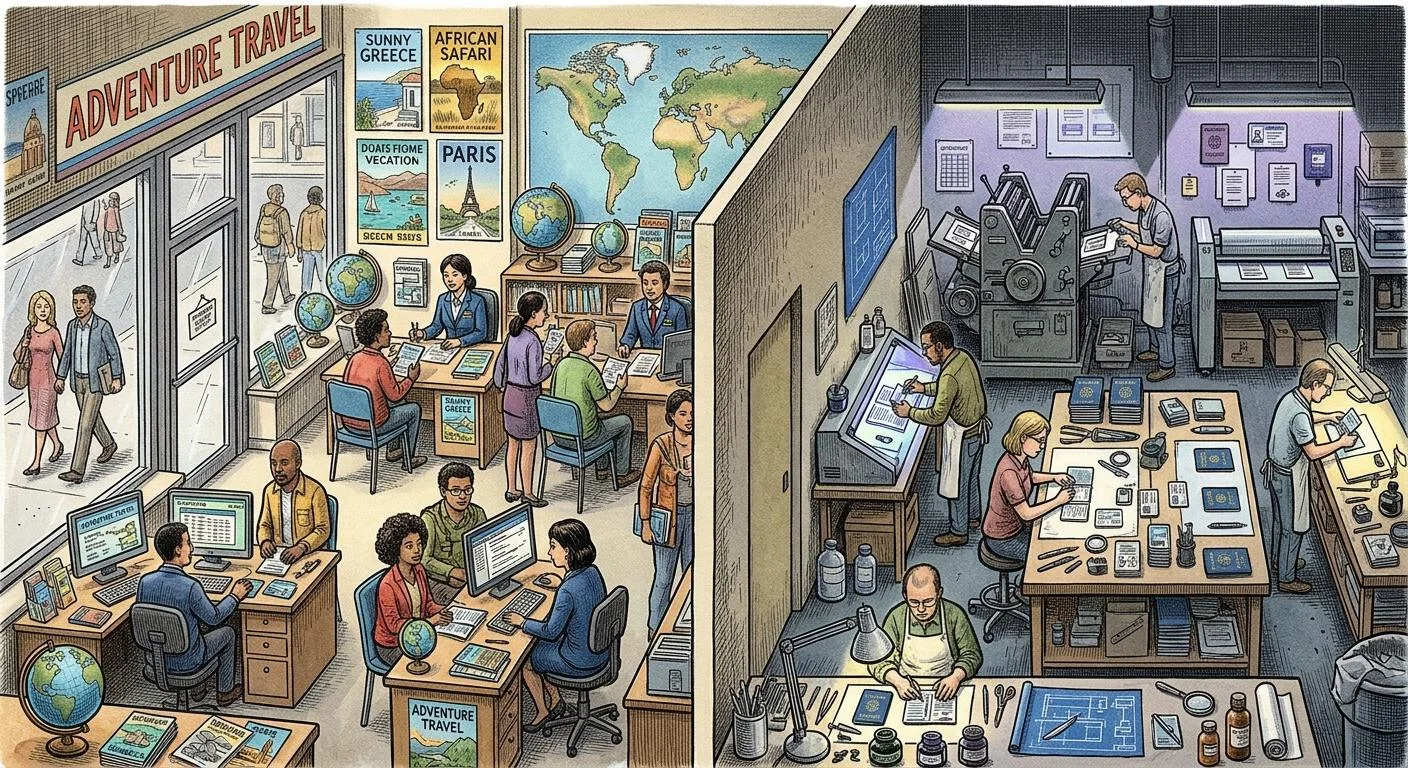
Investigations in Poland, Greece and the United States reveal how suspected document-forgery networks use legal-assistance claims, travel agencies and ordinary storefronts to conceal fraudulent identity services and attract customers across international borders.
WASHINGTON, DC, November 11, 2026 — Criminal networks supplying counterfeit passports and fraudulent identity documents have used the appearance of legitimate businesses to attract customers, conceal suspected illegal activity and make unauthorized identification services resemble ordinary commercial or immigration assistance.
Investigations in Poland and Greece reveal how suspected forgers advertised legal assistance, operated through travel agencies and used recognizable business premises while allegedly producing counterfeit passports, residence permits, identification cards and other official-looking credentials.
The operations illustrate an increasingly important challenge for international law enforcement because a professional website, established storefront or familiar business description can create an appearance of credibility without establishing that documents originate from an authorized government agency.
Authorities are consequently examining the commercial relationships surrounding document fraud, including advertising, customer communications, payments and distribution, while distinguishing criminal fronts from legitimate advisers and businesses that provide lawful assistance with immigration or travel requirements.
Polish Investigation Exposes False Legal-Assistance Claims
Polish Border Guards began investigating an international document-forgery organization in 2020 after officers encountered a fraudulent driver’s license at the Korczowa border crossing, eventually uncovering suspected manufacturing and distribution activities involving several cities and foreign jurisdictions.
Europol reported in February 2025 that the investigation resulted in 42 arrests, the recovery of more than 12,000 counterfeit documents and the securing of approximately 250,000 euros in assets associated with the alleged criminal organization.
The suspected group, whose members included Ukrainian and Belarusian nationals operating mainly in Poland and Ukraine, allegedly produced fraudulent passports, visas, residence permits, identification cards and driver’s licenses while presenting its commercial services as legitimate legal assistance.
The critical distinction was that purported professional representation served as an advertising identity for unauthorized document production, rather than evidence that any genuine government office had approved the credentials offered to customers.
Social Media Helped Create an Appearance of Legitimacy
Investigators said the Polish group promoted its services through websites and social media, offering official-looking documents under the pretense of helping customers navigate legal or administrative requirements related to residence, identification, and international travel.
As Cybernews reported in its coverage of the Polish investigation, suspected sellers advertised fraudulent identification through online channels and allegedly charged approximately 1,500 euros for individual documents supplied through the organization.
Europol described a process involving customer communications, deposits and electronic photographs of completed documents before physical delivery, demonstrating how ordinary commercial practices can be imitated within an illegal identification business.
However, investigators must evaluate each customer’s circumstances individually because someone exposed to misleading advertising may have been deceived, while another may have knowingly sought fraudulent credentials for an unlawful purpose.
Multiple Production Facilities Supported the Polish Operation
Polish authorities identified suspected document-production facilities in Katowice and additional premises in Gdańsk associated with fraudulent credentials, showing the organization allegedly operated through several locations rather than a single identifiable storefront.
Investigators recovered equipment, completed documents and financial evidence during operations spanning several years, with the final coordinated raids occurring Dec. 3 and 4, 2024, before Europol announced cumulative findings in February 2025.
These facts matter because closing one location does not automatically establish that investigators dismantled an entire organization, particularly when they suspect separate participants handled customer contact, production, and physical distribution.
The Polish case also illustrates why legitimate-looking advertising deserves factual verification, since a business can describe its services in professional language without possessing authority to manufacture identification issued exclusively by government agencies.
Athens Travel Agency Allegedly Concealed Document Distribution
Greek authorities reported another example in July 2025, when an international investigation involving Greek, German and American agencies resulted in eight arrests and the recovery of counterfeit identification, electronic devices and materials associated with suspected document production.
Investigators alleged that an Athens travel agency operated as a commercial front and distribution hub, connecting customers with fraudulent passports, identity cards, residence permits and other documents intended for use across European jurisdictions.
Officers conducted residential searches and examined premises linked to the agency, recovering hundreds of suspected fraudulent credentials, biometric information, equipment, and more than 68,000 euros in cash during the coordinated enforcement operation.
The alleged use of a travel business was significant because travel agencies ordinarily handle bookings, passenger information and administrative inquiries, creating opportunities for criminal participants to disguise improper document services within apparently routine commercial interactions.
International Cooperation Revealed the Alleged Greek Network
Europol assisted the Greek investigation by facilitating cooperation with German and American authorities, helping agencies examine potential links between suspected document suppliers, migrant-smuggling arrangements, and international distribution activities.
The investigation showed how a business operating in one European city could allegedly support criminal activity across several countries, requiring authorities to combine evidence collected under different national investigative procedures.
However, an allegation that a travel agency served as a criminal front does not justify suspicion toward legitimate travel businesses, whose lawful activities routinely involve foreign customers, passport information and international transportation arrangements.
Establishing criminal responsibility requires evidence that particular individuals knowingly participated in prohibited conduct, not assumptions based on business location, customer nationality, unusual destinations, or ordinary international financial transactions.
Greek Police Find a Coffee Shop Linked to Forgery
A separate Athens investigation announced in June 2026 revealed allegations involving a coffee shop in Kato Patissia, where police said suspects used an ordinary hospitality business to meet prospective customers seeking fraudulent identification.
Investigators alleged that the actual document production occurred at a residential property equipped with printing and personalization materials, while the coffee shop provided a recognizable commercial location associated with customer contact.
Greek authorities arrested two suspects and recovered hundreds of counterfeit or partially completed identity documents, including passports and national identity cards, with investigators estimating suspected proceeds of at least 200,000 euros.
The case illustrates the importance of distinguishing a location used for alleged customer contact from a manufacturing site, since each setting may provide different evidence concerning the suspected participants and their activities.
Business Fronts Can Complicate Criminal Investigations
Criminal groups may exploit the appearance of ordinary commercial operations because customers and outside observers frequently associate registered premises, recognizable branding and professional correspondence with legitimate administrative or travel services.
Investigators examining such arrangements must establish whether a business was deliberately created for criminal purposes, knowingly misused by particular participants or operated legitimately while unrelated individuals engaged in separate wrongdoing.
The distinction matters when assessing employee responsibilities because working for a business later investigated by police does not, by itself, prove that every staff member knew about suspected illegal document production.
Authorities may therefore investigate communications, financial records, and other lawfully obtained evidence to distinguish individuals responsible for alleged criminal arrangements from employees, customers, or commercial partners who were not knowingly involved.
U.S. Prosecutors Document Immigration Adviser Impersonation
American investigations have revealed comparable risks involving fraudulent claims of professional immigration assistance, although those cases may concern deceptive legal representation rather than the physical manufacture of counterfeit passports.
In July 2025, federal prosecutors in Houston announced that Jesus Carlos Silva had pleaded guilty to conspiring to commit mail and wire fraud after falsely presenting himself as an immigration attorney.
According to the U.S. Department of Justice’s account of the Houston prosecution, Silva falsely promised immigration assistance and admitted to taking more than $1.45 million from over 100 victims without providing legitimate legal services.
The prosecution illustrates how professional-sounding representations can facilitate fraud against people seeking lawful immigration outcomes, even when the underlying offense differs from organized counterfeit document manufacturing in Poland or Greece.
False Government Appointments Increased the Deception
Federal prosecutors said Silva instructed victims to travel to Houston for supposed appointments with U.S. Citizenship and Immigration Services, although those appointments did not exist and the promised immigration assistance was never legitimately arranged.
The deception demonstrates how an unauthorized service provider can misuse the names of official institutions to create credibility, especially when customers are unfamiliar with government procedures or face complicated immigration circumstances.
Such conduct can impose significant financial and emotional burdens on victims, who may spend money on transportation and purported professional fees while believing they are progressing through lawful government processes.
For investigators, false appointment representations can become relevant evidence of deception, but the applicable criminal process must still establish an accused individual’s specific legal responsibility.
Legitimate Advisers Must Be Distinguished From Criminal Operators
Lawful immigration consultants, licensed attorneys and authorized administrative representatives may assist clients with complicated documentation requirements, making it essential to distinguish legitimate professional support from individuals falsely claiming government authority.
A professional adviser can help explain procedures, organize supporting evidence and communicate within authorized channels, but cannot independently manufacture a valid government passport or guarantee approval contrary to the issuing authority’s legal requirements.
Likewise, a legitimate travel agency can help with transportation arrangements and published entry requirements without becoming responsible for forged documents simply because customers seek international travel or have unfamiliar nationality records.
The appropriate distinction rests on verified authority, actual services and demonstrable conduct, ensuring that enforcement focuses on deliberate fraud without undermining confidence in lawful businesses serving international travelers and immigration applicants.
Passport Authentication Provides an Independent Security Check
Modern passport authentication can help distinguish genuine government-issued travel credentials from convincing counterfeits, reducing dependence on a vendor’s professional presentation, advertising claims or apparent familiarity with official immigration procedures.
As explained in Amicus International Consulting’s examination of modern passport security and counterfeit detection, physical examination, electronic authentication, and biometric identity comparison provide complementary safeguards that address different questions about authenticity, information integrity, and rightful possession.
A counterfeit passport may reproduce visible artwork while lacking valid electronically protected information, whereas a genuine government-issued passport may still require investigation when questions arise concerning fraudulent enrollment or unauthorized presentation.
These distinctions matter when purported service providers promise authentic identity documents, because verification should rely on the responsible government authority and official records rather than promotional photographs or unsupported claims.
Financial Evidence Helps Distinguish Business Activity From Fraud
Financial investigations can help authorities establish whether payments received by a suspected business corresponded to lawful professional services, alleged counterfeit document transactions or other activities requiring separate examination.
The Polish investigation included suspected money laundering and substantial frozen assets, while Greek authorities recovered cash and electronic materials linked to alleged document distribution through commercial premises.
However, business revenue, international transfers, and customer deposits are not inherently criminal, so investigators must establish the specific facts linking individual transactions to prohibited conduct and responsible participants.
International Cooperation Supports Broader Investigations
The Polish and Greek investigations demonstrate why authorities increasingly coordinate across borders when suspected document suppliers, customer records and financial relationships extend into countries governed by different criminal laws.
Europol’s involvement gave participating agencies opportunities to exchange relevant information and compare findings, while national investigators retained responsibility for gathering evidence and pursuing proceedings within their jurisdictions.
Such cooperation must also protect personal information and distinguish suspected organizers from individuals who may have been deceived by fraudulent advertising or whose genuine identity records were misused.
Victims May Believe They Are Purchasing Lawful Services
The use of legal-assistance terminology creates particular risks for customers who believe an advertised provider can obtain government documentation, especially when unfamiliar administrative requirements make it difficult to assess whether promised services are authorized.
Some prospective customers may knowingly seek false documents, while others may misunderstand the provider’s authority or receive deceptive assurances about government approval, making individual circumstances important when investigators determine potential criminal responsibility.
Authorities should therefore assess whether people deliberately participated in fraud or were victims of misleading representations, without assuming every customer approaching a suspicious business had identical intentions.
Digital Advertising Expands the Reach of False Services
Websites, social media, and online messaging allow alleged document suppliers to reach international audiences while presenting professional descriptions that may obscure the difference between legitimate application assistance and unauthorized identity document production.
The Polish investigation demonstrated how online commercial communications could connect customers with suspected document manufacturers, while the Greek cases illustrated the potential role of ordinary physical premises in facilitating alleged criminal transactions.
These findings support greater scrutiny of verifiable issuing authority and commercial representations, although online advertising remains lawful and cannot establish fraud without additional evidence of deception or prohibited conduct.
Reliable Government Records Remain Essential
Authentic passports, residence permits and other government credentials originate through legally established issuance systems, making official records and appropriate authentication procedures more reliable than the branding or commercial claims of private intermediaries.
Secure application procedures, accurate identity enrollment and appropriate document checks help protect legitimate travelers while giving investigators stronger grounds for identifying credentials that were fabricated, altered or obtained through deception.
A business may provide professional administrative guidance, but any claim that it can independently produce genuine government-issued identity documents must be evaluated against the actual legal authority responsible for issuance.
Enforcement Must Preserve Trust in Legitimate Services
The European and American cases demonstrate how fraudulent operators can exploit ordinary commercial language, creating a challenge for authorities seeking to disrupt document crime without casting unsupported suspicion on lawful advisers and businesses.
Effective enforcement requires evidence linking specific participants to deception, unauthorized manufacturing, or related offenses, while protecting individuals who may have relied on misleading promises or had their personal information misused.
Ultimately, exposing fraudulent business fronts depends on coordinated investigations, trustworthy government identity systems and careful distinctions between lawful assistance and criminal document production, ensuring that legitimate services remain accessible while organized fraud is addressed.