
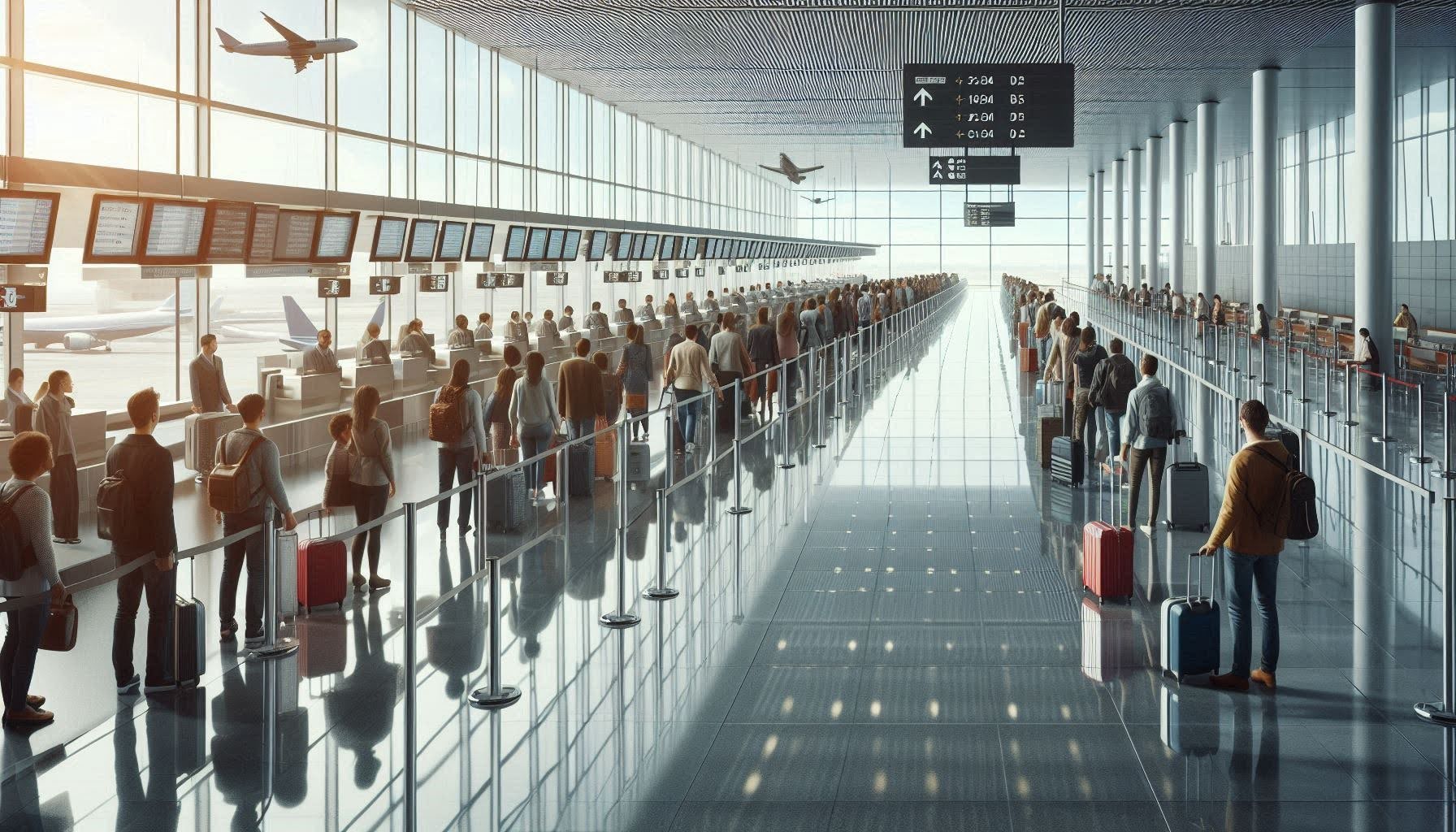
As the TSA improves its own facial recognition technology, private companies are pivoting to offer concierge biometrics to maintain their edge in the race for the fastest airport lane.
WASHINGTON, DC
The fastest lane in the airport is becoming a contest of identity systems
The airport security line has become the newest battleground between public authority and private convenience, as the Transportation Security Administration expands its own biometric tools while Clear and other private identity companies fight to remain the premium shortcut through the terminal.
For years, Clear’s value proposition was simple enough for the exhausted frequent flyer to understand: travelers paid for a private biometric membership that bypassed the identity-check queue before joining the standard TSA or TSA PreCheck screening flow.
That model became powerful because it solved a visible problem at exactly the right moment, giving members a faster path through the airport when conventional document checks, crowded podiums, and uneven staffing made security feel unpredictable.
Now the competitive landscape is changing because the government itself is improving the identity layer, using facial comparison and digital identity systems to reduce the same bottleneck that made private biometric membership so attractive in the first place.
The TSA’s own Touchless ID program allows eligible TSA PreCheck travelers flying with participating airlines to verify their identities through facial comparison, posing a direct public-sector challenge to private companies that built their brands around faster verification.
Clear is responding by moving deeper into what might be called concierge biometrics, a premium identity experience that promises speed, recognition, service, and convenience beyond a simple shortcut at the checkpoint podium.
Clear built the private fast lane before the government caught up
Clear became familiar to frequent flyers because it offered a private membership system built around biometric verification, allowing enrolled passengers to confirm their identities at dedicated kiosks or lanes before being escorted to TSA screening.
The company’s airport product was especially appealing because it did not replace federal screening authority, but instead inserted a private identity layer ahead of the government checkpoint process, where passengers often lost time.
That distinction helped Clear grow because travelers could understand that the company was not searching bags, deciding security risk, or replacing TSA officers, but confirming identity faster than the ordinary line.
The service also fit the psychology of premium travel because members were not only buying minutes but also predictability, recognition, and the feeling that the airport had a separate route for people who planned ahead.
As Clear expanded beyond airports into stadiums, events, and digital identity services, the company positioned itself as a broader secure identity platform rather than merely a line-skipping tool for frequent travelers.
That wider identity ambition matters because the airport lane is no longer just a revenue stream; it is a showcase for how private companies want to manage trusted identity across physical and digital spaces.
The TSA is moving into the same territory
The government’s biometric expansion changes the market because TSA has access to the checkpoint itself, federal authority over aviation screening, and a growing set of partnerships with major airlines that already hold passenger identity and travel data.
TSA PreCheck Touchless ID compresses identity verification into a facial comparison process for eligible passengers, which means the government can offer some of the same speed benefits that travelers once associated primarily with private biometric memberships.
The Washington Post reported that TSA planned a major Touchless ID expansion across dozens of airports in 2026, including locations tied to heavy travel demand and World Cup host-city planning, placing the government directly into the premium-speed conversation.
That expansion does not make Clear obsolete, because private programs can still differentiate through enrollment experience, airport coverage, family benefits, partner locations, concierge handling, and bundled travel services beyond the federal checkpoint.
Still, it changes the commercial math because a traveler who already has TSA PreCheck and can use a free or airline-enabled facial-verification lane may question whether a paid biometric membership still delivers enough incremental value.
The private fast lane must therefore become more than faster identity verification, because the government is now narrowing the very bottleneck that private biometric companies originally monetized.
The contest is not private security versus public security
The debate should not be framed as Clear replacing TSA or TSA replacing Clear, because the real competition is over who controls the traveler’s identity experience before formal screening begins.
TSA remains responsible for federal aviation security, while Clear operates as a private identity-verification company that must function within rules, permissions, and checkpoint architecture controlled by the government.
This creates a strange partnership rivalry, because private identity companies need TSA cooperation to operate inside airports, while TSA can learn from private-sector passenger-flow innovation and then build comparable public systems at scale.
That relationship may be productive when it improves speed and reduces congestion, but it becomes tense when passengers, airports, airlines, and regulators ask whether private members should receive faster access to a federally controlled security process.
The fairness question is unavoidable because airport security is a public function, even when parts of the passenger experience are improved by private technology vendors and paid membership systems.
The next phase of competition will therefore involve not only speed, but public trust, privacy rules, equitable access, vendor oversight, and the political optics of premium lanes in government-controlled spaces.
Clear is pivoting toward concierge biometrics
As TSA improves its own biometric lanes, Clear’s strategic advantage may increasingly depend on making the experience feel more personalized, guided, and premium than a government facial-comparison checkpoint can reasonably become.
Concierge biometrics means the traveler does not merely verify identity faster but also receives an airport experience that includes navigation, status recognition, family coordination, bag support, event access, lounge integrations, and digital identity features.
That service layer matters because federal biometric programs are designed primarily for security efficiency, while private identity companies can compete on hospitality, membership experience, app design, partner benefits, and customer support.
Clear’s public positioning as a secure identity company for airports, stadiums, and other venues shows how the company is trying to make biometric membership part of a broader convenience lifestyle rather than a single airport shortcut.
In practical terms, that means Clear may seek to own the journey around the checkpoint, while TSA owns the security decision inside the checkpoint, creating overlapping but distinct roles in the future passenger experience.
The private company that wins may be the one that makes biometric identity feel like a service, not a procedure, while still satisfying regulators that speed does not compromise accountability.
Government biometrics have a price advantage
TSA’s strongest advantage is simple, because many eligible travelers already pay for TSA PreCheck or qualify through existing trusted traveler programs, and Touchless ID does not require a separate Clear-style airport membership fee.
When a passenger can receive faster identity verification through an existing government-linked program and airline profile, the value of paying extra for a private biometric lane becomes more dependent on actual time savings at specific airports.
That creates a more demanding consumer, because frequent flyers will compare lane length, enrollment friction, airport coverage, companion rules, reliability, and whether Clear still saves enough time during peak travel periods.
Clear can still outperform at airports where its lanes are shorter, its staff assistance is stronger, or its coverage provides a more predictable premium experience, but the margin of advantage may vary from terminal to terminal.
This means the future market may become less about national brand promises and more about local airport performance, because travelers will judge biometric services by what happened at their last departure gate.
A paid private lane that saves fifteen minutes at one airport may feel indispensable, while the same membership may feel redundant at another airport where TSA Touchless ID is already moving quickly.
Privacy is the second battlefield
Speed wins attention, but privacy may determine loyalty, because biometric identity systems ask travelers to trust organizations with sensitive information that cannot be replaced, unlike a password, credit card, or boarding pass.
Government systems raise concerns about oversight, retention, interagency sharing, watchlist interactions, and how passengers challenge errors, while private systems raise concerns about commercial use, vendor partnerships, cybersecurity, bankruptcy risk, and future changes to business models.
Travelers may trust the TSA because it is a public agency subject to government rules, or they may distrust it precisely because it is a government agency with law-enforcement connections and broad security authority.
Similarly, travelers may trust Clear because it is a consumer-facing company with a paid relationship, or they may distrust it because private companies can change terms, expand partnerships, and monetize identity ecosystems over time.
The strongest privacy programs will be those that explain data collection, storage, deletion, sharing, consent, and opt-out rights in language ordinary passengers can understand while standing near a checkpoint.
Without that clarity, both public and private biometric providers risk the same backlash, because passengers will not separate convenience from exposure when they feel the airport is asking for their face without explaining the full bargain.
The premium lane can become a political issue
Airport fast lanes are convenient for members, but they can become politically sensitive when ordinary travelers perceive that paid identity programs allow wealthier passengers to bypass lines associated with public security.
TSA PreCheck already created a managed version of this hierarchy through vetting, fees, and risk-based screening, but Clear adds a more obviously private layer that can make the checkpoint feel commercially stratified.
When government biometric systems improve, policymakers may ask whether private biometric lanes remain necessary, whether they create inequitable access, and whether airports should prioritize public technology that benefits more travelers.
Private companies will argue that they invest in innovation, reduce congestion, enhance passenger experience, and expand identity tools that government agencies may not build as quickly or as elegantly.
Both sides can make credible claims, but the public will judge the system by practical fairness, especially during periods when standard lines are long, precheck lanes are crowded, and private biometric lanes appear to move more smoothly.
The politics of airport speed may therefore become sharper as biometrics expand, because the fastest lane is no longer just a convenience product; it is a visible statement about who gets friction removed first.
Airlines are becoming identity brokers
Airlines are central to this competition because they control passenger profiles, reservation data, loyalty accounts, passport information, mobile apps, and the customer relationship before travelers ever reach the checkpoint.
TSA Touchless ID depends heavily on airline participation because eligible passengers usually opt in through carrier platforms, meaning airlines help determine how easily travelers access government biometric lanes.
Clear also depends on airline and airport partnerships, as private biometric lanes become more valuable when integrated with check-in, bag drop, lounge access, boarding, and other premium services.
This puts airlines in a powerful position as identity brokers, because they can steer travelers toward government-backed digital identity, private biometric membership, proprietary airline biometrics, or some blended journey across multiple systems.
For passengers, that creates both convenience and confusion, because a single trip may involve an airline app, TSA facial recognition, Clear enrollment, passport data, loyalty status, and a boarding-gate biometric scan.
The industry will need clearer language because travelers should not need a technical flowchart to understand which organization is verifying them, which database is being used, and which privacy policy applies.
The fastest lane may depend on interoperability
The ultimate winner may not be the system that operates alone, but the system that connects cleanly with other trusted identity layers without forcing passengers to enroll repeatedly in overlapping programs.
A traveler does not want one biometric profile for TSA, another for Clear, another for the airline, another for lounge access, another for international boarding, and another for foreign border processing.
Interoperability could reduce that fragmentation, but it also raises privacy concerns because the more systems connect, the more valuable and sensitive the underlying identity architecture becomes.
A well-designed system would allow verified identity to be reused under strict rules, with limited purpose, meaningful consent, strong encryption, independent audits, and clear deletion practices after each transaction.
A poorly designed system would create biometric sprawl, in which passengers are repeatedly encouraged to enroll in separate private and public systems without understanding how long each organization retains their data.
The battle for the fastest lane is therefore also a battle over identity governance, because convenience will eventually depend on whether public and private systems can cooperate without creating an unmanageable biometric footprint.
Travelers will choose based on lived experience
Most passengers will not decide this debate by reading privacy policies, procurement announcements, or technology white papers, because they will choose based on what happens when they reach the airport, tired and pressed for time.
If TSA Touchless ID consistently moves faster than Clear at a traveler’s main airport, the private membership may become harder to justify unless it offers broader concierge benefits beyond security entry.
If Clear remains faster, more predictable, and more helpful during peak hours, frequent flyers may continue paying because time certainty is worth more than the annual fee for business travelers and elite leisure passengers.
This means the competition will be brutally practical, because brand loyalty matters less than whether the traveler actually saves time between curbside arrival and the screened side of the terminal.
The market may also be split by traveler type, with occasional travelers relying on government digital identity while road warriors pay for private biometric concierge services that work across airports, stadiums, and events.
In that future, Clear does not need every traveler, but it does need enough high-frequency travelers to believe that private biometric service remains meaningfully better than the improved public alternative.
Errors will define trust more than success
Biometric systems are impressive when they work, but public trust is often shaped by failures, including false rejections, enrollment mismatches, outages, name discrepancies, expired documents, and unclear fallback procedures.
A passenger who clears instantly may barely remember the scan, but a passenger who is delayed because a system fails may remember the incident every time a biometric lane appears.
This is why both TSA and private providers must invest in human backup, because biometric identity cannot become a black box that leaves travelers stranded between a machine denial and a rushed officer response.
Clear’s concierge model may give it an advantage when exceptions occur, because a private service can emphasize customer support, lane guidance, and staff assistance as part of the membership promise.
TSA’s advantage is its authority, because federal officers can resolve identity questions within the official screening environment without relying on a limited-role private intermediary.
The best passenger experience may therefore combine fast automation with calm human intervention, because the airport needs machines to reduce friction and people to preserve dignity when the machines hesitate.
The biometric race changes privacy planning
The competition between Clear and government biometrics is not only a consumer story; it also changes how privacy-conscious travelers think about lawful mobility, identity exposure, and airport visibility.
A traveler who enrolls in multiple biometric programs may save time, but they also create more identity relationships with airlines, federal agencies, private vendors, airport operators, and partner platforms.
For executives, journalists, public figures, investors, and families with complex international lives, the question is not whether to avoid lawful screening, but how to reduce unnecessary exposure while maintaining compliant travel records.
Amicus International Consulting’s work in anonymous travel planning reflects that reality, because modern privacy requires structure, disciplined documentation, secure communications, and an understanding of how biometric travel systems record movement.
The fastest lane may be attractive, but sophisticated travelers must weigh convenience against the number of organizations that can connect identity, location, loyalty status, travel history, and biometric participation.
In a biometric airport, privacy is no longer achieved by carrying fewer documents, because the deeper challenge is managing the digital and biometric trail that follows the traveler through the journey.
Second passports must fit the biometric era
The battle for the fastest lane also affects second-citizenship planning, because airports increasingly compare the person, passport, booking, travel history, and biometric record in a single integrated environment.
A second passport remains a lawful mobility tool when properly issued, honestly used, and supported by consistent records, but weak identity structures become more vulnerable as automated systems expand.
Private and government biometric lanes both reinforce the same point, because travel identity is no longer judged only at the passport booth, but across airline profiles, trusted traveler records, security lanes, lounge systems, and border databases.
Through second passport and citizenship planning, lawful travelers can assess how nationality, tax records, banking access, digital identity, and biometric screening interact within the modern travel ecosystem.
The future will not reward fragmented identities because systems designed for speed are also systems designed to detect inconsistencies faster than manual processes ever could.
That means legitimate mobility planning must prioritize clean documentation, lawful issuance, coherent records, and careful travel behavior rather than outdated assumptions about privacy through paperwork alone.
The airport lane is becoming the new identity marketplace
Clear and TSA are not merely competing over a few minutes at the checkpoint, because they are competing over who defines trusted identity in one of the world’s most sensitive public environments.
The government brings authority, scale, and direct control over aviation security, while private companies bring consumer design, membership models, concierge service, and pressure to innovate faster than public procurement cycles often allow.
Airports and airlines sit between them, trying to reduce congestion, improve passenger satisfaction, monetize premium experiences, and avoid public backlash over privacy, fairness, or technology failures.
Travelers sit at the center of the contest, deciding whether to trust a public biometric lane, pay for a private one, use both, or opt out whenever practical.
That choice will become more complicated as facial recognition, mobile identity, iris scanning, automated gates, and digital travel credentials spread through the entire airport journey.
The fastest lane will not simply be the one with the shortest queue, because the true winner will be the identity system that passengers believe is fast, fair, private, reliable, and worth using again.
The future belongs to trust, not just speed
The race between Clear and government biometrics began as a race for speed, but it is becoming a broader debate about how much identity infrastructure should be public, how much private, and how much control travelers should retain.
TSA’s biometric expansion may reduce the need for paid private shortcuts, but Clear’s concierge model may still appeal to travelers who want a more personalized, predictable, and premium path through the airport.
The strongest future may involve competition rather than monopoly, because public systems can establish broad access while private systems push service innovation, provided both remain transparent, accountable, and respectful of passenger choice.
For passengers, the calculation will remain practical, because the fastest lane is valuable only when it saves time without creating privacy concerns, confusing consent, unreliable processing, or a sense that security has been quietly commercialized.
For the aviation industry, the lesson is that biometrics are no longer a novelty because they are becoming the infrastructure through which travelers are identified, sorted, accelerated, and sometimes monetized.
The battle for the fastest lane is therefore only beginning, and its outcome will shape not just how passengers move through airports, but how modern identity itself is packaged, governed, sold, and trusted.