
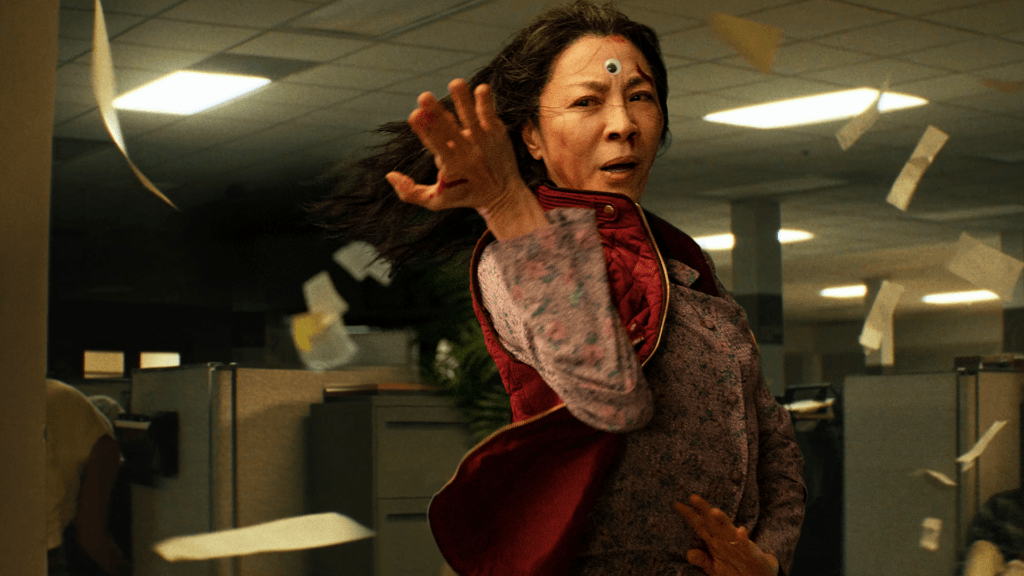
So much is happening in Everything Everywhere All at Once—and it goes on so relentlessly, and for so long—that after a while a kookiness overload begins to weigh it down. Once you’ve absorbed the wild fanny-pack smackdown, the marauding bagel, and the sight of a monstrous Jamie Lee Curtis tearing down a door, you may be a little too tuckered to maintain excitement for the movie’s other oddities—the puppy-flinging, the butt-plugging, the floppy hot-dog-fingered hands. There is an endless uproar.
This picture is by Dan Kwan, Daniel Scheinert and is therefore not surprising. They write and direct under the same name Daniels. The 2016 feature was their debut film. Swiss Army Man—the story of a fart-propelled corpse, played by Daniel Radcliffe—was no run-of-the-mill affair either. But All is vastly more complex—or complicated, anyway. The motivating notion is that every choice made by every human being creates a “branching universe”—an alternate reality in which every rejected possibility takes root and flourishes, independent of the originating human’s existence, which of course continues on.
One day, a confused Chinese-American woman called Evelyn Wang is able to reveal this undiscovered multiverse (the ageless Hong Kong action goddess Michelle Yeoh). Evelyn and Waymond run a laundry that accepts coins in Los Angeles with Joy (Stephanie Hsu), their daughter. The Marvelous Mrs. Maisel), and, at the moment, her ancient father, Gong Gong (the great James Hong). It’s not going as planned for the Wangs. Waymond is seeking a divorce and there are tax problems. Strange things happen during a visit to the IRS. Evelyn is riding up in an elevator with Waymond when he suddenly morphs into another person—well, another Waymond. This version of her husband tells Evelyn that she’s in the crosshairs of “a great evil”—an entity called Jobu Tupaki. He advises Evelyn to be cautious. He says, “I have seen you die in a thousand different ways.”
Evelyn quickly finds herself whizzing through dimensions in a bizarrely edited tour that shows all of the other lives she could have had, but did not. You see Evelyn wielding a terrifying-big knife at Benihana’s steakhouse and then glaming at the premier of a new movie about martial arts. There’s also a Bollywood universe, and some kind of pizza world, and—one of the film’s most endearing interludes—a world with no people in it at all: only a pair of rocks snuggling on a slope. Evelyn, in the middle of this interdimensional chaos checks in with Waymond the original: “I saw mine without you,” she said. It was wonderful.
It’s surprising that the movie, despite its frantic pace which can last more than two hours and is very exhausting, shows such tenderness. The movie shows the changing nature of relationships and sometimes the difficult dynamics between families. We are left amazed at how they manage to show this without any hipster detachedness. It is an entertaining movie that doesn’t contain a smidgen of cynicism. However, anyone looking for eternal human truths may wish that this movie contained more than the “You need to be kind” statements and “We can make whatever we like, it doesn’t matter.”
One of the picture’s most admirable achievements is its provision—at last—of a true starring role for the great Michelle Yeoh, an incandescent screen presence who has been making films for nearly 40 years now. She will reign for many more years.