
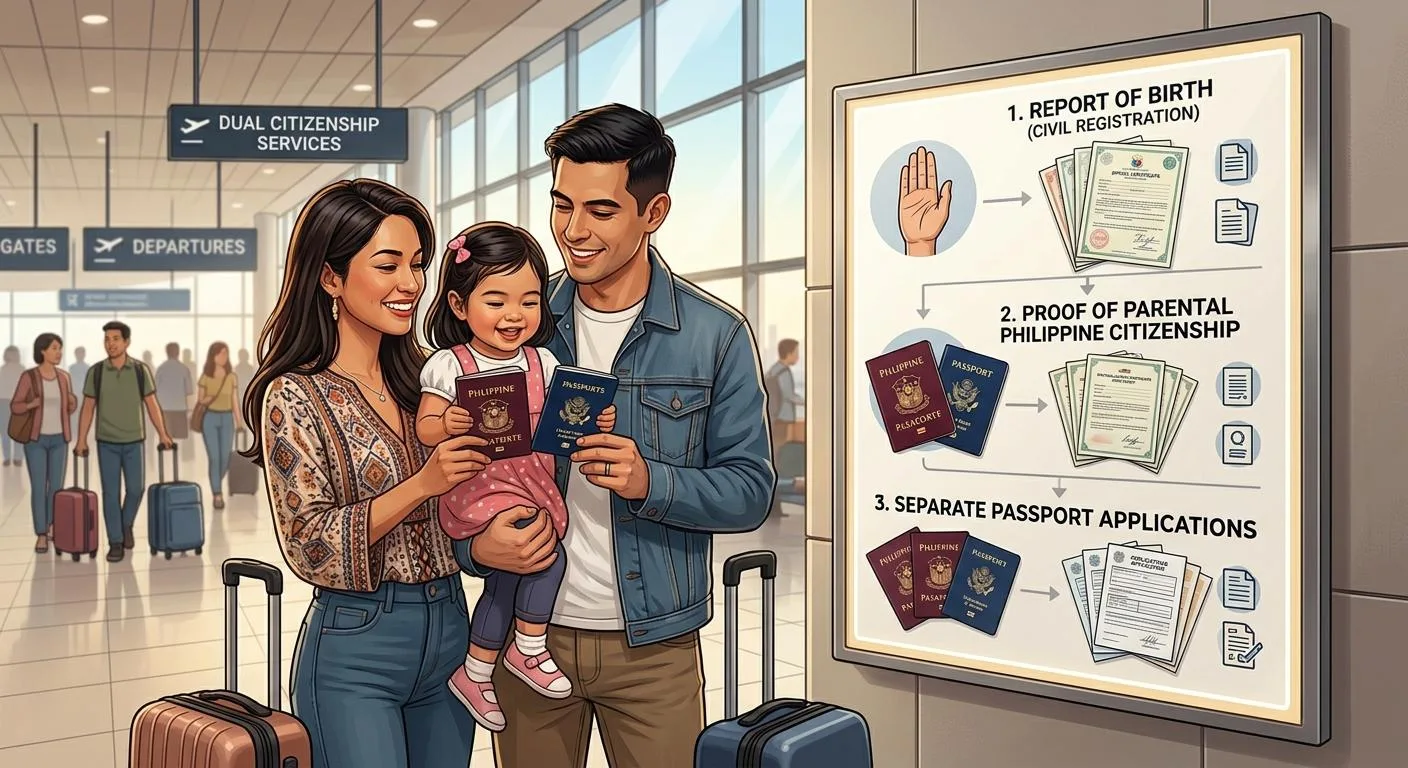
Children born abroad to qualifying Filipino parents may possess Philippine nationality from birth, while accurate civil registration, proof of parental citizenship and separate passport procedures determine how families document that status across international borders.
WASHINGTON, DC, November 28, 2026
Children born outside the Philippines can acquire Philippine citizenship through a Filipino mother or father, even when they have never lived in the country, because constitutional nationality rules primarily examine parental citizenship at the time of birth.
For Filipino American, Filipino Canadian and other overseas households, documenting that existing status can strengthen family connections and simplify later administrative transactions, although the correct procedure depends on historical citizenship facts rather than ancestry claims alone.
Philippine Citizenship Follows a Parent’s Nationality
Article IV of the 1987 Philippine Constitution recognizes people whose fathers or mothers are Philippine citizens, establishing a descent-based nationality rule that ordinarily does not depend on the child’s birthplace, the parents’ marriage, or their residence in the Philippines.
Under the current constitutional framework, decisive evidence generally shows that at least one parent was Filipino when the child was born, making historical passports and civil records particularly important when citizenship status later changed.
A Philippine surname, family photograph or grandparent’s account may help identify potential records, but none independently proves that the relevant parent possessed citizenship at the legally decisive time or that the claimed parent-child relationship is documented.
The Date of Birth Can Change the Legal Analysis
The 1987 Constitution also preserves a special provision for people born before January 17, 1973, of Filipino mothers who elected Philippine citizenship upon reaching majority, reflecting differences between older constitutional rules and later recognition of maternal transmission.
Adults researching historical claims should therefore identify the constitution applicable to their birth and any election of nationality, rather than assume that modern consular descriptions for newborn children govern every applicant born several decades earlier.
Later registration may document nationality already possessed at birth, but registration cannot rewrite the law that applied on the original birth date or erase a missing statutory election when one was legally required.
Report of Birth Creates the Philippine Civil Record
Philippine embassies and consulates receive a Report of Birth for qualifying births within their territorial jurisdiction, transmit accepted information to the Philippine Statistics Authority for registration, and create an official record usable in later government transactions.
The report is not ordinarily a naturalization petition for a child born Filipino, because the underlying citizenship derives from constitutional parentage, while registration provides the documentary means to demonstrate that status to institutions.
The Philippine Statistics Authority subsequently maintains the registered civil information, while consular processing and later requests for certified records can take different periods depending on document transmission, office workload and the method used to obtain official copies.
Families should contact the mission responsible for the place of birth rather than the consulate nearest their current home, because consular jurisdictions may be defined by particular states, provinces, or countries.
Proof of Citizenship at Birth Is Essential
A foreign birth certificate showing the parents’ names usually forms the foundation of the application, accompanied by the parent’s relevant Philippine passport, citizenship records and immigration documents establishing nationality at the child’s birth.
An expired Philippine passport may be useful if a parent later naturalized abroad, but the applicant should confirm what additional evidence the consulate currently requires under its published rules before treating passport possession as conclusive proof of citizenship on a particular date.
Where the parent has become a foreign citizen, immigration records and the foreign naturalization certificate can help clarify whether Philippine citizenship continued through the child’s birth or had already been lost under the rules then applicable.
Marriage certificates, official name-change instruments and parents’ identification can also be necessary, especially where foreign and Philippine documents follow different surname conventions or where a parent’s civil status changed after the child was born.
Delayed Registration Remains Possible
Report births promptly, but families who missed the ordinary reporting period can often submit a delayed Report of Birth with additional documentation rather than assuming adulthood or a long period overseas extinguished a valid citizenship claim.
Consular instructions commonly require an affidavit explaining registration more than one year after birth, and applicants may need historical identification records or supplemental proof connecting a parent to the child’s original foreign registration.
Late filing should not be confused with a guarantee that officials will accept every historical claim, since documentation may be incomplete, parents may be unavailable and the reviewing office must still confirm eligibility under the correct constitutional period.
An adult seeking recognition decades later should be particularly careful about dates and original supporting documents, because the relevant parent’s nationality may have changed through foreign naturalization between the child’s birth and the belated reporting appointment.
Overseas Naturalization Can Interrupt Transmission
A parent who became a naturalized citizen of another country may have lost Philippine citizenship under the applicable law, making the chronology of foreign naturalization and subsequent Philippine reacquisition essential when evaluating a child born abroad.
If the parent was no longer Filipino when the child was born, the ordinary constitutional citizenship-by-birth claim cannot simply be assumed, even when the parent previously held a Philippine passport and maintained cultural ties.
Families should gather the naturalization certificate, any later Philippine oath and official approval documents before seeking advice, because accurately establishing those dates helps determine whether birthright citizenship or another legal procedure might apply.
Republic Act 9225 Provides Another Potential Route
Republic Act 9225 enables qualifying former natural-born Filipinos who lost Philippine citizenship through foreign naturalization to reacquire citizenship by taking the prescribed oath, but this procedure addresses a different legal event from registering a child Filipino at birth.
The law also provides derivative citizenship for an unmarried child younger than 18 when a qualifying parent reacquires citizenship, including children within the statute’s legitimate, nonmarital and adopted categories, subject to the prescribed documentation.
A child already 18 when the parent reacquires citizenship is not automatically covered by that derivative provision, so the family must explore any available recognition or naturalization procedure instead of filing an unsupported birthright claim.
When a minor qualifies derivatively, the family should preserve the approval and identification documents issued through the parent’s reacquisition case, because those records may be essential to later civil registration and first passport applications.
A 2026 Justice Department Clarification Matters
A Philippine Department of Justice opinion released in 2026 clarified that a Bureau of Immigration identification certificate recognizing Philippine citizenship can support processing of a Report of Birth in certain cases involving parents who had naturalized abroad before the child’s birth.
The clarification does not declare every such child Filipino from birth, because it distinguishes recognition of an individual’s citizenship from the separate statutory derivative benefit available to qualifying children when a parent reacquires Philippine nationality.
Families with unusual histories should ask the competent Philippine authority which recognition document is necessary, since the correct sequence can involve the Bureau of Immigration before a consular civil registry accepts the birth report.
U.S. Dual Citizenship Does Not Require Choosing One Passport
Children who acquire American citizenship under United States law and Philippine citizenship through a qualifying Filipino parent may lawfully hold both nationalities, but each country’s passport, entry and documentation obligations remain independently applicable.
The U.S. State Department’s dual-nationality guidance explains that American citizens, including dual-national children, generally must use U.S. passports to enter and leave the country, even when they have valid foreign travel documents.
Families should distinguish citizenship acquired at birth from later voluntary naturalization, because the method of acquisition can affect Philippine reacquisition questions, while U.S. nationality remains governed by separate U.S. legal standards.
Recent News Highlights Families’ Continued Interest
A Philippine Daily Inquirer report on dual citizenship described an embassy clarification that Filipino Americans retain established opportunities under current law, including recognition of children born abroad to Filipino parents and the separate reacquisition process for former citizens.
That discussion illustrates why families should verify published laws and official embassy announcements rather than accept social media claims that routine registration has ended, dual citizenship has been prohibited or parental nationality is irrelevant.
The report also emphasized the distinction between people already Filipino at birth and adults invoking Republic Act 9225, a separation that can prevent unnecessary applications, incorrect oaths and mistaken expectations about passports and citizenship.
Philippine Passports Require Separate Applications
A completed Report of Birth can support a first Philippine passport application, but civil registration does not itself issue travel documents, and applicants must satisfy the Department of Foreign Affairs’ identity, personal appearance and biometric requirements.
Parents should verify the passport instructions for minors, including attendance and authorization requirements, while adults registering their birth late may need additional identity evidence before the consulate can process a first passport request.
The Philippine Statistics Authority copy may not become available immediately after consular registration, so families should confirm whether the consulate will accept its issued Report of Birth for a particular passport appointment during the intervening period.
The New Philippine Passport Act of 2024 separately addresses evidence of citizenship and identity in passport applications, reinforcing that a recognized nationality entitlement and the issuance of a biometric travel document involve distinct legal checks.
Consular Requirements Differ Across Locations
The Philippine Embassy in Washington specifies jurisdictions for its Report of Birth service, while Philippine consulates in Canada and other countries publish separate checklists concerning original certificates, notarized forms, return envelopes, and applicable administrative fees.
For example, the Vancouver consulate identifies British Columbia, Yukon, and the Northwest Territories as its birth-reporting jurisdiction, while other Canadian offices cover different provinces, underscoring why the place of birth must guide initial contact.
Families who move between consular districts after a child’s birth should preserve an address history and check the original place of delivery, because a convenient nearby office may lack jurisdiction over that foreign civil registration.
Fees, document copy counts and appointment formats can change without extensive public notice, so families should obtain current instructions from the responsible mission rather than assume a form downloaded years earlier will remain acceptable for submission.
Names and Parentage Must Be Documented Consistently
Philippine civil registry rules can require careful treatment of the child’s middle name, parents’ maiden surnames and recognition of paternity, especially when the foreign birth certificate follows naming practices different from those ordinarily applied in Philippine records.
Where parents were unmarried, additional affidavits may be necessary to establish paternal acknowledgment or a child’s authorized surname, but families should not alter a foreign certificate merely to create superficial consistency across jurisdictions.
Documents concerning adoption, marriage after birth or a lawful correction should connect existing and amended records transparently, allowing officials to assess the actual legal relationship without relying on an invented or incomplete family narrative.
Historical Records Can Become More Valuable With Age
Children who grow up abroad may later need a Philippine birth record for education, identity documentation, inheritance matters, or administrative services, making it useful to preserve original certificates and registration receipts even before any planned relocation.
Parents should maintain copies of the Philippine Report of Birth, foreign registration and evidence of nationality at birth, because those records can become harder to retrieve after family moves, office closures or the death of a parent.
Securing documents early may also help another generation establish its own nationality position, although every new claim requires examining the parent’s status on the relevant birth date rather than assuming transmission without limits.
A future child born in another country may depend on records showing that the intermediate parent actually held Philippine citizenship at birth, making accurate registration today important to the documentary history of a growing transnational family.
Legal Identity Changes Require a Clear Documentary Trail
Families consulting Amicus International Consulting’s new identity services should distinguish legitimate privacy planning and legally changed names from any attempt to fabricate parentage or conceal historical nationality facts in a government registration process.
A valid court-ordered name change can be documented through certified records, whereas an invented birth history cannot replace the real relationship between a child and the Filipino parent whose nationality supports the claim.
Consular officials must be able to reconcile former names, foreign records and current identification, and applicants should provide truthful explanations whenever required rather than treat confidentiality as a reason to withhold material evidence.
Family Mobility Planning Must Respect Official Issuance
People exploring Amicus International Consulting’s second passport services may find Philippine descent an important topic for professional review, but no private adviser can grant citizenship that the applicable Philippine law does not recognize.
A reliable plan distinguishes proof of nationality at birth, late civil registration, derivative citizenship after parental reacquisition and actual passport issuance, recognizing that these different routes involve different authorities, supporting documents and eligibility rules.
The underlying opportunity is substantial for qualifying families, because Philippine nationality can pass to children born overseas through an eligible parent, yet only accurate records and authorized procedures turn that legal status into dependable documentation, rather than unsupported promises that foreign-born children automatically qualify despite gaps in parental citizenship, missing civil records or unresolved questions about the applicable law.