
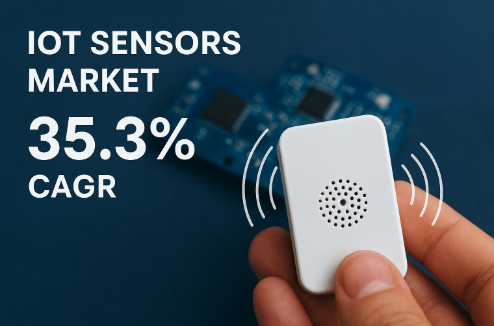
The IoT Sensors Market has emerged as one of the most dynamic and transformative segments within the global technology landscape. As industries rapidly adopt digitalization, smart connectivity, and automation, IoT sensors play a crucial role in enabling real-time data collection, monitoring, and decision-making. These sensors are embedded in devices, machinery, infrastructure, and consumer products to track parameters such as temperature, pressure, motion, humidity, light, and gas levels. Their ability to connect physical environments with digital systems is driving widespread adoption across manufacturing, healthcare, automotive, agriculture, smart cities, and energy sectors.
IoT Sensors Market Size and Growth Outlook
According to the SNS Insider, The IoT Sensors Market was worth USD 12.64 billion in 2023 and is forecast to surge to USD 191.04 billion by 2032, registering a remarkable CAGR of 35.3% during the forecast period from 2024 to 2032.
The IoT Sensors Market is witnessing unprecedented expansion driven by rapid technological advancements and rising demand for connected ecosystems. In 2023, the market demonstrated a strong valuation base, reflecting early-stage maturity across multiple industries. Looking ahead, the market is projected to experience exponential growth, supported by increasing investments in smart infrastructure, industrial automation, and AI-powered analytics.
Key Drivers Accelerating the IoT Sensors Market
Multiple factors are fueling the rapid expansion of the IoT Sensors Market. One of the primary drivers is the growing adoption of Industry 4.0 practices, where connected sensors enable predictive maintenance, asset tracking, and operational efficiency. The rise of smart homes and smart cities is further increasing demand for sensors used in security systems, traffic monitoring, energy management, and environmental sensing. Additionally, advancements in wireless communication technologies such as 5G, LPWAN, and NB-IoT are enhancing data transmission capabilities, making IoT sensor deployment more scalable and cost-effective.
Technological Advancements Shaping the IoT Sensors Market
Technological innovation is at the core of the IoT Sensors Market evolution. Miniaturization of sensors, improved battery life, and integration of AI and machine learning algorithms are significantly enhancing sensor performance. Modern IoT sensors can process data at the edge, reducing latency and dependency on centralized cloud systems. Moreover, the development of MEMS-based sensors and flexible sensors is opening new opportunities in wearable devices, healthcare monitoring, and industrial robotics. These innovations are not only expanding application areas but also improving accuracy, reliability, and real-time responsiveness.
Application Expansion in the IoT Sensors Market
The IoT Sensors Market is benefiting from its extensive application range across diverse industries. In healthcare, IoT sensors are used for remote patient monitoring, wearable fitness devices, and smart medical equipment. In agriculture, sensors enable precision farming by tracking soil moisture, weather conditions, and crop health. The automotive sector leverages IoT sensors for advanced driver-assistance systems (ADAS), vehicle diagnostics, and connected mobility solutions. Similarly, in manufacturing and energy, IoT sensors improve productivity, safety, and sustainability by enabling real-time operational insights.
Challenges Impacting the IoT Sensors Market
Despite its strong growth outlook, the IoT Sensors Market faces several challenges that could impact adoption rates. Data security and privacy concerns remain critical, as connected sensors continuously transmit sensitive information. Integration complexity, lack of standardization, and high initial deployment costs can also act as barriers, particularly for small and medium-sized enterprises. Additionally, issues related to data overload and sensor calibration must be addressed to ensure reliable and actionable insights. Overcoming these challenges will be essential for sustaining long-term market growth.
Regional Performance of the IoT Sensors Market
Regionally, the IoT Sensors Market shows varied growth patterns. North America currently holds a significant market share, driven by early technology adoption, strong presence of key market players, and large-scale investments in smart infrastructure. Europe follows closely, supported by industrial automation initiatives and strict environmental regulations promoting smart energy solutions. Meanwhile, Asia-Pacific is expected to witness the fastest growth during the forecast period due to rapid urbanization, expanding manufacturing bases, and increasing adoption of smart devices in countries such as China, India, Japan, and South Korea.
Competitive Landscape of the IoT Sensors Market
The IoT Sensors Market is highly competitive, with global and regional players focusing on innovation, partnerships, and product differentiation. Companies are investing heavily in R&D to develop advanced sensor technologies with improved connectivity and lower power consumption. Strategic collaborations with cloud service providers and AI solution vendors are also shaping the competitive environment. As demand grows, market participants are increasingly targeting niche applications to strengthen their market position and expand their global footprint.
Future Opportunities in the IoT Sensors Market
The future of the IoT Sensors Market looks highly promising, with emerging opportunities in areas such as smart healthcare, autonomous systems, renewable energy management, and environmental monitoring. The convergence of IoT with digital twins, blockchain, and artificial intelligence is expected to unlock new business models and revenue streams. As costs continue to decline and interoperability improves, IoT sensors will become an integral component of next-generation digital ecosystems, driving sustained market expansion through 2032.
Frequently Asked Questions (FAQs)
Q1. What is the CAGR of the IoT Sensors Market during the forecast period?
The IoT Sensors Market is expected to grow at a robust CAGR of 35.3% between 2024 and 2032, reflecting strong demand across multiple industries and applications.
Q2. What is the forecast value of the IoT Sensors Market by 2032?
By 2032, the IoT Sensors Market is projected to reach a valuation of approximately USD 191.04 billion, up from USD 12.64 billion in 2023.
Q3. Which region is expected to experience the fastest growth in the IoT Sensors Market?
The Asia-Pacific region is anticipated to witness the fastest growth during the forecast period, driven by rapid industrialization, smart city projects, and expanding adoption of IoT technologies.