
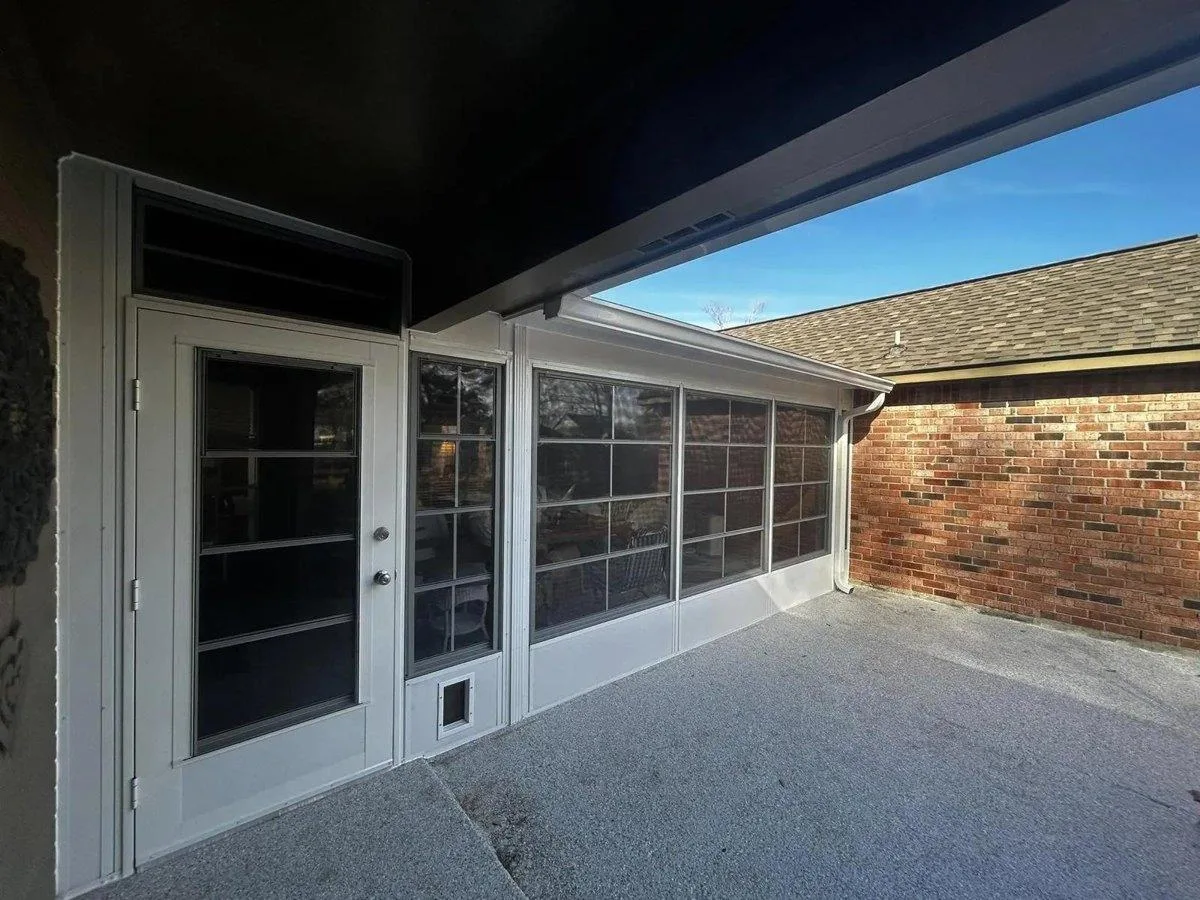
Most new homes built across the South come with some kind of outdoor living space attached. The harder question for Baton Rouge-area owners is how many months of the year that space actually gets used.
Federal housing and energy data offer a useful frame. They show how common porches and patios have become, how Louisiana homes are cooled, and which window ratings matter most in a hot, humid climate.
Porches and Patios Are Now Standard on New Southern Homes
The Census Bureau’s Characteristics of New Housing tracks the features of new single-family houses completed each year, by region. Its 2025 figures, published on July 1, 2026, cover about 584,000 new homes completed in the South.
Only 7% of those homes had none of the three outdoor features the survey counts: a patio, a porch or a deck. The most common setup, at 41%, was a home with both a patio and a porch.
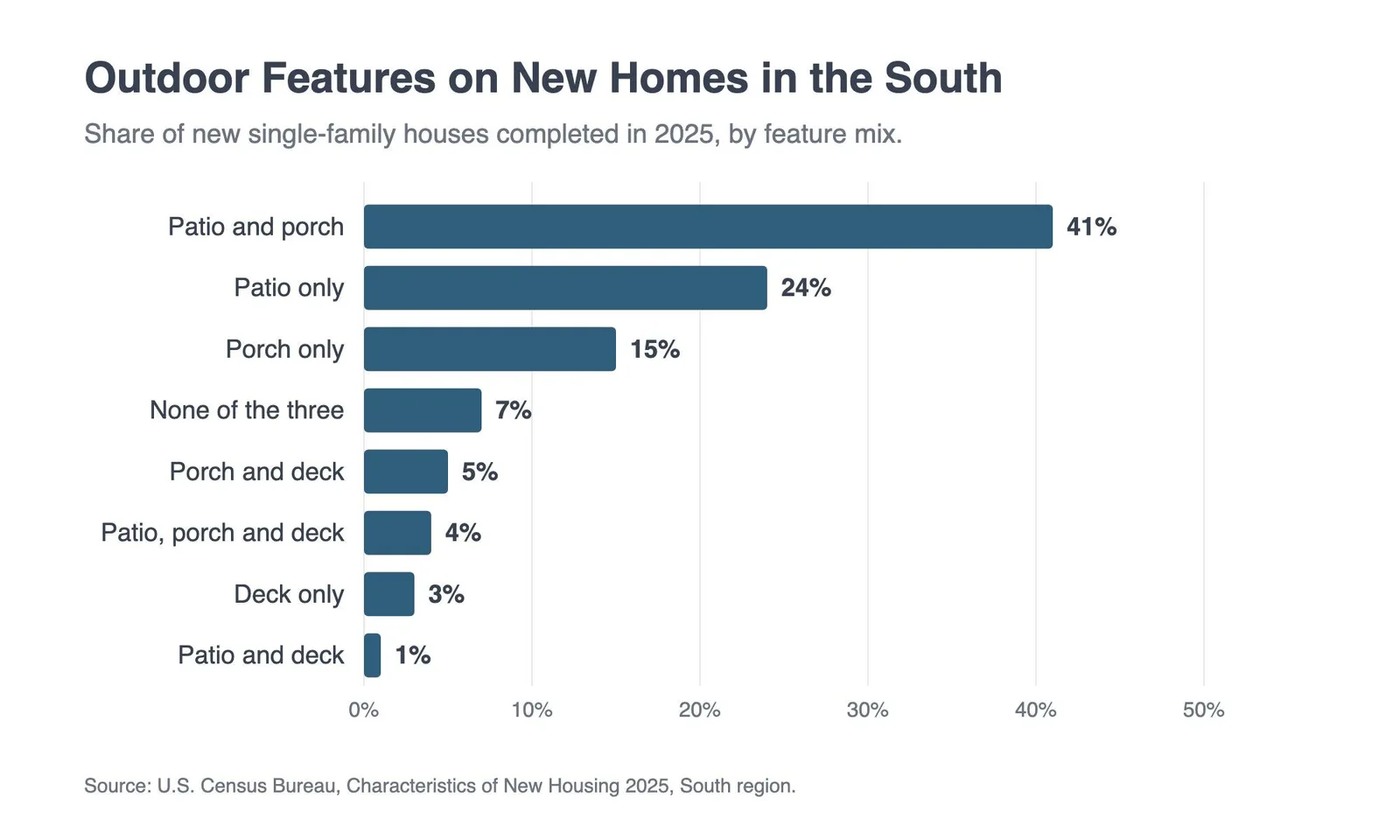
Outdoor features on new Southern homes, 2025.
Adding up the categories, about 64% of new Southern homes completed in 2025 had a porch of some kind, and about 70% had a patio, by our arithmetic from the Census counts.
The Patio and Porch Pairing Keeps Growing
The trend runs in one direction. In 2010, 28% of new Southern homes had both a patio and a porch. By 2025, that share had reached 41%.
Over the same stretch, the share of new Southern homes with no patio, porch or deck fell from 11% to 7%. The South also accounted for about 58% of the roughly 1,005,000 new single-family homes completed nationwide in 2025.
These figures describe new construction, not every house already standing. Still, they show that a porch or patio has become a normal part of the Southern floor plan, and that space is the natural place to start when an owner thinks about enclosing part of the house.
How Louisiana Homes Stay Cool
Any room that is closed in with glass has to be cooled. The Energy Information Administration’s 2020 Residential Energy Consumption Survey shows how Louisiana households handle that today.
The survey found that 93% of Louisiana’s roughly 1.73 million occupied homes use air-conditioning equipment, compared with 89% nationally. Louisiana homes also lean hard on ceiling fans, at 87% of homes, compared with 72% for the country.
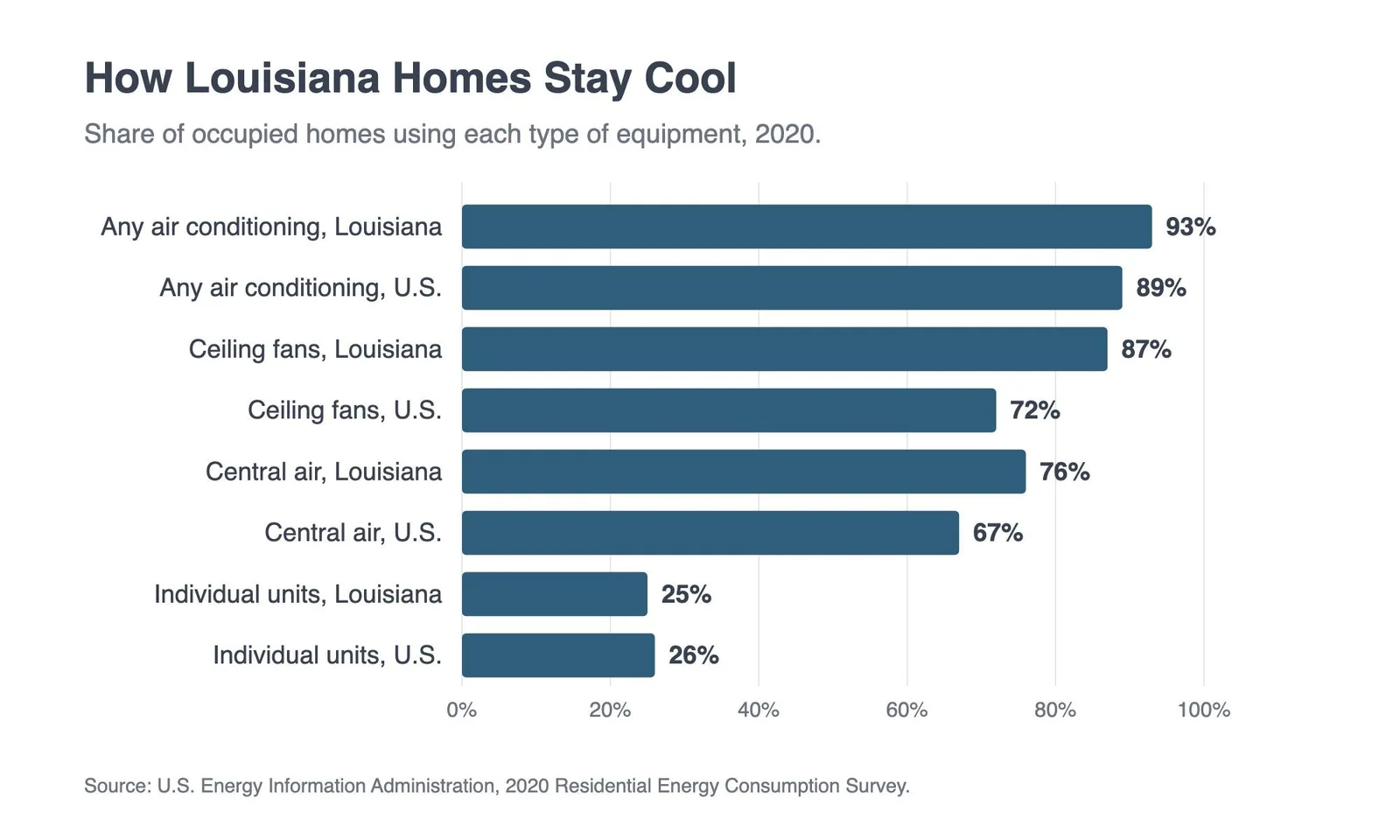
Cooling equipment in Louisiana and U.S. homes, 2020.
Central air was the main approach, used in 76% of Louisiana homes. About 25% used individual units, a group EIA defines to include ductless mini-splits, window or wall units and portable air conditioners. Some homes use both, so the shares overlap.
For a new enclosed room, those are the same two paths: extend the existing system or add a separate unit. The right answer depends on the house and the room, and it is easier to settle during design than after the glass is in.
The Glass Ratings That Matter in South Louisiana
A sunroom is mostly glass, so the glass does most of the work. ENERGY STAR’s certification criteria for windows set different limits by climate zone, based on ratings certified by the National Fenestration Rating Council.
The program’s zone list places every ZIP code it lists for Baton Rouge, Denham Springs, Greenwell Springs, Gonzales and Zachary in its Southern zone. In that zone, a certified window needs a solar heat gain coefficient of 0.23 or lower and a U-factor of 0.32 or lower, with air leakage of no more than 0.3 cubic feet per minute per square foot.
The rating council’s label explains the two main numbers. The solar heat gain coefficient measures how much solar heat a product lets in, and low numbers resist it. U-factor measures how well a product keeps heat from escaping a room, and lower is better.
The same label explains the third figure. Air leakage measures how much outside air will enter a room through a product, which matters for a space that has to hold its cooling through a long, humid summer. The council also notes that in summer months, a low solar heat gain coefficient helps keep a home cool.
The Southern zone’s 0.23 heat gain limit is far tighter than the 0.40 allowed in the North-Central zone. Skylights in the Southern zone are held to a 0.25 solar heat gain coefficient and a U-factor of 0.50.
Questions Worth Asking Before Enclosing a Porch
The data points to a short list of practical questions. None of them require special knowledge, only a look at the house and the paperwork for the glass.
- Will the room be screened, partly glassed or fully insulated, and which seasons should it serve?
- What do the rating labels on the proposed glass show for solar heat gain and U-factor?
- How will the room be cooled: through the existing system or a separate unit?
- Is the room wired for ceiling fans and lighting, given how common fans already are in Louisiana homes?
- Does the neighborhood have a homeowners association that needs to approve the design?
Who Builds Enclosed Rooms in the Area
Tiger Town Construction, a father-and-son outdoor living builder serving Denham Springs and the Greater Baton Rouge area, is one company that builds custom glass sunrooms and four-season rooms. Tiger Town Construction’s sunroom page lists energy-efficient glass and insulated framing, wiring prepared for lighting, fans and outlets, and a design matched to the home’s architecture.
The company says each sunroom is engineered and built to Louisiana code. Its site separates three options: screen rooms that use mesh and stay open-air, sunrooms fully enclosed with glass and insulation for year-round use, and glass rooms that sit between the two.
What the Numbers Add Up To
Most new Southern homes now come with a porch or patio. More than nine in ten Louisiana homes use air conditioning, and most also run ceiling fans.
For anyone weighing an enclosed room, the deciding details are technical rather than cosmetic. Glass rated for the Southern zone, a cooling plan settled early and a clear choice between screen, glass and full enclosure will shape how many months of the year the room actually gets used.