

Most sort their projects by building type. Fewer say in plain words that a licensed architect is on staff, and a third leave the phone number off the home page.
By Clint Sanchez
A school board, a church building committee or a family planning a house will often look at an architect’s website before making contact. Before anyone asks for a proposal, the site has to answer two questions: has this firm built what we need, and is it qualified to build it?
On November 9, 2026, I reviewed the websites of 15 small and mid-size architecture firms in eight states, from Maine and North Carolina to Idaho and Washington. I recorded what each site shows a prospective client about its work, its people and how to reach it.
I found the firms through ordinary web searches for architecture firms in eight cities, skipped national firms with offices in many states, and logged every site in a spreadsheet with the date and each field. No firm is named here. The counts are the point.
A Field Built on Small Offices
Most architecture practices are small. The Census Bureau’s County Business Patterns counted 22,805 employer establishments in architectural services nationally in 2023.
Nearly two in three of them, 14,512, had fewer than five employees. Fewer than 3 percent had 50 or more. The count leaves out owner-only practices with no payroll, so the share of very small firms is, if anything, understated.
For an office that size, the website often has to do the introducing that a marketing staff would handle at a larger firm.
Where the Sites Were Strong
The portfolios were the strongest part of most sites. Thirteen of the 15 grouped their projects by building type or market, such as schools, housing, workplaces or healthcare, so a visitor could go straight to the kind of building they had in mind.
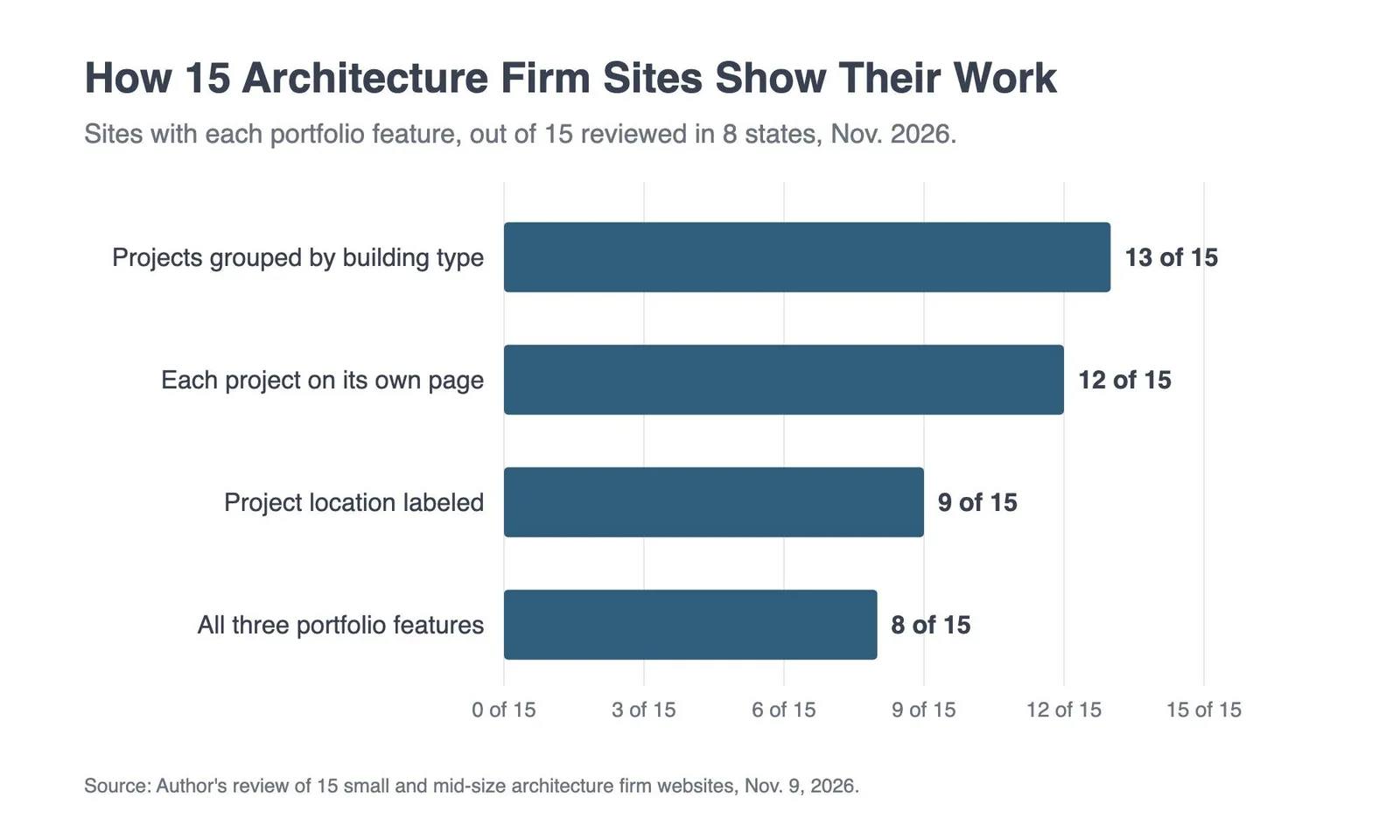
Portfolio features on 15 architecture firm websites, November 2026.
Twelve gave each project its own page. Nine labeled where each project was built, with a city and state under the title or in a short facts panel.
Several of the labeled project pages also gave a short facts panel with the client, the completion year or the square footage, which lets a reader judge the scale of the work at a glance.
Only eight did all three. Three had no page for any individual project. One home page was a slideshow of photos with no captions, where the only text attached to each image was a file name.
Licensure, in Plain Words
Architecture is a licensed profession. The federal Occupational Outlook Handbook states that all states and the District of Columbia require architects to be licensed, and it counted about 124,600 architect jobs in 2025. Licensing, the handbook notes, typically means a degree in architecture, a paid internship and a qualifying exam.
Yet only nine of the 15 sites said in plain words that the firm or a named person was licensed or registered, or listed an NCARB credential. The phrasing varied, from a bio noting a license in two states to a header line describing a licensed firm.
The other six left the reader to work it out. Four referenced membership in the American Institute of Architects or listed a staff title of “Architect.” Two gave no credential at all, one listing staff names and titles only and the other having no team page.
Thirteen sites did name their principals or staff, and 11 listed a specific award or a named publication. The pieces of a credible firm profile were usually there. The licensing line, the one fact a client cannot check by looking at photos, was the item in that group most often left implicit.
Getting in Touch
Contact details were thinner than the portfolios. Ten of the 15 sites put a phone number on the home page, and all five of the others listed one on an inner page.
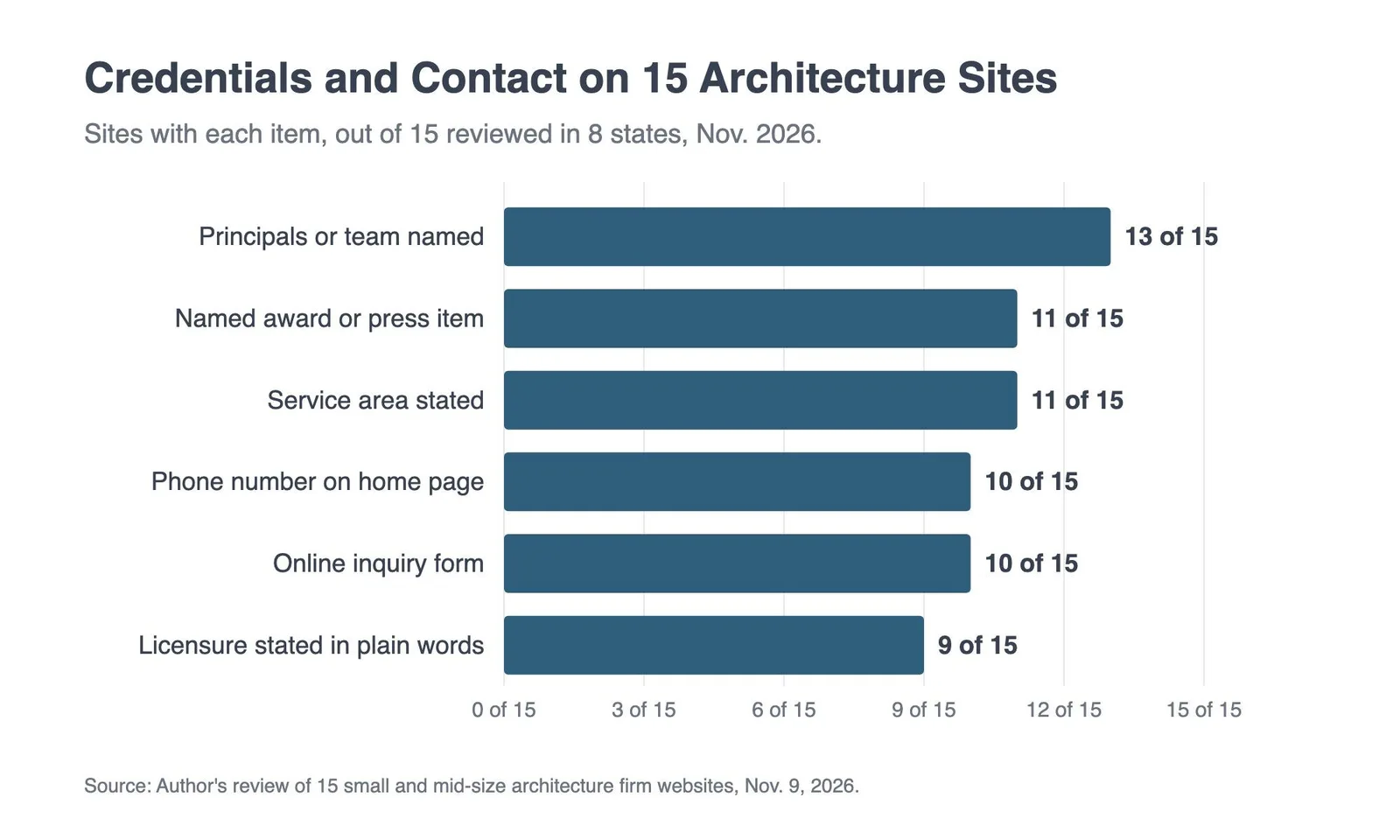
Credential and contact items on 15 architecture firm websites, November 2026.
Ten had an online inquiry form. Two of them asked what kind of project it was and where it was located before anything else. Most of the rest asked for a name, contact details and a message, and five sites had no form at all, only an email address and a phone number.
Eleven said where the firm works, naming a region, a list of states or the communities it serves. The other four gave an office address and nothing more.
Limits of the Review
Fifteen sites is a small sample, and it was not random. The firms came from searches in eight cities, and one pick was replaced because its own contact page said the firm had closed its office and was winding down. The counts describe these sites as they stood on one day in November 2026.
The review measured what a visitor can see, not what wins commissions. A firm may win much of its work through repeat clients, referrals and public requests for qualifications, where the website matters less.
Some judgments also take a call. Licensure counted only when stated in words, so initials after a name and a job title of “Architect” did not count, even though they may reflect a license. A location counted only when it appeared as a label, not inside a project description. Mobile layouts were not checked. Every row, with the definitions, is kept in the spreadsheet behind this piece.
What the Counts Point To
Most of these firms have done the hard part. Their portfolios are grouped by building type, and most give each project its own page.
The gaps sit around the edges: a project page with no location, a team page with no word about licensure, a phone number one click deeper than it needs to be. One published breakdown of website design for architecture firms makes the same point about portfolios, arguing that clients look for firms by building type, not by year.
In a profession where nearly two in three offices have fewer than five people, those fixes are small. They are decisions about what a prospective client reads first, and in this sample, several sites have not made them yet.