
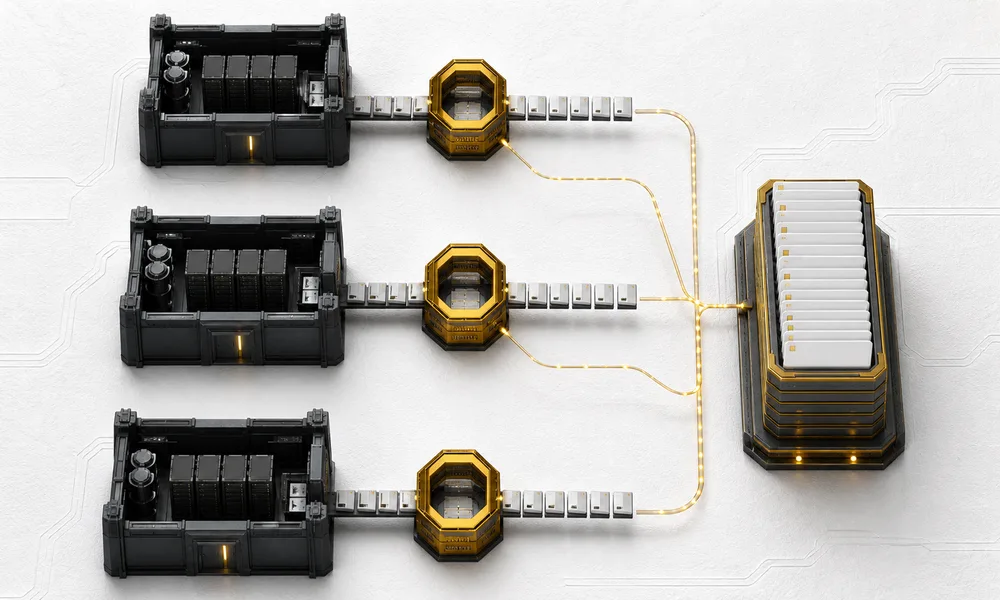
Cybersecurity Maturity Model Certification changes the practical meaning of a file transfer inside the defense industrial base. Moving controlled unclassified information from one approved location to another is not merely a storage operation. It is an activity that touches system boundaries, identities, encryption, logging and the evidence an organization may later need to produce.
The current DFARS CMMC provisions connect contract eligibility to the CMMC status of information systems that process, store or transmit federal contract information or CUI. That wording should focus attention on the complete route a file takes—not only its source and destination.
No replication product can certify an organization or substitute for its assessment. But a poorly designed replication path can enlarge the assessed environment, create unmonitored copies or make otherwise sound controls difficult to demonstrate. Buyers should therefore evaluate data movement as an auditable system.
Draw the Boundary Before Comparing Products
Begin with a data-flow diagram that an assessor and an operations engineer can both understand. Identify each source, destination, relay, management service, credential store, and log repository. Mark where CUI is stored temporarily, including queues, caches, and failed-transfer locations.
The diagram should answer uncomfortable questions. Does traffic pass through a vendor-operated service? Can administrators view file contents? Are management and data channels separate? What happens when the destination is unavailable? Does the system retain a copy on an intermediate node, and if so, for how long?
Boundary work also exposes subcontractor implications. If a replication flow sends CUI to a partner, laboratory, or manufacturing site, the technical design cannot be separated from the contractual flow-down and the receiving organization’s authorized environment. A hostname in a configuration file may represent a legal and compliance dependency.
Avoid assuming that “encrypted” settles the issue. Record the protocols, cryptographic modules, certificate ownership, key rotation process, and behavior when validation fails. Encryption is a capability; secure operation depends on configuration, identity management, and evidence.
Test Identity, Privilege and Integrity as One Control Chain
Replication commonly runs with service credentials because human users cannot supervise every transfer. Those identities deserve the same scrutiny as privileged administrative accounts. Determine what each service identity can read, write, delete, and configure. Remove interactive login where it is unnecessary. Establish how secrets are issued, stored, rotated, and revoked.
Then test the negative cases. Attempt to write outside an approved destination. Present an expired or untrusted certificate. In an isolated test environment, introduce a controlled integrity mismatch and establish which layer detects it. Transport protection and validation of a stored file are separate checks; a successful encrypted session does not prove that a later disk copy is unchanged. Disable an account while a queue is active. Evidence from failure tests is often more revealing than a successful demonstration.
Products should also make operational separation possible. A help-desk operator may need to see that a transfer is delayed without gaining access to CUI. A security analyst may need events but not configuration authority. A replication administrator may need to manage routes without controlling the underlying identity system.
EnduraData’s published description of EDpCloud security and audit features provides a useful starting point for vendor questions, including secure defaults, least-privilege operation, integrity, and structured logging. Those statements still need to be mapped to the buyer’s architecture, configuration, and required CMMC practices.
Demand Logs That Reconstruct an Event
An audit log is valuable only if it helps answer a real question. For a selected file or transfer window, an authorized investigator should be able to determine the source, destination, time, result, and relevant policy. Failed, retried, skipped, and conflicting operations matter as much as completed ones.
Ask where events are stored, who can alter them, and how they reach the organization’s central monitoring platform. Synchronize time across endpoints. Define retention based on contractual, investigative, and operational needs. Test whether identifiers remain useful after logs are exported to a security information and event management system.
The most useful pilot includes an incident narrative. For example: a remote site loses connectivity, files accumulate, an administrator changes a route, connectivity returns, and one file fails integrity validation. The team should use the resulting records to reconstruct the sequence without relying on the administrator’s memory.
Logging should also support continuous operation. Alerts need thresholds that distinguish a transient delay from a growing backlog that threatens a mission process. Buyers should measure the time between a material failure and a visible, actionable signal.
Turn the Pilot Into Assessment-Ready Evidence
A procurement pilot should end with an evidence package, not a presentation. Include the approved data-flow diagram, system inventory, versions, configuration baseline, identity model, cryptographic settings, log samples, test scripts, results, and unresolved exceptions. Assign an owner and review date to every exception.
Test representative CUI patterns without exposing live sensitive content unnecessarily. Include large files, many small files, locked files, interrupted sessions, and recovery after endpoint restart. Measure not just throughput but completeness, latency, integrity, backlog behavior, and administrative visibility.
Document product boundaries with equal care. If backup, immutable retention, malware scanning, or data classification is supplied by another control, state that plainly. A defensible architecture does not require one tool to perform every security function; it requires each function and dependency to be visible.
Finally, require the operations team to repeat the test using written procedures. If success depends on a vendor engineer improvising commands, the pilot has not yet demonstrated a sustainable control. Repeatability is what turns a capability into operating evidence.
CMMC does not make file replication a special compliance category. It makes the consequences of unexamined data movement harder to ignore. Defense suppliers that map the route, constrain identities, verify integrity and retain usable records will be better prepared to explain how CUI moves—and to prove that the real environment matches the diagram.