
Introduction
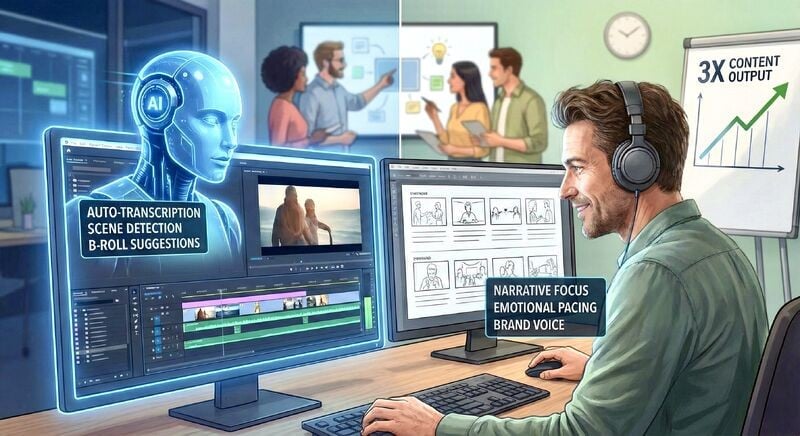
The video landscape is entering a brand new era as synthetic intelligence simplifies planning, editing, captions, and formatting. A ChatGPT video editor can assist creators streamline repetitive tasks at the same time as keeping human creativity and judgment. This technology makes expert-level video production more accessible, connecting text, pictures, audio, and video within flexible workflows.
1. Powerful Ways AI Is Transforming Video Production
Faster Video Planning and Pre-Production
One of the most useful applications of AI happens before editing even begins.
A poorly planned video often creates problems later. Clips can be lacking, the tale can also be disorganized, or the very last recording may additionally include needless clutter. AI-assisted planning can help creators prepare their minds before they open the editing timeline.
. An opening hook.
. A brief introduction.
. The main points.
. Supporting examples.
. A transition between ideas.
. A conclusion or call to action.
This structure doesn’t have to become the final script. It can simply serve as a starting point.
Smarter Editing Workflows
Video editing contains many repetitive activities.
Cutting undesirable sections, arranging clips, growing captions, resizing content, and making ready one-of-a-kind variations can eat up a great deal of time.
AI-assisted software can automate or boost a number of these duties.
For example, speech recognition can identify spoken phrases and connect them with specific moments in a recording. This could make it simpler to discover sections of a long interview or presentation.
AI-Assisted Storytelling and Pacing
Good editing isn’t simply about cutting clips together. It’s about controlling attention.
A strong sequence needs an appropriate rhythm. A long pause may weaken a presentation. A rapid series of cuts may work for an energetic social video but feel distracting in an educational lecture.
A long-form video could become:
. A detailed educational version
. A short explainer
. Several social clips
. A teaser
. A quote-based video
. A vertical mobile version
This creates an important shift in content strategy.
Better Audio, Captions, and Accessibility
Pleasant audio has a prime impact on how professional a video feels.
Background noise, choppy sound, unclear speech, and bad microphone placement can make even strong content hard to understand.
AI-powered audio equipment can help with tasks such as speech enhancement, transcription, noise reduction, and caption technology.
Captions are mainly valued because they improve accessibility and allow people to access content when sound isn’t available.
Personalized Video Content for Different Audiences
Another major opportunity involves personalization.
A technical audience may prefer detailed explanations. Beginners may need simpler language. A professional audience may want a concise presentation, while social media viewers may respond better to a faster opening.
For example, a long educational video might be transformed into:
|
Audience |
Possible Version |
|
Beginners |
Simple explanation with examples |
|
Professionals |
Detailed technical version |
|
Social viewers |
Short, fast-paced summary |
|
Students |
Structured lesson with captions |
|
International audience |
Translated or subtitled version |
This doesn’t mean every variation should be automatically published.
Making Professional Editing More Accessible
Complex software can discourage people from experimenting with video.
Someone may have excellent knowledge of a subject but limited experience with editing timelines. Conversational interfaces can reduce some of that friction.
This is where the concept in the back of a ChatGPT video editor becomes specifically interesting.
Natural-language instructions could make creative technology experience much less intimidating. A person does not necessarily want to understand the name of every enhancing characteristic before asking for assistance.
A More Collaborative Editing Model
AI doesn’t have to function as an automatic editor working independently.
A better model is often collaborative.
The creator provides direction, the software handles suitable technical tasks, and the creator evaluates the result.
This approach combines human strengths and machine strengths.
2. Traditional Editing vs. AI-Assisted Video Production
Understanding the Main Differences
Traditional video editing remains valued and isn’t disappearing overnight.
Professional editors regularly need particular control over timing, sound, colour, motion graphics, transitions, and visual effects. AI-assisted tools don’t always replace that control.
Instead, they can provide another layer of assistance.
|
Editing Area |
Traditional Workflow |
AI-Assisted Workflow |
|
Planning |
Manual outlining |
AI-supported structure |
|
Transcription |
Manual or separate tool |
Automated assistance |
|
Captions |
Manual correction |
Automatic generation plus review |
|
Clip selection |
Manual searching |
AI-supported identification |
|
Resizing |
Manual export setup |
Automated format options |
|
Visual concepts |
Manual research |
AI-assisted ideation |
|
Editing decisions |
Human-led |
Human-led with AI suggestions |
|
Quality control |
Human review |
Human review remains essential |
The difference isn’t simply speed.
Where Human Editors Still Matter
AI systems can make mistakes.
They may misunderstand sarcasm, select an important sentence as an unnecessary pause, misread a person’s intention, or produce a visual that doesn’t fit the context.
This is why human oversight remains essential.
Editors provide qualities that automated systems can’t reliably reproduce in every situation.
They understand why a particular moment matters.
Responsible Use of AI Video Technology
As AI video tools become more capable, responsible use becomes increasingly important.
Creators should consider several factors.
Accuracy
AI-generated captions, scripts, summaries, and visuals must be checked before publication.
Originality
Creators must make sure that AI-assisted paintings do not, by chance, imitate covered fabric or misrepresent another person’s paintings.
Transparency
When AI plays a huge role in creating synthetic media, appropriate disclosure may be vital, depending on the context and platform.
Privacy
Users must be cautious about uploading private recordings, private documents, or personal information to services without understanding their data guidelines.
Human Review
Important content material must receive human assessment, especially whilst it includes news, schooling, finance, health, prison facts, or other areas wherein mistakes could have significant consequences.
These standards don’t restrict creativity. They make AI-assisted creativity more truthful.
How Creators Can Start Using AI Video Tools
Creators do not need to remodel their complete workflow overnight.
A sluggish method is often extra realistic.
Step 1: Start With One Repetitive Task
Choose something that takes an excessive amount of time.
Captions are a terrific example.
Step 2: Test AI Assistance
Let the software carry out the first pass.
Step 3: Review the Result
Check accuracy, timing, tone, and formatting.
Step 4: Refine the Workflow
Identify which components honestly save time and which nonetheless require manual work.
Step 5: Expand Carefully
Once one task works well, introduce AI help into another part of the process.
This method avoids the common mistake of expecting one tool to solve every creative challenge.
Choosing the Right AI Video Workflow
The best workflow depends on the type of content being produced.
A short social media creator may prioritize speed and automatic formatting.
An educator may care more about captions, transcripts, clarity, and structured explanations.
A business may prioritize brand consistency and multiple versions.
3. The Future of AI Video Creation
Conversational Editing May Become More Common
Editing software has traditionally been visual.
Timelines, menus, panels, sliders, and buttons dominate the experience.
Conversational interfaces introduce another possibility.
Creators may increasingly explain the desired outcome instead of manually navigating every function.
That could make video production feel closer to having a digital production assistant.
One Source Video Could Produce an Entire Content Package
The future may also involve greater content repurposing.
A single recording could potentially become:
. A full-length video.
. Short-form clips.
. A written article.
. Social media posts.
. Caption files.
. A transcript.
. A presentation outline.
. Supporting images.
This approach could be especially useful for small teams.
AI Video Editing Could Lower the Barrier to Entry
Perhaps the most critical long-term effect is accessibility.
Someone who could not formerly have the funds for a professional editing guide may be capable of creating polished content with AI assistance.
Students can experiment with video storytelling. Small businesses can explain their products. Teachers can create visual lessons. Independent creators can publish more consistently.
That doesn’t guarantee success.
What Skills Should Creators Learn?
AI doesn’t make creative skills useless. It changes which skills deserve the most attention.
Creators should continue developing:
. Storytelling
. Audience research
. Visual composition
. Basic audio knowledge
. Editing judgment
. Fact-checking
. Copyright awareness
. Prompt writing
. Brand consistency
. Critical thinking
Prompting can help, but it should not be the best skill.
Conclusion
AI is reworking video production by way of simplifying repetitive responsibilities and streamlining creative workflows. A ChatGPT video editor can support planning, editing, captions, and content creation, while human judgment remains important. Combining AI with creativity enables creators to produce attractive, accurate, and meaningful videos.
FAQ’s
What is a ChatGPT video editor?
A ChatGPT video editor refers to the AI-assisted video editing era, which can use natural-language instructions to assist with tasks that include planning, enhancing, captions, content creation, and innovative improvement. Capabilities vary by platform, so customers have to take a look at the particular functions available on each device.
Can AI completely edit a video without human help?
Some AI tools can automate massive quantities of video editing, but full automation isn’t always ideal. Human review stays important for storytelling, accuracy, context, pacing, visual consistency, and overall quality.
Is AI video editing useful for novices?
Yes. AI assistance can reduce the technical learning curve by helping customers with repetitive tasks and allowing them to describe their ideas in ordinary language. Beginners can still benefit from learning simple enhancement principles.