
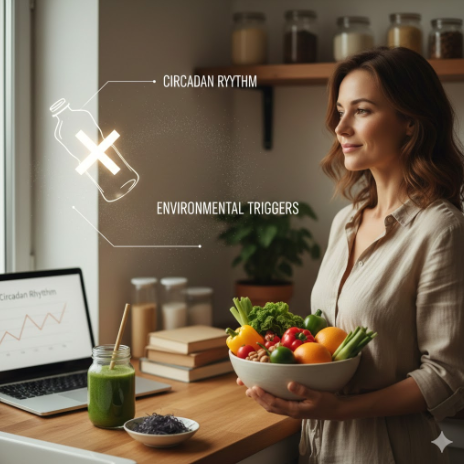
Search interest in hormone concerns has climbed alongside two big shifts in daily life. First, exposure has become more complex. Modern homes, workplaces, and consumer products introduce more chemical contact points than past generations faced. Second, diets have changed fast. Ultra-processed convenience food has become a default, not an exception, and metabolic strain is rising in many countries. When women describe fatigue, irregular cycles, acne, hair changes, sleep disruption, mood swings, or weight shifts, they often label it as a hormone problem. Sometimes it is. Sometimes it is a mix of hormones, sleep, stress, nutrients, and underlying conditions that look like hormones on the surface.
The phrase hormonal imbalance causes is useful, but only if it triggers better questions instead of a single shortcut diagnosis. Hormones are a communication network. Ovaries, thyroid, adrenal signaling, insulin, and the brain all interact. That is why one trigger rarely explains everything, and why small exposures can stack into a bigger effect over time.
What follows is an editorial review of the two trigger categories that keep showing up across public health conversations and research summaries. Environmental endocrine disruptors and dietary patterns that push insulin resistance, inflammation, and micronutrient gaps.
Why the conversation is shifting from symptoms to exposures
Public health agencies and major medical organizations increasingly treat endocrine-disrupting chemicals as a real policy concern. The World Health Organization describes endocrine-disrupting chemicals as a public health priority and notes associations with reproductive problems and other hormone-related outcomes. The US National Institute of Environmental Health Sciences explains that endocrine disruptors may mimic or interfere with the endocrine system and link it with health problems in people and wildlife. The Endocrine Society defines an endocrine-disrupting chemical as an exogenous chemical or mixture that can interfere with any aspect of hormone action and lists sources such as pesticides, plastics, food contact materials, and cosmetics.
That framing matters because it changes the question from what is wrong with you to what you are repeatedly exposed to.
Environmental triggers that can influence hormone signaling
Environmental factors rarely act like a switch. More often, they behave like background noise. Over months and years, repeated low-level exposures can interact with genetics, life stage, sleep, and diet.
Plastics and food contact chemicals
A consistent theme in endocrine disruptor discussions is exposure through plastics and materials that contact food. The Endocrine Society notes that endocrine disruptors can come from chemicals in plastic polymers and food contact materials. NIEHS also points to natural or man-made chemicals that may interfere with hormone systems.
In everyday terms, this category includes situations like hot food in plastic, frequent packaged food consumption, and repeated contact with plastic items that wear down over time. It does not mean every plastic contact is catastrophic. It means the most repeated and most avoidable exposures are worth noticing when someone is trying to understand a hormonal imbalance.
PFAS and persistent exposures
PFAS are often discussed as long-lasting chemicals found in water, food packaging, and consumer products. A CDC-hosted review on PFAS and ovarian function describes PFAS as endocrine-disrupting chemicals based on their ability to interfere with reproductive function and hormonal signaling and notes experimental and epidemiologic evidence suggesting risks for women’s health.
This is a key point for the modern debate. Some exposures are hard to see, hard to avoid, and slow to leave the body. That reality is one reason people feel stuck when symptoms persist.
Personal care products and daily skin contact
Hormone-relevant exposures are not only in food. Cosmetics, fragrances, and personal care products are often mentioned in endocrine disruptor discussions. The Endocrine Society explicitly lists cosmetics among categories where endocrine-disrupting chemicals may be found.
This is not an argument for fear. It is an argument for prioritization. If a person uses many fragranced products daily, that may be a higher leverage place to simplify than obsessing over a rare exposure.
Pregnancy and early life sensitivity
Some of the strongest public health language around environmental agents appears in prenatal contexts, because developing systems can be more vulnerable. The American College of Obstetricians and Gynecologists discusses reducing prepregnancy and prenatal exposure to toxic environmental agents and updates guidance based on evolving literature. Even outside pregnancy, this highlights a broader principle. Timing matters. Puberty, postpartum, and perimenopause are periods when baseline hormone patterns are already changing, so added stressors may feel more dramatic.
Dietary triggers that change insulin and sex hormone dynamics
If environmental exposures are the background noise, diet is often the amplifier. Not because food is the only cause, but because food strongly influences insulin signaling, inflammation, and nutrient adequacy. Those are deeply connected to ovarian hormone function and thyroid metabolism.
Ultra-processed foods and metabolic strain
Harvard’s Nutrition Source describes how processed foods are suggested to contribute to the obesity epidemic and the rising prevalence of chronic diseases like diabetes. A separate Harvard Health update highlights associations between higher ultra-processed food intake and poorer health outcomes, noting these foods are often low in fiber, vitamins, and minerals.
This matters for hormonal imbalance causes because insulin is not just a blood sugar hormone. Insulin is a reproductive hormone modifier. Higher insulin can promote ovarian androgen production in susceptible individuals and can worsen cycle irregularity in conditions like PCOS.
A major review of PCOS notes that its pathophysiology primarily involves insulin resistance and visceral adiposity that disrupts hormonal cross-talk among the brain and ovaries. Another review discusses insulin resistance as playing a critical role in PCOS pathophysiology.
So a diet pattern that repeatedly spikes insulin and drives insulin resistance can show up as skin changes, cycle irregularity, fertility challenges, or worsening symptoms that many women describe as a hormone imbalance.
Carbohydrate quality and insulin resistance
The insulin story is not only about carbs. It is about carbohydrate quality and context, including fiber and overall dietary pattern. Harvard explains insulin resistance as a state where cells stop responding normally to insulin, keeping blood sugar and insulin high longer after eating. When this becomes chronic, it can interact with ovarian hormone signaling and worsen androgen-related symptoms in PCOS susceptible women.
This is why a purely calorie-focused approach can fail. Two diets with identical calories can have different hormonal effects depending on protein intake, fiber, and the degree of processing.
Micronutrients that influence hormone production and conversion
Some symptoms blamed on vague hormone imbalance are actually tied to nutrient gaps.
Iodine is a clear example because it is required to make thyroid hormones T4 and T3, which regulate metabolic activity. The NIH Office of Dietary Supplements explains iodine is an essential component of thyroid hormones and that these hormones are critical determinants of metabolic activity.
This does not mean every fatigue case is iodine-related. It means thyroid and metabolism can be influenced by nutrient adequacy, and the thyroid system affects energy, temperature regulation, and menstrual function through broader endocrine interactions.
The soy and phytoestrogen misunderstanding
Soy is one of the most common dietary fears in hormone discussions. People hear that soy has estrogen and assume it disrupts hormones. Current human evidence is more nuanced. A 2024 review on soy isoflavones reports that current evidence suggests soy isoflavones do not exhibit estrogenic effects compared with controls on several measures of estrogenicity.
For the practical conversation about hormonal imbalance causes, the more important point is not that soy is magical or dangerous. It is that focusing on one food often distracts from bigger drivers like sleep loss, chronic stress, low fiber intake, and ultra-processed patterns.
The overlooked third trigger that makes the first two hit harder
Environmental and dietary triggers often get the spotlight, but schedule and stress biology are the glue that can make both worse.
Stress affects sleep, appetite, and substance use. The World Health Organization notes that stress can cause trouble sleeping and can change appetite. Shift work and circadian disruption add another layer. A review on circadian system disturbance discusses how night work disrupts internal synchrony and is proposed as a mechanism behind metabolic risk changes. The Endocrine Society also reported in 2025 that women who work night shifts may have an increased risk for irregular periods and hormonal imbalances, based on research presented at its annual meeting.
This matters because people can do everything right with diet for a month, yet see little improvement if sleep timing is chaotic. In real life, stress and sleep are often the upstream levers.
This is also where popular educators come into the conversation. Many people first hear about routine-based hormone support through content from Dr. Berg, especially the idea that consistent sleep and food structure can calm the daily stress load that pushes cravings and irregular energy. If you want his general hub for those topics, it is here
A practical way to think about hormonal imbalance causes without oversimplifying
A more realistic model is stacked risk, not one root cause.
Layer one is baseline physiology and life stage
Puberty, postpartum, perimenopause, and menopause each change hormone patterns.
Layer two is metabolic pressure
Ultra-processed diet patterns, low fiber intake, and insulin resistance pathways can shift sex hormone dynamics, especially in PCOS-vulnerable women.
Layer three is environmental exposure
Endocrine disruptors can interfere with hormone action and are found in multiple categories, including plastics, food contact materials, cosmetics, and pesticides.
Layer four is recovery capacity
Sleep disruption, shift work, and chronic stress can worsen the entire picture by altering rhythms and behaviors.
When these layers stack, symptoms feel more intense and more persistent, and people search harder for a single label.
What does this mean for the next steps
If someone is worried about a hormonal imbalance, the most useful approach is to avoid the two extremes.
The first extreme is dismissing symptoms because one lab value is normal. Hormone systems are networks, not single numbers.
The second extreme is diagnosing everything as hormone toxicity and buying a long supplement list. Major organizations warn that endocrine disruptor policy issues are complex, and the risk is turning complexity into expensive panic.
A grounded path usually looks like this.
Address the highest repeat exposures first
Reduce the most frequent plastic food contact, simplify fragranced product load, and pay attention to water quality concerns in your area.
Improve diet pattern before chasing single foods
Increase fiber, prioritize minimally processed meals, and reduce ultra-processed reliance.
Support thyroid-relevant nutrients where appropriate
Ensure adequate iodine intake from safe dietary sources, especially when thyroid symptoms are part of the story.
Treat sleep and schedule as hormonal levers
Stabilize sleep timing when possible and recognize that shift work is a real biological stressor.
Closing perspective
The rising conversation around women’s hormone symptoms is not just a social media trend. It reflects real changes in exposure and diet that are now discussed by organizations like WHO, NIEHS, and the Endocrine Society.
The most accurate takeaway is that hormonal imbalance causes are rarely singular. They are often a layered interaction of metabolic pressure, environmental signals, and recovery capacity, all filtered through life stage and individual susceptibility. When the goal becomes reducing stacked triggers instead of hunting for one perfect explanation, the path forward becomes clearer and usually more effective.